
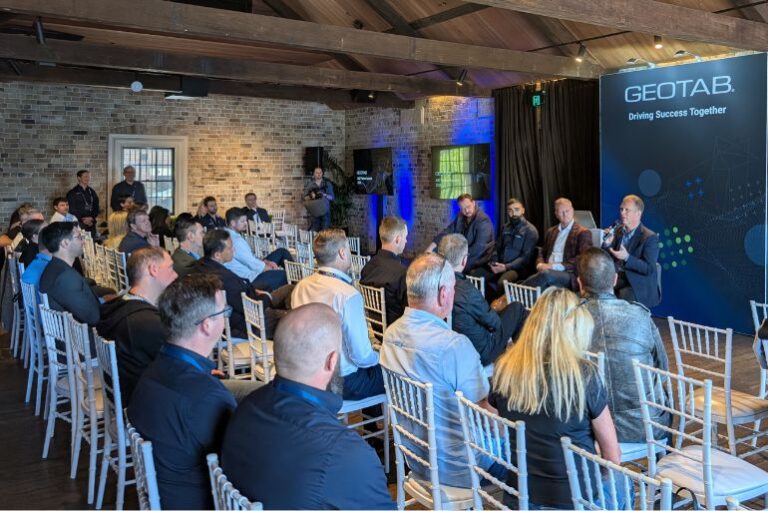
At the 2025 Geotab Partner Day in Sydney, industry leaders shared practical advice for Fleet Managers navigating an era of tightening emissions standards, electrification, and data-driven decision-making.
The panel featured Mike Costello (Cox Automotive Australia), Mace Hartley (AfMA), and Marc Sibbald (IPWEA & Fleet News Group). Together, they delivered a clear message: the next decade of fleet success will come from smarter use of data, flexible lifecycle planning, and better communication with the C-suite.
1. Leverage policy changes to your advantage
With the New Vehicle Efficiency Standard (NVES) now in place, fleets could see new opportunities. Mike Costello explained that manufacturers will soon need to balance their fleet-average CO₂ emissions or face fines — a dynamic that can work in a buyer’s favour.
“As the year ends, you’ll see OEMs realise they need to move more EVs and plug-in hybrids to hit their targets,” Costello said. “That could create some great deals for fleet managers in November and December.”
Fleet Managers are encouraged to time their procurement cycles around these new seasonal trends and to engage early with suppliers.
2. Rethink replacement cycles for EVs
Traditional three-to-five-year replacement policies may not make sense in the electric era. EVs continue to improve through over-the-air updates and show slower depreciation than many predicted.
“An EV gets better with software updates — it’s not at its best the day it leaves the showroom like an ICE vehicle,” said Mace Hartley.
Marc Sibbald added that Geotab data can help identify the optimal replacement point. “You can move from a time-based model to a risk-based one,” he said. “Look at utilisation, battery health, and fault codes — not just the calendar.”
3. Use data to make smarter, risk-based decisions
Both Sibbald and Costello said fleets should use telematics to gain a deeper understanding of asset health and cost trends.
“Fleet Managers have gotten lazy over the years, replacing every four years because that’s what the last guy did,” Sibbald said. “With Geotab, you can see which vehicles are underused, overworked, or developing faults and make decisions based on data rather than habit.”
Costello noted that for EVs, vehicle age matters more than odometer readings, as technology evolves so quickly.
4. Measure and communicate fleet performance
Sibbald offered a simple but powerful way for Fleet Managers to raise their profile internally: start reporting.
“Do a monthly report — doesn’t matter what’s in it, just send it to your CFO or executive,” he advised. “After a few months they’ll start asking questions, and that’s when you become part of the conversation.”
He suggested presenting results in a “traffic-light” format showing what’s working, what’s not, and what’s at risk.
5. Manage plug-in hybrids with data, not assumptions
Plug-in hybrids (PHEVs) remain an important bridge technology — but only if they’re used properly.
“Plug-in hybrids are fantastic — but only if you charge them,” Sibbald warned. “If fleets buy them just to tick a box and never plug them in, they’re actually worse for emissions than a petrol car.”
Using Geotab’s reporting tools, fleet managers can track charging frequency, fuel use, and electric-only kilometres, ensuring their environmental targets are backed by evidence.
Looking ahead
The experts agreed that the next phase of fleet management will be defined by flexibility, insight, and accountability. Geotab’s connected vehicle data enables fleets to measure utilisation, manage electrification, and report results with confidence.
As Costello concluded, “Fleets will be at the front line of Australia’s decarbonisation. Those who understand the data and act on it will lead the market.”
- One fleet, many applications: why tyre management can’t be one-size-fits-all
 From passenger cars and utes to buses, trucks and waste vehicles, fleet applications can vary dramatically. Bridgestone Australia says the starting point for effective tyre management is understanding what each vehicle is being asked to do. There is no such thing as a single fleet application – and Bridgestone Australia says there should not be
 - Why Fleet Managers Need Real-Time Visibility of Vehicle ServicingKeeping vehicles serviced on time sounds like one of the most basic fleet management tasks. In practice, maintaining visibility across a large fleet can be much more difficult. Vehicles may be approaching a service interval, drivers may already have made bookings, workshops may have completed work, and fleet managers can still be left trying to
- Why Bridgestone says the real cost of a tyre isn’t the tyreFor mature fleet operations, tyre management is no longer just a question of purchase price or kilometres travelled. Bridgestone Australia says the bigger opportunity is to reduce downtime, improve utilisation and manage the true cost of keeping vehicles on the road. Fleet managers have spent years shifting procurement conversations away from purchase price and towards
- More Payload, Less Red Tape for HiLux FleetsFleet operators looking to increase Toyota HiLux payload capacity without adding unnecessary compliance costs are being encouraged to consider GVM upgrades that keep vehicles within the 3500kg NA category. Pedders says selecting the highest available payload upgrade is not always the most cost-effective answer, with fleet operators needing to balance legal compliance, operational efficiency and
- Yoogo Fleet Adds Mobile Servicing Through Turners PartnershipYoogo Fleet has expanded its Digital Concierge platform with mobile vehicle servicing through a new exclusive partnership with Turners Servicing & Repairs. The partnership means fleet drivers can now arrange for vehicles to be serviced or repaired at their workplace or home, reducing the disruption associated with taking vehicles to a workshop. Turners Servicing &