

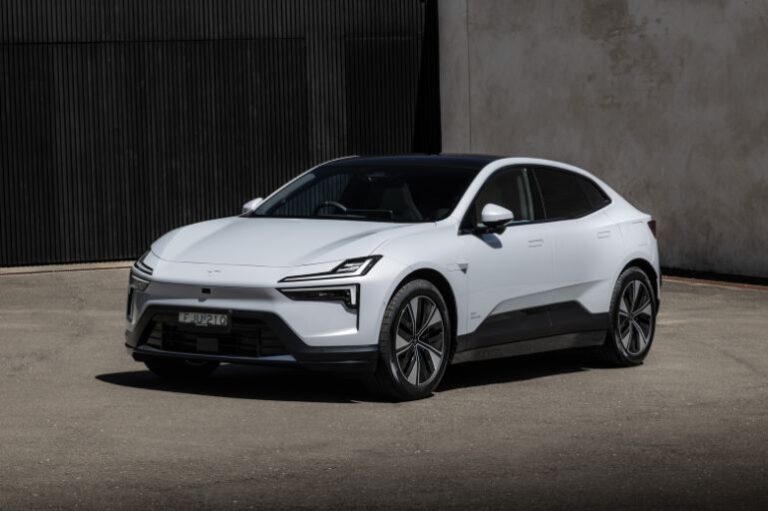
The Federal Government has confirmed the Electric Car Discount will continue unchanged until April 2027, followed by a phased transition — a decision welcomed by NALSPA as a win for household budgets, energy security and Australia’s emissions reduction goals.
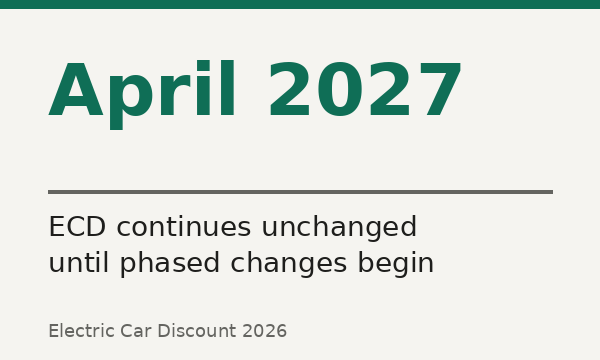
The Federal Government has announced the Electric Car Discount (ECD) — Australia’s FBT exemption on eligible battery electric vehicles — will remain fully in place for another year, with a phased continuation of the policy beginning in April 2027. The decision follows a statutory review conducted by Treasury and the Department of Climate Change, Energy, the Environment and Water.
The policy provides employees using salary sacrifice or novated leasing arrangements with an exemption from Fringe Benefits Tax on eligible EVs priced below the fuel-efficient luxury car tax threshold, currently set at $91,387 for 2025–26. For an EV valued around $50,000, that can translate to annual savings of $3,200 to $4,700 depending on marginal tax rate — making it Australia’s most significant demand-side lever for EV uptake.
“At a time when Australians are feeling real pain at the pump, the Electric Car Discount is helping households take control of their fuel bills while reducing emissions and reliance on foreign-owned oil.”
Rohan Martin, CEO, National Automotive Leasing and Salary Packaging Association (NALSPA)

What the Treasury review found
The statutory review estimated the ECD generated approximately 64,000 additional battery EV sales — and up to 78,000 including plug-in hybrids — over its first three years to December 2025, representing around 24% of total EV sales in that period. Beyond raw sales numbers, the review credited the policy with generating an estimated $400 million in carbon abatement value, $430 million in health benefits from reduced air pollution, and around $1.1 billion in overlooked fuel cost savings — figures that are expected to grow further as Middle East-driven fuel price volatility raises the salience of running cost comparisons for new car buyers.
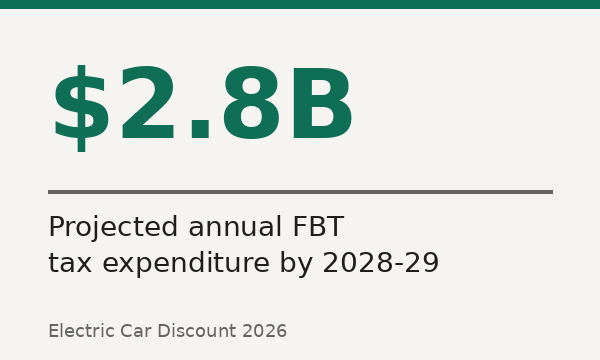
However, the review was also candid about the ECD’s growing fiscal footprint. The FBT tax expenditure totalled $2.0 billion over the first three years and is forecast to reach $1.35 billion in 2025–26 alone, growing to $2.8 billion annually by 2028–29. The review also raised equity concerns — noting that as a tax-based measure, the discount delivers greater value to higher-income earners, and is inaccessible to sole traders and employees whose employers don’t offer salary packaging.
The review’s conclusion was measured: the ECD has worked, but the market is changing. As BEV prices continue to fall globally and the New Vehicle Efficiency Standard begins to reshape supply, the additionality of the ECD is expected to decline — while its costs continue to rise. Treasury recommended government consider adjusting eligibility thresholds, improving equity, and phasing down the policy at a pace calibrated to avoid the sharp demand shocks seen when similar incentives were abruptly removed in New Zealand, Germany and the United States.
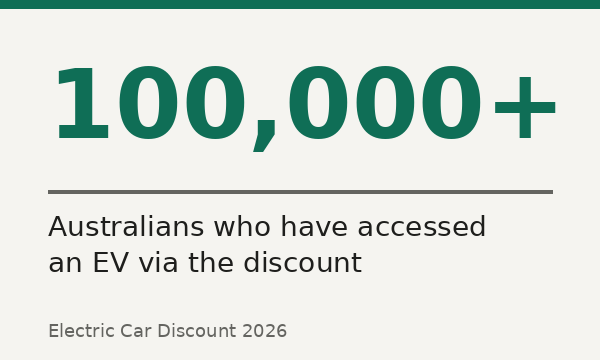
“The EV Discount has already helped more than 100,000 Australians overcome the upfront cost barrier to switching to a cheaper-to-run vehicle. Without it, many outer-suburban families, essential workers and cost-conscious households simply wouldn’t be able to make the switch.”
— Rohan Martin, CEO, NALSPA
Industry response : A pragmatic win
NALSPA — which represents Australia’s novated leasing and salary packaging sector and submitted to the review — welcomed the Government’s approach, framing it as the right balance between cost-of-living relief, market certainty and longer-term fiscal responsibility.
NALSPA CEO Rohan Martin acknowledged the review’s findings on fiscal sustainability, while maintaining that the case for maintaining current settings for another year remained strong.
“Whilst expert modelling underlined the importance of the current Electric Car Discount policy settings remaining in place until the EV market becomes self-sustaining, we recognise the government has a responsibility to balance fiscal sustainability with Australia’s transition to a low emissions future,” Mr Martin said.
On the phased transition from April 2027, NALSPA pointed to international precedent as justification for the graduated approach — noting that jurisdictions including France and the United Kingdom have successfully reduced incentives without triggering demand collapses by signalling changes clearly and in advance. The review itself warned against rapid withdrawal, citing New Zealand’s experience where BEV market share fell from 27% to 11% within a year of its incentive removal.
“The Electric Car Discount is Australia’s most effective demand-side lever for EV uptake. International experience shows that withdrawing incentives too early stalls adoption, delays emissions reductions and leaves households exposed to ongoing fuel price volatility.”
— Rohan Martin, CEO, NALSPA
What this means for the fleet industry
For Fleet Managers and salary packaging providers, the announcement provides a clear planning horizon. The current FBT exemption settings remain in place through to April 2027 — giving operators, employees and leasing providers time to structure arrangements under the existing framework before phase-down details are confirmed.
The review noted that fleet electrification has lagged private uptake, with EV purchases representing less than 5% of fleet sales in 2024 compared to 9.6% of total vehicle sales. Non-price barriers — limited BEV ute availability, charging infrastructure at depots and concerns about range — were identified as more significant constraints for fleets than the FBT exemption itself. That said, the exemption does apply to fleet vehicles made available for private use, and remains a relevant tool for organisations structuring mixed personal-use fleet arrangements.
Mr Martin said now is the optimal moment for Australian employees to explore EV options through salary packaging.
“There has never been a better time for Australians to explore their electric vehicle purchase through salary sacrifice or novated leasing as one of the most affordable and accessible ways to move away from petrol and protect household budgets from fuel shocks.”
Key facts
- The ECD FBT exemption continues unchanged until April 2027. A phased transition begins from that date.
- Eligible vehicles must be priced below the fuel-efficient LCT threshold ($91,387 in 2025–26).
- PHEVs are no longer eligible for the FBT exemption (removed from April 2025) but retain the import tariff exemption.
- Second-hand EVs first used on or after 1 July 2022 remain eligible for the exemption.
- Fleet vehicles made available for an employee’s private use qualify, subject to standard FBT work-use rules.
- Only 28% of potential BEV buyers are currently aware of the FBT exemption — communicating the benefit to employees remains an important role for fleet and HR teams.