

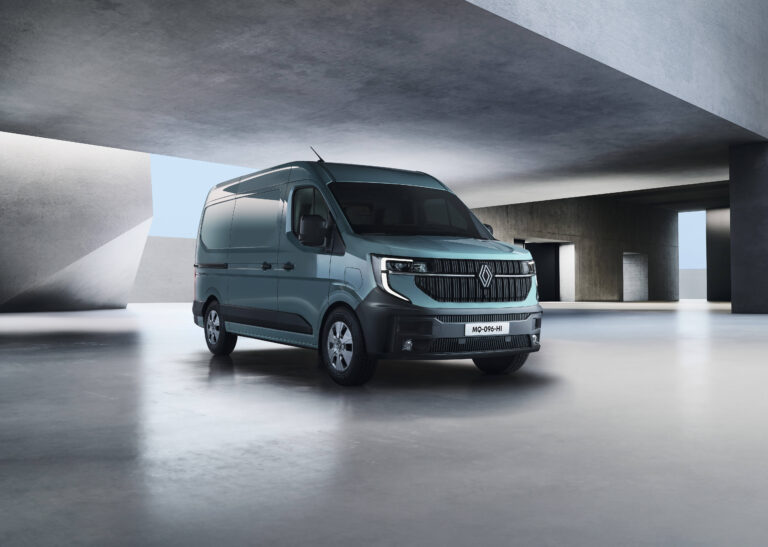
Renault Australia has confirmed pricing and specifications for the new-generation Renault Master, with diesel variants due in showrooms from June 2026 and electric E-Tech models to follow in the second half of the year.
The first all-new Renault Master in more than a decade arrives at a time when large vans are being asked to do more for fleet operators. Payload still matters. So does uptime, driver comfort, safety, emissions and whole-of-life cost. Renault is trying to cover all bases by offering the new Master with diesel and electric powertrains, giving fleets a choice depending on route profile, charging access and daily operating requirements.
The diesel range opens at $55,990 plus on-road costs for the mid-wheelbase standard-roof manual, rising to $65,990 plus on-road costs for the long-wheelbase high-roof automatic. The Renault Master E-Tech electric range starts at $77,990 plus on-road costs for the mid-wheelbase standard-roof model, with the long-wheelbase E-Tech priced from $79,990 plus on-road costs.
For diesel buyers, the new Master is powered by a 2.0-litre turbo diesel engine producing 125kW and 380Nm, matched to a nine-speed torque-converter automatic in most variants. Renault says the updated diesel delivers improved efficiency, while 12-month/30,000km service intervals will appeal to fleets trying to reduce downtime.
The diesel models offer a 4000kg GVM, payload between 1811kg and 1973kg, and 2000kg braked towing capacity. That makes the diesel Master the workhorse option for fleets carrying heavier loads or operating in areas where charging infrastructure is not yet practical.
The electric Renault Master E-Tech uses an 87kWh battery and offers up to 409km of WLTP driving range. It has a 105kW/300Nm electric motor and supports DC fast charging at up to 130kW, allowing a 15 to 80 per cent charge in a claimed 38 minutes on a suitable fast charger.
Payload for the E-Tech ranges from 1084kg to 1164kg, with a 3500kg GVM and 2000kg braked towing capacity. For fleets working on predictable metro routes, depot-based charging or last-mile delivery, the E-Tech gives Renault a serious entry in the growing electric large van segment.
Safety has also been given a major lift. Standard equipment includes autonomous emergency braking, blind-zone warning, rear cross-traffic alert, lane keeping assistance, speed-sign recognition, rear-view camera and rear parking sensors. The new Master has also achieved a Platinum safety rating from European NCAP.
The cabin has been redesigned with a 10-inch infotainment screen, wired and wireless Apple CarPlay and Android Auto, USB-C charging ports, overhead storage, underseat passenger storage and a three-seat layout as standard. E-Tech models also receive Google Automated Services.
Renault has retained physical buttons and familiar controls, which will be welcomed by drivers who spend long hours in the vehicle and do not want every function buried in a touchscreen. The gear selector has moved to a steering-column wand, freeing up space around the centre console.
For fleets that use vans as mobile offices, Renault offers an optional work office table that folds out from the middle seat. It is available through the Trade Pack, Business Pack or combined Business + Trade Pack.
Cargo access should also suit trade and delivery applications. Renault says the side sliding door has the largest opening in its class, wide enough to fit a forklift pallet, while the rear barn doors open to 270 degrees for easier loading.
Glen Sealey, General Manager of Renault Australia, said the new Master is an important part of the brand’s local renewal.
“The new-generation Renault Master is a game-changer with its added safety, capability, and improved efficiency,” Sealey said.
“We know the large van segment is highly competitive in Australia but the new Renault Master has already proven itself in Europe, where it has received numerous awards.”
Sealey said Renault’s experience in the large van segment has helped shape the latest model.
“Van drivers spend a lot of time on the road, which is why Renault has gone to great lengths to deliver comfort, safety, and excellent driveability with the new model,” Sealey said.
“Renault has been in the large van market since 1980 – when the original Master was introduced 46 years ago – so it has a lot of experience in this space, and all of that historical knowhow delivers significant improvements with each new model.”
For fleet buyers, the new Master lands with a useful mix of options. The diesel versions bring high payload, long service intervals and familiar operating economics. The E-Tech adds a zero-tailpipe-emission pathway for organisations under pressure to reduce transport emissions without stepping down from a large van.
With more fleets reviewing vehicle emissions, fuel spend and operational suitability, the new Renault Master gives buyers another reason to revisit the large van category in 2026.