

Kia believes its new Platform Beyond Vehicle (PBV) strategy could fundamentally change the way fleet operators think about vehicle design, utilisation and lifecycle management.
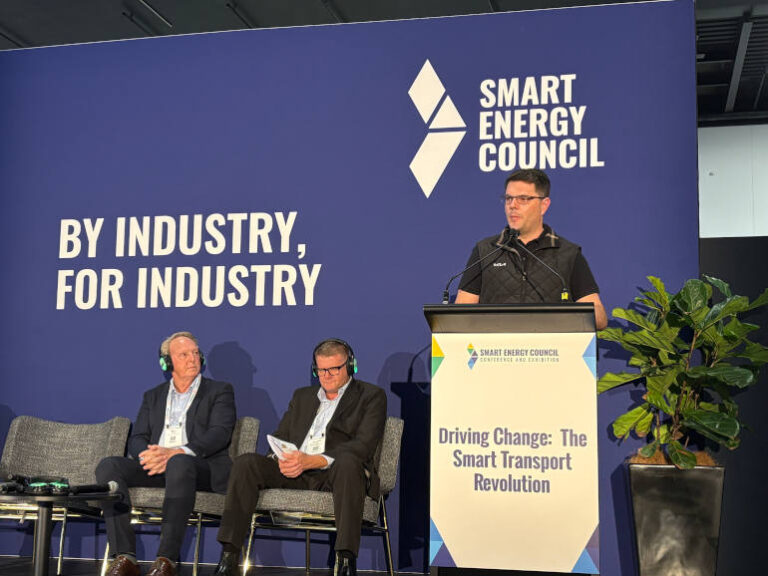
Speaking at the Smart Energy Conference and Exhibition in Sydney, Trent Kontopoulos, National Account Manager at Kia Motors Australia, explained that Kia’s approach moves beyond simply replacing diesel vehicles with electric alternatives and instead rethinks how commercial vehicles are designed and used across their operational life.
“Back when I started, we were Kia Motors. We’re now Kia Australia. We’ve dropped the motors part,” explained Kontopoulos.
“We dropped the motors part because we are focusing on the ability to talk about vehicles beyond platform. So a platform beyond vehicle scenario, which is the car that you see out there, is more about not how it’s four wheels, how it’s got an engine, how it sits on the road. It’s actually more about how we scale up the opportunity within the market to meet demand across an international scenario.”
According to Kontopoulos, Kia’s global “Plan S” strategy is reshaping how the company approaches commercial vehicles by focusing on modularity, flexibility and long-term operational adaptability rather than fixed vehicle designs.
“We have a strategy from 2020 which is called Plan S, and Plan S is shift. It’s shifting the idea of what a vehicle is before we even get into what we talk about like commercial vehicle.”
At the centre of that strategy is Kia’s new PBV platform architecture, which allows a single electric skateboard chassis to support multiple body configurations throughout its operational life.
Kontopoulos described how the concept was initially presented internally during the COVID lockdown period and challenged traditional thinking about vehicle ownership and fleet replacement cycles.
“Kia fleet were sharing videos of an opportunity that Korea proposed to us about a van that could drive along and have a multi-purpose proposition,” said Kontopoulos. “We’re talking about a van that could have a cab and a skateboard platform.”
Rather than fleets purchasing entirely new vehicles every few years, Kia’s vision is for the same underlying platform to evolve into different applications as operational requirements change.
“Two years of the use of the van would be a van cargo designed to carry around things,” explained Kontopoulos. “A couple of slides later, we talk about converting it into a ute. So all of a sudden, we’ve got a van that goes into a Kia dealership, swaps the body over, we put a ute on the back of it, the van drives out and lives two more years of its life as a ute.”
The concept could continue even further into the vehicle lifecycle.
“We need a people mover now. Our usage needs have changed. We put a five or seven-seat van conversion on the back and that van drives out again. So the scalability of our product is incredibly interesting.”
For fleet operators, the concept introduces the possibility of significantly improving asset utilisation while reducing replacement costs and aligning vehicle specifications more closely to changing operational needs.
Although Kia’s Australian rollout is only beginning with the PV5 electric van, Kontopoulos said the company is already seeing stronger-than-expected market interest.
“The challenge remains — is the acceptance there for an electric van?. Today, the pre-sales and the interest and expressions of interest on the website for Kia has been absolutely phenomenal.”
Kontopoulos said the PV5 is also opening conversations with customers and fleet sectors that Kia has not traditionally supplied.
“We think we’ve got expressions of interest from a lot of different organisations who we, as Kia the brand, have previously never, ever dealt with,” said Kontopoulos.
The vehicle is also reshaping discussions around fit-for-purpose fleet procurement, particularly for operators who may not require a traditional diesel ute for every role.
“We’ve got customers who say, ‘Well, we don’t actually have a need for a diesel ute in this space. This driver doesn’t require this product. It’s costing me $200 or $300 a week. What have you got?’” Kontopoulos shared.
According to Kontopoulos, the PV5 is already generating interest across multiple fleet applications including last-mile delivery operations.
“For example, we’re talking to Repco about doing deliveries in their van as opposed to having a big cabin, big body on the back of a ute. All of a sudden now it’s given people and companies the opportunity to justify their zero-emission strategy with a light commercial product.”
Kontopoulos believes the broader PBV strategy reflects a larger shift occurring across the automotive industry where vehicles become adaptable operational platforms rather than fixed-purpose assets.
“Platform Beyond Vehicle and Kia — we’re talking about very, very different segments. We’re talking about a massive shift.”
The strategy is also creating unexpected interest outside traditional fleet use cases, particularly from consumers looking for flexible lifestyle applications.
“The exciting part is attending these events and actually talking to people who say, ‘I actually just want to put a bed in this thing. I want to sit there and go camping. I want to put my bike in the back and go for a ride,’” says Kontopoulos. “It really shifts where we thought this van was going to sit in the market.”
For Kia, the PBV strategy is no longer just a concept presentation from head office. It is now becoming a real-world product strategy designed to support fleet electrification, operational flexibility and future mobility services.
“We start looking at vehicles in a sense that it’s not necessarily single energy — energy goes in, energy is expelled as it drives along and we all refuel it at the end of the day. We’re talking about the ability to be multi-purpose.”