
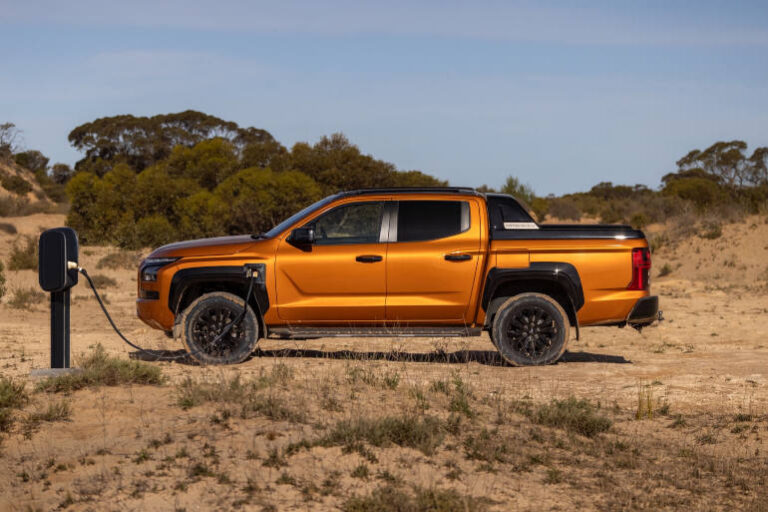
The specific needs of fleet operators are defining the capabilities of a future Mitsubishi Triton hybrid variant, with payload, 3,500kg towing capacity and axle load limits put forward as key considerations by fleet buyers.
A flurry of plug-in hybrid (PHEV) utes arriving in Australia has generated significant private-buyer interest, but Fleet Managers in Australia are considering how PHEV, hybrid (HEV) and even battery electric (BEV) light commercial vehicles (LCVs) might be suitable for their operators.
Mitsubishi is keeping a close eye on the success of the BYD Shark 6, GWM Cannon Alpha and Ford Ranger PHEVs among others, but according to a senior Mitsubishi Motors Australia Limited (MMAL) executive, a Triton hybrid will need to combine heavy-duty capabilities such as:
- Braked towing capacity of 3500kg
- Carrying a similar payload to today’s diesel Triton
- Offering similar axle load ratings to the current Triton
PHEV Utes Have Compromised Payload—Can Triton Avoid This?
Discussing the issues around hybrid utes exclusively with Fleet News Group, MMAL deputy director of fleet management Fulvio Fattore acknowledged the trajectory of the LCV market is towards hybrid and electric options.
“The trend toward electrification will only continue. I think this is going to be an incredibly exciting space as we see fundamental shifts in vehicle capability and we start to realise what some of that means for end users,” Mr Fattore said.
Hybrid utes typically unlock greater levels of onboard power, combining large batteries with high-amperage outlets to power tools and appliances. But the weight of those batteries means the Shark 6, Cannon Alpha PHEV (and to a lesser extent the Ranger PHEV) lose capabilities elsewhere.
“Some of those EVs and PHEVs that are coming into the [ute] market, they don’t have the 3.5 tonne [towing capability], they don’t have over a tonne of payload, and when we look at the actual rates, there is also a deficit in some of those areas,” Mr Fattore explained.
While the Ford Ranger PHEV’s payload is close to that of the diesel versions, the payload of the BYD Shark 6 (790kg) and GWM Cannon Alpha PHEV (685kg) is notably lower than the circa-one-tonne payload fleets have come to expect in Australia.
“These have been key features in LCVs that fleet customers have sought for a number of years. There is a fundamental trade-off [for] some of that technology. Fleets need to make a decision about…the mix [of] CO2 reduction and sweating assets to make sure they are as productive as possible,” he said.
Fleet Managers take note
As today’s PHEV utes typically have compromised towing or payload, check if your operations fall within their limits.
Australia’s NVES Laws Mean Mitsubishi Has To Act
The problem is that manufacturers, including Mitsubishi, can’t afford to ignore PHEV technology for utes. The Australian government’s New Vehicle Efficiency Standard (NVES) laws are now in force, penalising carmakers that do not offset diesel ute sales with big EV sales numbers.
Many Fleet Managers are also facing demands to lower the CO2 profile of their corporate vehicles. On paper, PHEV utes (typically with 40-100km electric range) slash CO2 emissions from about 200g/km (diesel utes) to around 50g/km, helping carmakers and fleet managers alike.
The 2.4-litre diesel engine in Australia-spec Triton produces 195-203g/km depending on variant, which is cleaner than many rivals but well above NVES limits for LCVs in future, which reduce annually from 210g/km (2025) to just 110g/km (2029).
“The new Triton has the Euro 6B version engine, which [uses] AdBlue and has a significant focus on total emissions effectiveness and efficiency. We are introducing new technology that is safe, capable and [achieves] fitness-for-purpose requirements,” Mr Fattore said.
“Does that mean we are not looking at newer, efficient LCVs down the track? No, it does not—but clearly it means that we’re focussed on making sure that we are bringing capable products that the market is currently demanding.”
Insight for fleets
Many more electric and hybrid utes will launch in Australia in order to help carmakers meet strict CO2 emissions laws that have been in force since 1 July 2025.
Fleets Need A Broad Service Network and Reliable Parts Supply
Beyond towing, payload and axle load limits, Mr Fattore also called attention to parts and service, which continue to be problematic for some new brands that have launched into Australia’s LCV market and are competing with Mitsubishi for fleet business.
Plus, there are concerns about resale values—setters have significant data on Triton’s resale but less is known about models from new brands.
“The difference between fleet and private customers is productivity. Those businesses are looking to get as much productivity out of their assets as possible.”
“You’ll find new [brands] coming onto the market, but new operators won’t have the stability of residual value. On face value, you might be achieving a…degree of CO2 reduction. But it comes at a cost that currently is not very well known.
“Where there is a vehicle offroad, do we have the parts for a new entrant? Where there is a crash component, does that result in a two-month delay? Where we’re selling the vehicle at 24/36/48 months, is that RV well below its standard counterparts?”
When Mitsubishi chooses to add a lower-CO2 variant of the Triton to its lineup, Mr Fattore indicated that such a vehicle would carry the support of Mitsubishi’s dealer, service and parts supply network.
“It is [not only] about…bringing new variants, but that you have that support network with 187 service outlets…if you are 400km away, you are not towing the vehicle back. If you are involved in an accident, you have parts to get [you] back on the road as quickly as possible.”
Fleet Managers take note
Some new brands are having teething problems with parts supply, which can cause long VOR delays.
Final Word for Fleets: Mitsubishi Is Being Conservative, For Now
Australia’s new vehicle emissions regulations system, and a desire from many fleet operators to lower their vehicular CO2, has created a strong incentive for Mitsubishi to introduce a hybrid version of the Triton ute.
However, there is strong pushback from MMAL’s fleet team—and from fleet operators themselves—on many of the compromises that PHEV utes currently inflict on metrics like payload and towing capacity.
Expect to see Mitsubishi attempt to circumvent these problems, or at least minimise them, when a Triton hybrid makes its first appearance.
Advice to fleets
Plug-in hybrids (PHEVs) like the Mitsubishi Outlander provide a turnkey lower-CO2 solution for SUV and personnel transport needs.
- Subaru Uncharted review: Familiar Subaru strengths meet a new electric direction
 The Subaru Uncharted arrives at an interesting point in the Australian new-car market. Electric SUVs are no longer unusual, but the challenge for established brands is convincing existing customers that moving to an EV doesn’t mean giving up everything they already like about their current car. That is where the Uncharted makes sense. For people
 - Kia PV5 review: An electric van that feels ready for workThe Kia PV5 arrives with an unusual job to do. It has to convince businesses that an electric van can deliver the practicality expected from a commercial vehicle while also offering the quieter, smoother driving experience that comes with an EV. After driving the PV5 at its Australian launch, the first impression is that Kia
- Kia EV6 Air review: My heart says yes, but my fleet brain says noThe Kia EV6 is one of those cars I had almost forgotten about. That sounds harsh, because when the EV6 arrived in Australia in 2022 it was one of the most interesting electric cars on the market. It looked different, it drove properly, and when the EV6 GT started lining up against supercars in drag
- LDV Deliver 7 LWB Review: After The First 1,890kmWhen Port Hedland Air Freight Director Dominic Barlow needed another van for the business, he wasn’t looking for something to impress on a short test drive. He needed a vehicle that could earn its keep. After buying an LDV Deliver 7 LWB in Perth and driving it 1,890 kilometres north to Port Hedland, he shared
- Geely Starray EM-i review: Big on space, strong on value and easy to live withThe Geely Starray EM-i arrives in Australia with a fairly simple proposition: give buyers the smoothness and convenience of electric driving around town, add a petrol engine for longer journeys, wrap it all in a roomy SUV and keep the price within reach of mainstream buyers. After spending time with the Starray EM-i around Sydney