
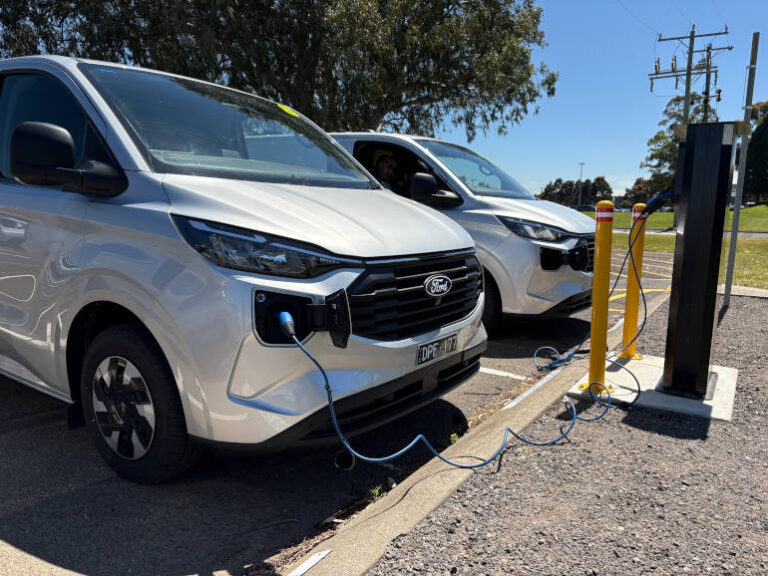
Australia’s New Vehicle Efficiency Standard (NVES) will soon reshape what every manufacturer sells — but not how Fleet Managers buy. As Ford made clear during the launch of its new E-Transit Custom and Transit Custom PHEV in October, NVES compliance sits squarely with manufacturers.
For fleets, the impact arrives through the range of new powertrains and the emission-reduction opportunities those vehicles create.
A flexible lineup built for a changing market
Ford’s Marketing Director in Australia, Ambrose Henderson, summed it up best when asked how NVES influences product planning:
“We’re providing choice to customers. The PHEV and BEV variants have a significant impact from an NVES perspective, but at the end of the day the customer has to buy it for it to have any impact to us. You can’t bring a car into the country for NVES and not sell it — it just doesn’t make sense.”
That pragmatic view underpins Ford’s multi-energy strategy: diesel for long-distance users, plug-in hybrid for mixed duty cycles, and battery-electric for zero-emission operations. Rather than chasing credits for the sake of compliance, Ford is using NVES as the framework to justify greater varietyand faster technology rollout.
Engineering for optionality
As Ian Foston, Product Development Director – Commercial Vehicles at Ford Pro Europe, explained, the new Transit Custom platform was deliberately engineered for flexibility.
“It’s horses for courses. If I was carrying lots of parts and needed them secure, I’d choose a Transit Custom — it’s exactly the right tool for the job.”
That “tool-for-the-job” mindset allows Ford to respond to market demand quickly: the same body architecture can host a 2.0-litre diesel, a 2.5-litre petrol-electric hybrid, or a 64 kWh battery-electric system without redesign.
It means the company can dial production between variants as NVES targets tighten — or as fleet demand shifts.
NVES as a catalyst, not a constraint
Henderson was candid about how regulation shapes decisions but doesn’t dictate them.
“The automotive industry is moving at a rate we’ve never seen before. Every day my team looks at the market and works out what’s best for our customers and to make sure our business continues to be successful.”
In practice, that means using NVES as a data-driven planning tool, not a box-ticking exercise.
It informs investment in electrification, battery sourcing, and connected-vehicle analytics, all while ensuring customers still have practical work vehicles available at realistic prices.
Implications for fleets
For Fleet Managers, NVES will not bring new paperwork — it will bring new product choices.
The Transit Custom range demonstrates what that future looks like:
- Diesel Trail AWD: 2.0 L EcoBlue, 125 kW / 390 Nm, 2 500 kg towing.
- PHEV: 2.5 L Duratec + 111 kW motor, 11.8 kWh battery, 54 km EV range, 38 g/km CO₂.
- BEV: 160 kW / 415 Nm motor, 64 kWh battery, 307 km WLTP range, 0 g/km CO₂.
Those numbers give fleet buyers tangible ways to reduce emissions without changing operational models.
NVES may set the rules, but it’s engineering — and customer demand — that will decide how quickly the transition happens.
Looking ahead
Henderson expects electrified vans to grow steadily rather than explosively.
“The commercial electrified space will grow, but it’s going to take some time — particularly as infrastructure grows and as more businesses and fleets make choices around their carbon emissions.”
In other words, Ford’s approach isn’t to force customers into EVs; it’s to make sure the right EV, hybrid or diesel is waiting when they’re ready.
The takeaway for Fleet Managers
While NVES headlines will dominate industry news, its effect on fleets will be felt quietly — through better vehicles, cleaner options, and data-backed efficiency. Ford’s latest Transit Custom lineup proves that compliance for manufacturers can translate into capability for customers.
For fleet buyers, the question isn’t how to comply — it’s simply which powertrain fits your job today, and which will fit tomorrow.