
When Ford engineers began work on the new Transit Custom, they weren’t just designing another van. They were building a platform that could carry Ford’s commercial-vehicle future — a single base flexible enough to handle diesel, plug-in hybrid, and full-electric drivetrains without compromise.
That’s a tall order for a workhorse that still needs to haul tools, tow trailers, and deliver packages through tight city streets. But for Ford, it’s the natural next chapter in a van story that’s been six decades in the making.
A global design effort with Australian fingerprints
Ambrose Henderson, Marketing Director at Ford Australia, reminded attendees at the launch that more than 1,500 engineers, designers, and technicians work across Ford’s Australian sites — a key part of the global team responsible for the new Transit Custom.
“Our major site is here where product development and design is based,” he said. “It provides design and engineering services for the full globe.”
That includes the You Yangs Proving Grounds, where Ford tests everything from suspension refinement to durability, and the Geelong Research Centre, which continues Ford’s legacy in powertrain innovation. Together, they connect directly into Ford’s global Transit engineering hub in Europe.
Henderson says this collaboration is what makes Ford’s commercial vehicles world-class: “We’re providing choice to customers — and in an area of strength for us, commercial vehicles.”
Built from the ground up for flexibility
At the heart of the 2025 Transit Custom is a new architecture that accommodates multiple powertrains on a shared line. Whether it’s diesel, plug-in hybrid, or full battery-electric, each model shares the same essential body and suspension design — a decision that dramatically reduces complexity for fleets running mixed drivetrains.
Ian Foston, Product Development Director Commercial Vehicles at Ford Pro Europe, explained that customer versatility drove this decision. “It’s horses for courses,” he said. “If I was carrying lots of parts and needed security, I’d choose a Transit Custom. It’s exactly the right tool for the job.”
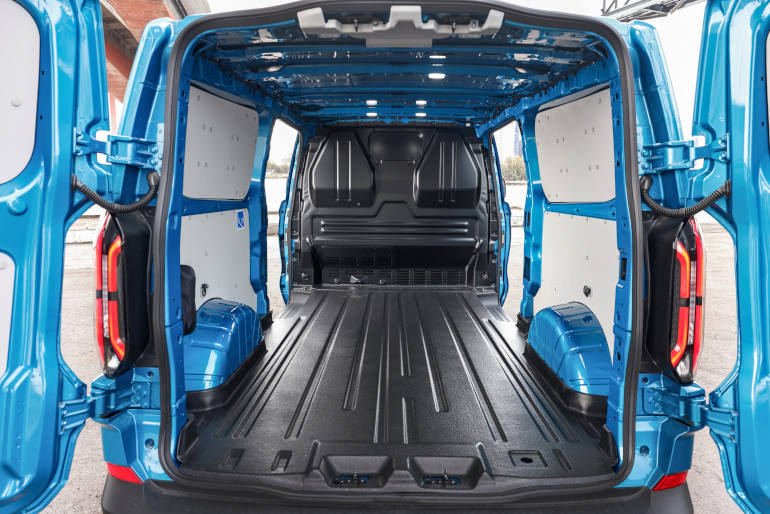
Under the floor, the van’s flat-pack battery housing in the E-Transit Custom sits between the rails of the independent rear suspension, preserving both cargo space and low centre of gravity. For diesel and hybrid models, that same space is used to optimise weight distribution and improve ride comfort — another reason the new Transit drives more like a car than ever before.
From powertrain to purpose
Flexibility is about more than packaging. It’s about giving buyers the right tool for their job — and Henderson emphasised that no two commercial customers are the same.
“For those who are in a city that have a defined route, that are back to base or back to home every night, the ability to charge a plug-in hybrid or a BEV makes absolute sense,” he said. “But if you’re a courier driving from Brisbane to Sydney every day or out in rural Australia, there just isn’t the infrastructure to support that. In those cases, the diesel option is still going to be the best for customers.”
That’s why Ford developed the Transit Custom lineup as a multi-energy platform rather than a single-technology gamble.
- The Trail AWD diesel retains long-distance muscle and 2,500 kg towing.
- The Transit Custom PHEV blends petrol-electric efficiency for fleets easing into electrification.
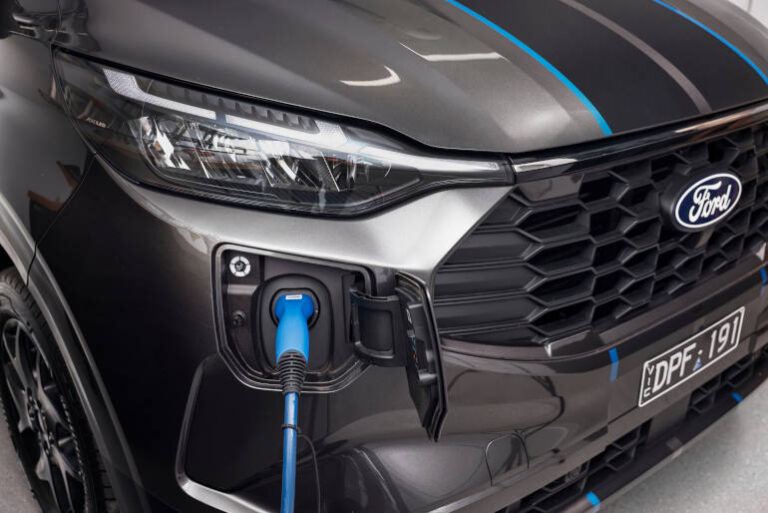
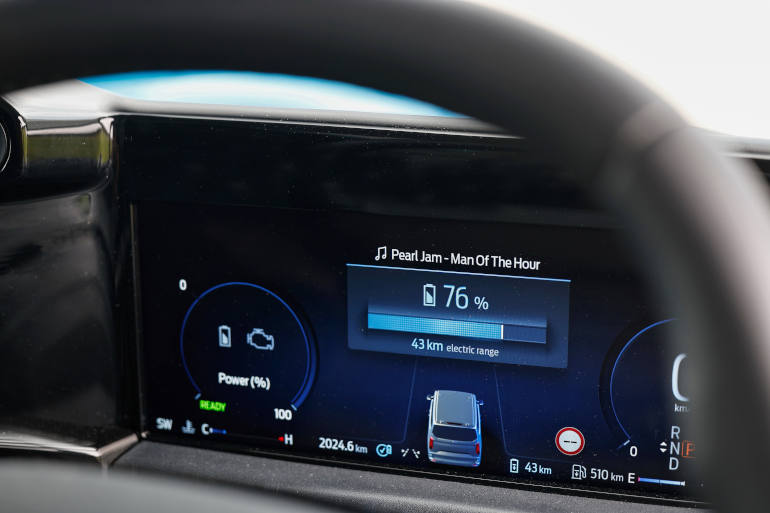
- The E-Transit Custom delivers zero-tailpipe emissions with up to 307 km WLTP range and 160 kW / 415 Nmoutput from its rear-mounted motor.
Each variant shares the same load volumes (up to 6.8 m³), the same driving position, and most importantly, the same driver experience.
Designed around the driver
Ford’s design team leaned heavily on feedback from tradespeople, couriers, and fleet operators when shaping the new cabin. That’s how the mobile office pack was born — a feature Henderson described as “a holistic solution” that turns the cabin into a workstation.
It’s not just marketing. The cabin includes mounting points for devices, a fold-down tray table, and intelligent storage for paperwork or tablets. Foston explained that Ford’s goal was to make the van fit modern working life: “It’s about understanding what customers are doing every day and making the vehicle work for them.”
Even the idea of a tilting steering wheel — currently in development — came from this philosophy. When folded flat, it becomes a laptop desk, another example of Ford’s willingness to rethink what a van interior can be.
A van that thinks like a system
In engineering terms, the 2025 Transit Custom isn’t a single product. It’s a modular system — one that anticipates an Australia where some fleets will run diesel for a decade, others will go hybrid, and a growing number will transition fully to electric.
As Henderson summed up: “It’s about providing choice to customers, adding value, and not taking away any of the capabilities of the vehicles.”
The result is a van that’s not tied to one future, but open to all of them — proof that smart design and clever engineering can keep a workhorse ready for whatever fuel tomorrow brings.