

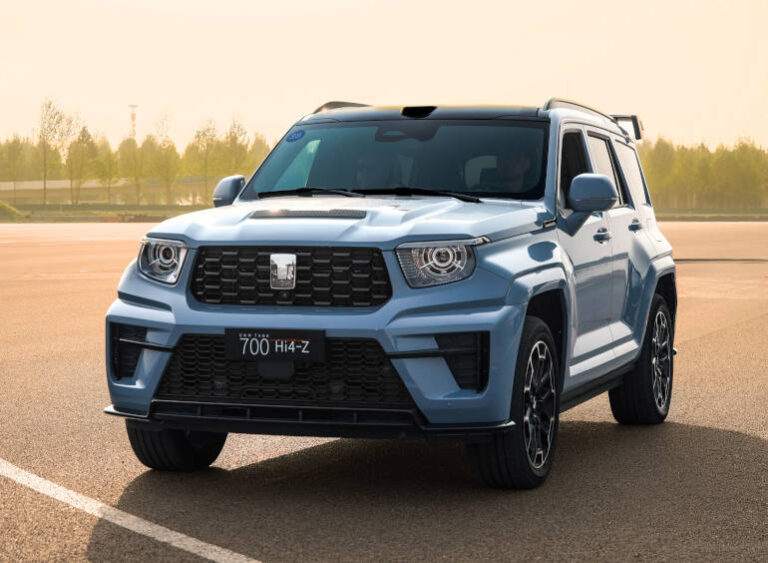
GWM has confirmed plans to introduce a V8-powered version of its flagship Tank 700 SUV, signalling a clear shift in strategy to meet demand from markets like Australia and New Zealand where large-capacity engines still hold strong appeal.
Speaking at the Beijing Auto Show 2026, GWM Chairman Jack Wei revealed that the Tank 700 will adopt a newly developed V8 engine, expanding the brand’s next-generation powertrain lineup beyond electrified and hybrid systems.
The move stands out in a global market increasingly focused on downsizing and electrification. Wei acknowledged that the decision runs counter to domestic trends in China but is driven by international demand.
“In the future, the Tank 700 will also use a V8 engine… We developed this V8 to meet the needs of more global users, in markets such as Australia and New Zealand,” he said.
A global play, not a local one
This isn’t a nostalgic nod to traditional powertrains—it’s a calculated move. GWM is building a multi-pathway strategy that blends EVs, hybrids, and now high-capacity petrol engines to suit different markets and applications.
For fleet buyers, that approach mirrors what established OEMs have been doing for years: matching powertrain to task rather than forcing a one-size-fits-all solution.
Australia remains one of the few developed markets where V8 engines still carry weight, particularly in towing, off-road, and remote-area applications. The Tank 700 appears aimed squarely at that use case, positioned as a premium off-road SUV with genuine capability credentials.
Part of a broader V8 strategy
The Tank 700 won’t be the only vehicle to benefit from GWM’s new V8 program. The company also confirmed that its upcoming GF supercar will feature a 4.0-litre twin-turbo hybrid V8, indicating multiple variants of the engine are under development.
That distinction is important. While the supercar will use a high-performance hybrid V8, the Tank 700 is expected to use a more conventional version tailored for durability and real-world usability rather than outright performance.
It suggests GWM is investing heavily in scalable engine architecture that can be deployed across different segments—from high-performance halo cars to heavy-duty SUVs.
Positioning the Tank brand
The Tank 700 sits at the top of GWM’s off-road SUV lineup and represents the brand’s push into higher-margin, premium territory. With bold styling, advanced technology, and increasing powertrain diversity—including the Hi4-Z hybrid platform in China—the addition of a V8 would further elevate its positioning.
For Australian fleets, particularly those operating in regional or mining environments, this could create a new alternative to traditional players in the large SUV and light commercial segments.
However, timing remains unclear. GWM has not confirmed when the V8-powered Tank 700 will launch or whether Australia will be among the first markets to receive it.
What it means for fleets
While the broader industry is focused on emissions reduction and electrification, this announcement highlights an ongoing reality: some applications still demand high-output internal combustion engines.
For Fleet Managers, the takeaway isn’t about abandoning EV strategies—it’s about recognising that transition pathways will remain mixed for some time. Vehicles like the Tank 700 V8 could fill gaps where EVs or hybrids aren’t yet practical, particularly in high-utilisation or remote operations.
At the same time, it reinforces how competitive the market is becoming. New entrants like GWM are willing to challenge established norms—whether that’s launching sub-$50,000 electric vans or introducing a V8 SUV when others are walking away from the segment.
It’s not the direction many expected. But it’s a reminder that global fleet strategy is rarely linear.