
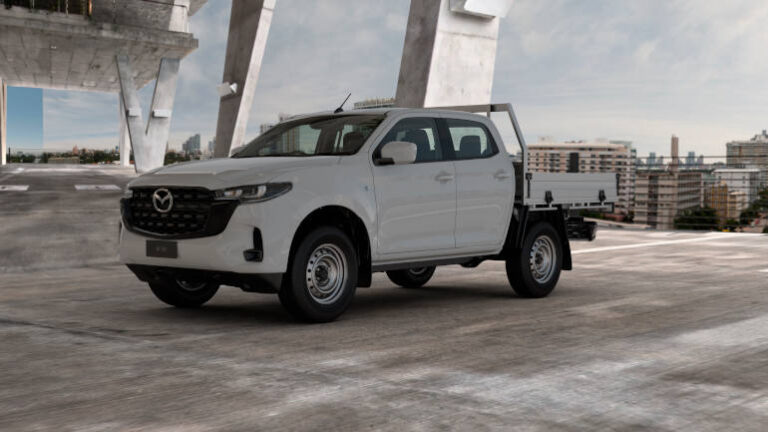
Mazda has strengthened its popular BT-50 ute line-up with the addition of a new 2.2-litre turbo-diesel powertrain, delivering more grunt, better efficiency, and the choice of 4WD.
Replacing the outgoing 1.9-litre engine, the new four-cylinder turbo diesel lifts outputs to 120kW and 400Nm – that’s 10kW and 50Nm more than before. Coupled to a new eight-speed automatic, it not only improves performance but also cuts fuel use by up to 0.7L/100km and trims CO₂ emissions by as much as 17g/km.
Expanded Capability
Previously only offered as a 4×2, the entry-level XS grade can now be had with the 2.2L engine in 4×4 Dual Cab Chassis and Dual Cab Pickup formats. This makes the BT-50 more versatile for buyers who need extra traction without stepping up to the larger 3.0L option.
The Dual Cab Pickup XS also benefits from alloy wheels, while standard kit across the XS range includes LED headlamps, reverse camera, Adaptive Cruise Control with Stop & Go, and wireless Apple CarPlay and Android Auto.
Efficiency Gains Across the Range
Mazda has also introduced a fuel-saving Idle Stop System on the proven 3.0-litre engine, cutting fuel use by up to 11 per cent in stop-start driving. In addition, XTR and GT 4×4 Dual Cab Chassis grades now come with a factory-fitted towbar for extra convenience.
Pricing and Variants
The refreshed BT-50 line-up continues with five grades – XS, XT, XTR, GT, and SP – and a wide spread of cab and drivetrain configurations.
Key pricing highlights include:
- Single Cab Chassis XS 2.2L 4×2 – from $37,900
- Dual Cab Pickup XS 2.2L 4×2 – from $46,710
- Dual Cab Pickup XS 2.2L 4×4 – from $54,720
- Dual Cab Pickup GT 3.0L 4×4 – from $66,620
- Range-topping Dual Cab Pickup SP 3.0L 4×4 – from $71,950
All models come backed by Mazda’s five-year, unlimited kilometre warranty, with a full suite of genuine accessories available to tailor the BT-50 for work or play.
Fleet and Business Buyers
For fleet operators and novated lease customers, the arrival of the 2.2L engine provides a strong balance of performance and running costs. The lower fuel consumption and CO₂ emissions compared to the outgoing 1.9L make it a compelling option for businesses looking to reduce operating expenses while keeping capability front and centre.
- 379 million kilometres of data is changing how Euclidic thinks about fleet safety
 Fleet safety reporting has traditionally focused on obvious measures such as speeding, harsh braking and acceleration. But after analysing more than 379 million kilometres of real-world fleet driving, Euclidic Systems believes the next step is understanding the context behind those events. The Australian-owned telematics provider has analysed seven years of data covering more than 33
 - Zetifi Challenges Fleets to Test the Call for HelpAustralian technology company Zetifi is urging fleet and safety managers to use National Safe Work Month this October to check whether workers can get help when they need it — particularly when mobile coverage drops out. The company, which connects vehicles, workers and assets with fleet and safety systems, has outlined five practical steps covering
- Bigger trucks, older bridges and new drivers are reshaping bridge strike riskAustralia’s bridge strike problem is not simply a question of drivers failing to read a clearance sign. The combination of growing freight volumes, pressure for more productive heavy vehicles, an ageing road network and a changing driver workforce is making the issue more complex for fleet operators. That was one of the themes to emerge
- Can in-cab coaching prevent the incident before it happens?Real-time alerts and video verification are moving fleet safety technology beyond post-event investigation. The Teletrac Navman research suggests drivers can accept these tools when alerts are clear, reliable and used as part of a fair coaching process. Traditional fleet safety processes often start after an event: a near miss, collision, complaint or telematics exception is
- BYD Shark 6 recall highlights the hidden fleet cost of a 30-minute repairBYD Australia has announced a safety recall affecting approximately 32,009 Shark 6 vehicles, providing Fleet Managers with a timely reminder that the real cost of a vehicle recall can extend well beyond the time spent in the workshop. The recall covers certain Shark 6 vehicles produced between 29 August 2024 and 15 June 2026. BYD