
When you’re weighing up a new car, it’s easy to focus on the numbers. Fuel economy, servicing costs, residual values — all of these matter. Especially if you’re a novated lease buyer where the whole-of-life cost (WOLC) really makes the difference to your take-home pay.
But here’s the truth: not every car decision is about the dollars. Sometimes, it’s about the way a car makes you feel.
Driving with Emotion
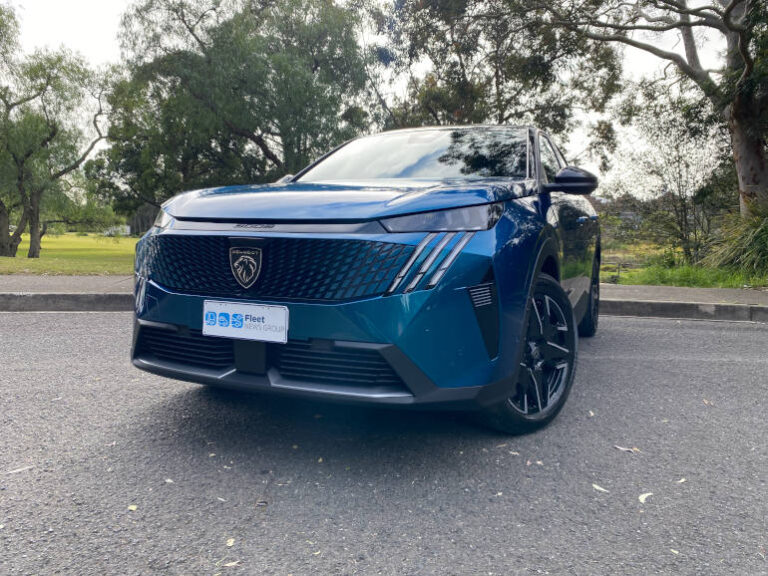
The Peugeot 3008 stands out because it brings emotion back into motoring. It’s not trying to be a spaceship with screens replacing mirrors or a silent pod that removes you from the road. Instead, the 3008 blends modern tech and safety with that analogue feel many drivers still crave. You can hear the engine, feel the road, and enjoy the connection.
As one team member in the Fleet News Group office put it, “It feels like I’m actually driving. I don’t want sterile and minimalistic. I want something with character, something memorable.”
A Car That Feels Like Home
Think about walking into a house. Some are sleek, modern, and white-on-white — but they don’t feel like home. Others have character, warmth, and timeless design that you instantly connect with. The Peugeot 3008 is that latter type of home, but on four wheels.
It’s a car with good bones and classic design DNA, yet it carries all the modern conveniences you expect. Stepping inside feels like walking into a beautifully renovated terrace — stylish, practical, and with an unmistakable personality.
Why Novated Lease Buyers Should Care
Novated leasing is a smart way to get into a new car, and with the Peugeot 3008 you get the tax benefits and budget certainty you’re looking for. But here’s the kicker: you also get something money can’t measure.
Every drive becomes a reminder that your car isn’t just transport — it’s a space where you spend time, clear your head, or share moments with family. The 3008 gives you technology and safety in spades, but it also gives you joy. And that’s worth factoring into the equation.
The Peugeot 3008 isn’t just a financial decision. It’s an emotional one. For novated lease buyers, it’s proof that sometimes the best value comes from how a car makes you feel every time you get behind the wheel.
- New Patrol Boosts Space and Towing Muscle
 Nissan has revealed further details of the next-generation Patrol ahead of its Australian launch, with the new model receiving significant changes to its interior packaging, load-carrying ability and towing capacity. The new Patrol will offer up to 2,749 litres of cargo space with the rear seats folded, while maximum braked towing capacity increases to 3,700kg
 - Hyundai STARIA Load vs Toyota HiAce: Which van suits fleet operations?The Hyundai STARIA Load and Toyota HiAce are two established choices for fleets requiring a practical commercial van with close to a one-tonne payload. The STARIA Load offers diesel and petrol-hybrid powertrains, relatively compact exterior dimensions and car-like driving characteristics. The HiAce provides a larger cargo area, a higher Gross Vehicle Mass and a strong
- Pajero Is Back: Mitsubishi Revives an Australian 4WD IconMitsubishi has confirmed the Australian range and specifications for the all-new Pajero, with the returning nameplate bringing a 2.4-litre turbo-diesel engine, seven drive modes, a 3.5-tonne towing capacity and a choice of five- and seven-seat configurations. The Mitsubishi Pajero will return to Australian showrooms in December 2026, reviving one of the brand’s best-known nameplates after
- Jaecoo Strengthens the J7 Line-UpJaecoo Australia is rolling out its MY27 J7 range, with the midsize SUV continuing to offer both petrol and plug-in hybrid powertrains as the brand broadens its appeal to Australian buyers. The updated line-up includes the petrol-powered Ridge AWD alongside three Super Hybrid System – PHEV variants: the Track SHS-P, Summit SHS-P 2WD and Summit
- Nissan Patrol Enters a New EraNissan has confirmed key Australian specifications for the new-generation Y63 Patrol, with the large SUV gaining a new twin-turbo V6, increased towing capacity, a revised chassis and a broader six-grade line-up. The new Patrol will arrive in Australia in early 2027, replacing the long-serving Y62 and introducing significant changes to the powertrain, suspension, cabin technology