

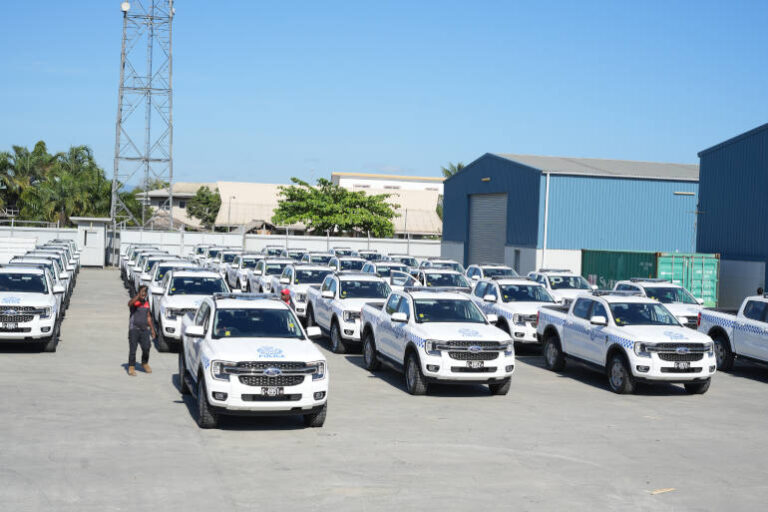
When 18 Pacific leaders gathered in Honiara, Solomon Islands, for the Fifty-Fourth Pacific Islands Forum (PIF) in September 2025, a fleet of 40 new Ford Ranger 4×4 utes was on hand to support local operations and the Royal Solomon Islands Police Force (RSIPF) — the result of a tightly coordinated project between Ford Global Fleet Sales (FGFS), RMA Group, and United Auto Solomon Islands.
The vehicles, funded by the Australian Federal Police, were procured and delivered in record time — less than three months from purchase order to deployment. According to Ratchaphon Sirayobhas (Lek), Regional Manager Asia Pacific at RMA Group, the project demonstrated the value of strong regional partnerships and local delivery capability.
“We received the purchase order on a tight schedule for 60 vehicles, with 40 allocated to the Australian Police and the remainder supporting the Solomon Islands Police. Vehicles needed to be on the ground before the Pacific Islands Forum began on 8 September,” said Lek.
“Normally, OEM production lead time for most manufacturers is four to six months, but thanks to working closely together with Ford, we were able to secure production and ship the vehicles in July.”
Delivered and Upfitted Locally
The vehicles arrived in the Solomon Islands in August, where they were locally upfitted to RSIPF specifications, including lighting, decals, and communication systems.
“It was critical to have the vehicles on the ground to meet the deadline,” Lek explained. “So the modification and fit-out were completed locally in Honiara under tight timelines to meet operational requirements.”
The Ford Rangers were selected for their proven reliability and suitability to Pacific Island terrain. RMA’s engineering team supplied spare parts and off-road tyres to ensure the vehicles could withstand demanding local conditions. Importantly, the utes were configured to meet Euro 4 emissions standards, aligning with available fuel quality and avoiding compatibility issues that might arise with Euro 5 models.
Proximity to Ford Production Key to Success
With the Ford Ranger manufactured in Thailand, RMA’s logistics advantage was clear. The group’s headquarters and modification facilities are located just 20 kilometres from Ford’s assembly plant.
“That proximity meant we could move very quickly,” Lek said. “Once Ford confirmed the allocation, our logistics and export teams ensured the shipment was ready to go without delay.”
This operational efficiency reflects the broader capability of RMA Group, which has more than 35 years’ experienceand employs 8,000 people across 14 countries. Its automotive division is a Ford Qualified Vehicle Modifier (QVM) Partner and manages extensive vehicle modification and assembly operations across Asia, Africa, the Middle East, and Australia.
Part of a Wider Regional Commitment
The Solomon Islands project highlights FGFS’s strategic role in supporting government and security operations throughout the Asia-Pacific region. As Ford’s exclusive global distributor for government, military, aid, and NGO fleets, FGFS has supplied more than 300,000 vehicles globally, including major deliveries to the United Nations, humanitarian agencies, and defence customers operating in challenging environments.
For more than 25 years, FGFS and RMA have delivered turnkey fleet solutions — from engineering design and vehicle modification to after-sales service, training, and spare parts management. Their ability to tailor vehicles to meet diverse operational and environmental needs has made them a trusted partner for agencies operating in remote or high-demand conditions.
Supporting Regional Security and Development
For the Solomon Islands, the project was more than just a vehicle delivery. It represented collaboration across borders — combining Australian funding, Thai manufacturing, and local fitment expertise to strengthen policing capability during a major international event.
“This was the first time we’d worked directly with the Australian Police for a Pacific Islands deployment,” said Lek. “It’s a great example of how effective coordination between partners can deliver real outcomes under pressure.”
The success of the Solomon Islands delivery reinforces FGFS’s position as a leading supplier to the Pacific region. With its established regional partnerships and engineering expertise, the company is positioned to continue supporting fleet modernisation and operational readiness across emerging markets.
As Patiwat “Bo” Changpriroa, Head of Group Marketing & Digital at RMA Group, noted, “Our mission is to provide mobility and engineering solutions that support governments and aid agencies in the most practical way — getting vehicles into the field where they’re needed most.”
- Hyundai Reveals a Bold New Chapter for Tucson
 Hyundai’s next-generation Tucson will arrive in Australia in mid-2027 with a hybrid-only line-up, bringing a larger body, redesigned cabin and new digital technology to the SUV market. Unveiled globally in New York, the all-new Tucson introduces Hyundai’s next-generation hybrid system and a design direction the company calls “Art of Steel”. For fleet managers planning replacements
 - MMS fleet business grows units as managed-only strategy gains momentumMcMillan Shakespeare’s (MMS) fleet management business increased the number of vehicles under management during FY26, with particularly strong growth in managed-only arrangements as the company invested in productivity and operational changes intended to support future expansion. MMS’s Asset Management Services (AMS) division finished the year with approximately 16,000 fleet units, up 3.3%, while the business recorded 20
- MG sees EV interest rise as Australian range expandsMG Motor Australia says its electric vehicle sales are accelerating as the company prepares to expand the choice of vehicles and powertrains available to Australian buyers. Speaking during the media tour at Everything Electric in Sydney, MG Motor Australia Marketing Director Dimitri Andreatidis said changing Australian buying patterns are being reflected in MG’s own results.
- Ford Gives Mustang Dark Horse the Triple Eight TreatmentFord is strengthening the Australian connection between its road cars and Supercars program with a locally developed T8-Spec Pack for the Mustang Dark Horse. Developed with input from Triple Eight Race Engineering and Ford’s local engineering team, the Australian-exclusive package is scheduled to reach customers in the fourth quarter of 2026. Rather than relying on
- Chery sees EV growth through novated leasingChery believes novated leasing will become an increasingly important sales channel as its Australian EV range expands across more vehicle segments and brands. Speaking with Fleet News Group at Everything Electric in Sydney, Lucas Harris, Chief Operating Officer at Chery Motor Australia & New Zealand, said the company was already seeing encouraging demand for its