

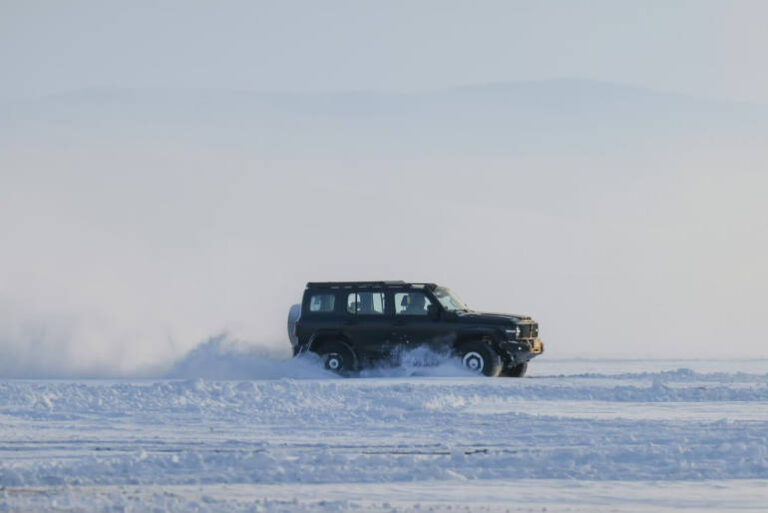
GWM has achieved another milestone, with the Tank 300 Diesel officially selected as an approved vehicle for China’s Antarctic and Arctic expeditions. The announcement follows a partnership agreement with the Polar Research Institute of China (PRIC) — marking the first time a Chinese automotive brand has joined a polar expedition with an unmodified, mass-production vehicle.
The production-spec Tank 300 will serve as a support vehicle at Antarctica’s Great Wall Station, reinforcing its credentials as a capable and dependable off-roader. The PRIC selection followed extensive evaluations on powertrain performance, off-road ability, low-temperature operation, and fuel adaptability — key measures that resonate with GWM’s growing reputation for reliability in the Australian market.
Proven in extreme conditions
At GWM’s environmental wind tunnel laboratory, the Tank 300 Diesel completed one-touch starting, defrosting, and heating operations at -30°C while simulating blizzard conditions. The vehicle’s ring-shaped frame, with 70% high-strength steel and 20% ultra-high-strength 1500 MPa steel, gives it the structural strength to withstand over 15 tonnes of roof pressure. Its chassis rigidity (284.5 kN·m/rad) ensures stability across uneven terrain.
Power comes from a 2.4-litre turbo diesel engine, tested for 14,000 bench hours — equivalent to 4.8 million kilometres of operation — and validated across 60 vehicles and 4.2 million kilometres of real-world driving. Noise levels remain below 65 dB at idle, underscoring refinement as well as toughness.
Australian off-roaders will already be familiar with the Tank 300’s capabilities. Earlier in 2025, it became one of the few production vehicles to conquer Beer O’Clock Hill — one of Australia’s most infamous “hell-grade” off-road challenges.
“The Tank 300’s selection for Antarctic expeditions validates what our owners already know — this is a vehicle built to handle the world’s most extreme conditions,” said Steve Maciver, Head of Marketing and Communications at GWM Australia. “From the Australian Outback to Antarctica, the Tank 300 delivers uncompromising reliability and performance, no matter what it encounters.”
Global R&D, local confidence
GWM’s success in securing the Antarctic partnership reflects its expanding global R&D strength, with a “Seven-Country, Ten-Site” development network spanning Japan, the US, Germany, and beyond. More than 110 projects are currently underway in powertrains, intelligent cockpits, and autonomous driving.
In Australia, GWM has operated since 2008 and continues to strengthen local capability under its new “At One” philosophy — ensuring every model is tuned to Australian conditions by mid-2026.
The company’s hybrid architectures — Hi4, Hi4-Z, and Hi4-T — underpin its electrification strategy. The Hi4-T platform, which uses a fuel-first, electric-assisted approach with a 9HAT hybrid transmission, is engineered for demanding off-road environments where durability and flexibility are essential.
Market momentum continues
Between January and September 2025, GWM sold 39,343 vehicles in Australia, a 23.7% increase year on year. The brand now ranks 7th overall and leads all Chinese manufacturers with a 4.3% market share. The Tank 300’s strong reputation has been further cemented by its top ranking in the 2025 China Automotive Product Quality Performance Study (AQR), where it was rated “No. 1 in Quality Performance among Independent SUVs”.
Since launch, over 470,000 Tank 300s have been sold globally, with more than 22,000 owners surpassing 100,000 kilometres of driving — proof of its endurance and reliability.
From Great Wall Motor to Great Wall Station
The Tank 300 Diesel’s role at Antarctica’s Great Wall Station symbolises how far GWM’s engineering has come — literally and figuratively. The partnership with PRIC demonstrates confidence in modern Chinese automotive technology and manufacturing, while also giving GWM a new testing ground at the edge of the world.
For Australian fleet and off-road buyers, it’s another reminder that vehicles designed for the harshest environments on Earth can handle the extremes of daily work and play just as confidently.