

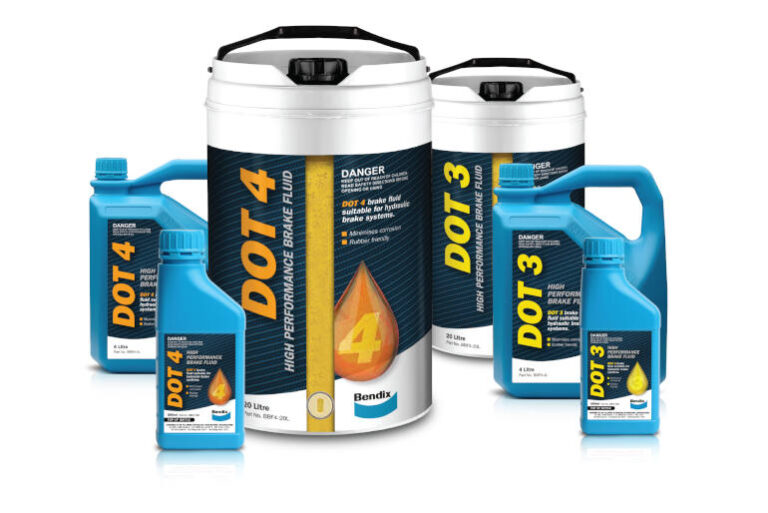
Brake fluid often sits low on the list of maintenance priorities, yet it’s one of the most critical safety components in any truck or fleet vehicle. Bendix has highlighted the importance of understanding Department of Transport (DOT) ratings when selecting replacement fluids to ensure safe and reliable braking performance.
What the DOT rating means
DOT is a standard set by the Department of Transport that defines the safety and performance benchmarks for brake fluids. Fluids are commonly labelled DOT 3, DOT 4, DOT 5 or DOT 5.1. The right choice depends on the make, model and age of the truck, and can be confirmed via the owner’s manual or a qualified technician.
The difference between these classifications comes down to boiling points. New brake fluid has a “dry” boiling point, while fluid that has absorbed moisture over one or two years has a lower “wet” boiling point. This matters because most brake fluids – including DOT 3, DOT 4 and DOT 5.1 – are hygroscopic, meaning they absorb water over time.
| DOT Type | Dry Boiling Point | Wet Boiling Point |
|---|---|---|
| DOT 3 | 205°C | 140°C |
| DOT 4 | 230°C | 155°C |
| DOT 5 | 260°C | 180°C |
| DOT 5.1 | 270°C | 190°C |
While the braking system is designed to be sealed, moisture can still enter when the cap is opened, through rubber hoses, or during normal heating and cooling cycles. This lowers the boiling point and increases the risk of the fluid vaporising – which can create a soft pedal feel or, in extreme cases, total brake failure.
Why it matters for fleets
For fleet managers, the choice of brake fluid affects more than compliance – it impacts uptime, driver safety, and the whole-of-life cost of trucks. A spongy pedal or delayed braking response can have serious implications for drivers hauling heavy loads or operating in demanding stop-start conditions.
DOT 4 is the most widely used specification across modern trucks and light commercials. Bendix offers both Polyglycol DOT 3 and DOT 4 fluids, meeting stringent Australian and U.S. safety standards.
Brake fluid DOs and DON’Ts for fleets
Bendix has outlined several best practices that apply directly to fleet workshops and operators:
- Don’t use old or opened bottles – contamination occurs within months.
- Don’t mix incompatible fluids – especially silicon- and glycol-based types, which can gel and damage the braking system.
- Don’t ignore leaks – they signal a system fault.
- Do change brake fluid every one to two years, or as per manufacturer guidelines.
- Do seal the reservoir cap quickly to limit moisture entry.
- Do train technicians to avoid overfilling reservoirs or spilling brake fluid, which is highly corrosive to paint.
Takeaway for fleet managers
Brake fluid is an inexpensive consumable, but using the wrong type or extending replacement intervals can put entire fleets at risk. For fleet managers, staying on top of DOT ratings and replacement cycles is not just about compliance – it’s about protecting drivers, vehicles, and the bottom line.