
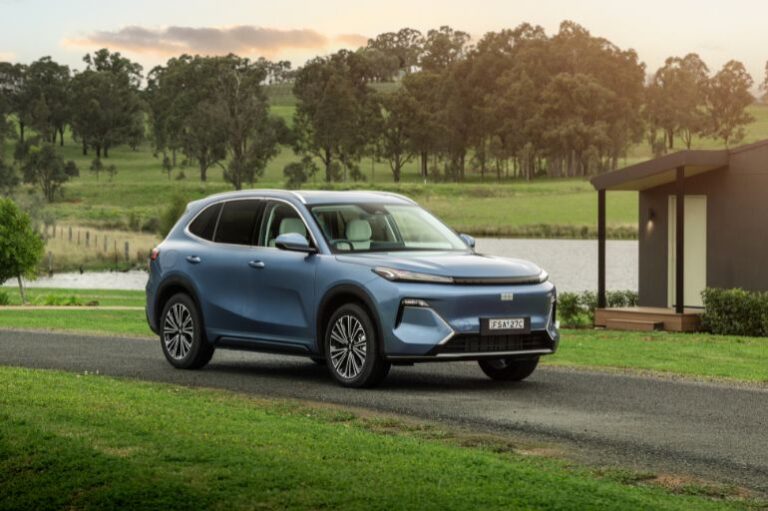
The Geely Starray EM-i arrives in Australia with a fairly simple proposition: give buyers the smoothness and convenience of electric driving around town, add a petrol engine for longer journeys, wrap it all in a roomy SUV and keep the price within reach of mainstream buyers.
After spending time with the Starray EM-i around Sydney and taking it on a return trip to Canberra, there is plenty about that formula that works.
It is spacious, comfortable and surprisingly refined, while the plug-in hybrid powertrain delivers the kind of flexibility that will appeal to private buyers and fleet drivers who like the idea of an EV but aren’t ready to rely completely on charging infrastructure.
Perhaps its strongest attribute, though, is value. This is a vehicle that looks and feels more expensive than its price suggests.
It certainly doesn’t look cheap
One of the first things I noticed during the test wasn’t from behind the wheel. People were looking at it.
Park the Starray and it attracts attention, and that is not something you can say about every medium or large SUV at this end of the market.
The styling is modern without being excessively complicated, and there’s enough road presence to make the Starray look like it belongs in a more expensive part of the showroom.
For a vehicle sitting around the $40,000 mark according to our test experience, that counts for plenty. And the impression continues once you climb inside.
There’s a lot of room in here
The Starray is 4,740mm long, 1,905mm wide and rides on a 2,755mm wheelbase, so this is a substantial five-seat SUV. Yet it doesn’t feel unnecessarily large from the driver’s seat.
Where you really notice those dimensions is in passenger space.
There is generous room in the front and rear, and the cabin has the airy feel you expect from something considerably larger. The 428-litre luggage compartment is useful with the second row upright, expanding to 2,065 litres with the rear seats folded.
During our test it easily swallowed boxes of Fleet News Group magazines, which is perhaps not part of the official luggage-capacity test cycle, but proved that the boot works in the real world.
Storage inside is also good.
The centre console offers plenty of space for everyday items and there’s additional storage underneath the floating console. The cupholders are less convincing; a large takeaway coffee cup and bottles can be a tight fit.
Mostly good ergonomics
The Starray gets a 15.4-inch central touchscreen and a 10.2-inch digital instrument display, while the Inspire specification adds a 13.4-inch head-up display. Wireless Apple CarPlay and Android Auto are included, along with satellite navigation, Bluetooth and connected services.
The dashboard presentation is clean and contemporary, but importantly Geely hasn’t completely abandoned physical controls.
There are still buttons for some climate functions and a proper volume dial, which makes everyday use easier. That’s good because not everything is perfect.
During our winter test, accessing the heated-seat controls through the touchscreen became one of those small irritations you notice after living with a vehicle for several days. Heated seats are something you want to turn on quickly on a cold morning, not something that should require several screen presses.
The steering wheel is another acquired taste. Its flattened, almost squared-off shape looks distinctive, but we found it slightly less natural when trying to settle into a relaxed driving position on longer journeys.
Neither issue is a deal-breaker, but they are examples of where fashionable design hasn’t necessarily improved basic usability.
The PHEV system makes sense in everyday driving
Underneath the Starray is where things become more interesting. All versions use a front-wheel-drive plug-in hybrid system combining a 1.5-litre naturally aspirated four-cylinder petrol engine with an electric motor producing 160kW and 262Nm.
The Complete uses an 18.4kWh LFP battery with a claimed WLTP electric range of 83km, while the Inspire Extended Range increases battery capacity to 29.8kWh and lifts claimed EV range to 136km.
Combined range is listed at 943km for the Complete and 996km for the Inspire. That combination is arguably the Starray’s biggest ownership advantage.
Charge it regularly and a large proportion of normal commuting could potentially be completed using electricity. Around town it delivers much of the appeal of a battery electric vehicle: smooth acceleration, quiet operation and no traditional gearbox behaviour interrupting progress.
Then, when you need to head interstate, the petrol engine removes the need to plan your trip around chargers.
It’s effectively the best-of-both-worlds argument for PHEVs, provided the owner actually plugs it in.
Sydney to Canberra proves the point
Our test included a Sydney-to-Canberra return journey, which gave the hybrid system a chance to show what happens once the easy electric kilometres have disappeared.
With no meaningful battery charge remaining and the Starray effectively operating as a hybrid on the motorway, we saw approximately 5.2L/100km.
That’s a respectable result for a vehicle of this size travelling at highway speeds.
Geely’s official WLTP fuel-consumption figures are 2.4L/100km for the Complete and 1.5L/100km for the Inspire Extended Range, although—as with any PHEV—real-world consumption can vary dramatically depending on charging frequency and driving pattern.
A driver who charges every night and travels mainly short distances could use very little petrol. A driver who rarely plugs in will get a completely different result.
That distinction matters for fleet managers too. A PHEV only delivers its full fuel and emissions potential when drivers have access to charging and are encouraged to use it.
Smooth rather than sporty
The Starray isn’t trying to be a performance SUV. Zero to 100km/h takes a claimed 8.0 seconds in the Complete and 8.2 seconds in the Inspire, which is more than adequate for everyday driving.
What stands out more is the smoothness.
The transition between electric and petrol operation is generally well managed, and even when the petrol engine becomes involved under load, it doesn’t dominate the experience.
The suspension combines MacPherson struts at the front with a multi-link rear arrangement, and the overall character suits the vehicle: comfortable, predictable and easy to drive rather than sharp or particularly sporting.
That is exactly what most family and fleet users will want.
Driver assistance still needs some refinement
The Starray comes with an extensive suite of active safety technology.
Standard features include autonomous emergency braking, adaptive cruise control, intelligent cruise control, front and rear collision mitigation, rear cross-traffic alert and braking, blind-spot detection, lane-keeping assistance, emergency lane-keeping assistance, traffic-sign information and driver-fatigue alert.
There’s also a surround-view camera system and seven airbags. The equipment list is impressive. The calibration wasn’t always as convincing.
I found the adaptive cruise control could be quite assertive when responding to changing speed zones. Moving from 110km/h to 80km/h, for example, could result in relatively firm braking rather than allowing the vehicle to progressively coast down to the new limit.
It worked, but it wasn’t always subtle, and occasionally required the driver to disengage the system and manage the transition manually.
This is an area where refinement matters just as much as the number of systems fitted.
Some thoughtful everyday touches
There are several smaller features that make the Starray pleasant to live with.
Keyless entry and start mean you can approach the vehicle, climb aboard and drive away without going through a conventional start-up routine. The electronic parking brake and Auto Hold further simplify the process.
It sounds minor, but these are exactly the features you appreciate when you use a vehicle every day.
The seats are comfortable too, and depending on specification buyers can get heated, ventilated and even six-mode massage functions up front. The Inspire also adds a panoramic sunroof, power tailgate, memory driver’s seat, 256-colour ambient lighting and a 16-speaker, 1,000W Flyme Sound audio system.
There’s a lot of equipment here for the money.
What does it mean for fleet buyers?
For fleet operators, the Starray raises an interesting question.
A PHEV can be a useful stepping stone toward full electrification for drivers who regularly travel beyond metropolitan areas or operate in regions where charging access isn’t consistent.
The Starray’s 83km or 136km claimed electric range, depending on specification, is long enough to cover many normal commuting patterns without starting the petrol engine.
But fleet managers need to look beyond the specification sheet. If the vehicle isn’t charged, much of the benefit disappears.
That means driver behaviour, home-charging access, workplace infrastructure and reporting should all form part of the decision before a PHEV is added to the fleet.
For the right application, however, the Starray presents an interesting combination of space, equipment, long-distance flexibility and the ability to dramatically reduce petrol use on shorter journeys.
Verdict
The Geely Starray EM-i isn’t perfect.
Some touchscreen functions would be better served by physical buttons, the steering-wheel design won’t suit everyone, and the adaptive cruise control could use greater finesse.
But those criticisms sit alongside a much longer list of positives.
It’s spacious without feeling enormous, the interior is well presented, the plug-in hybrid system is smooth and practical, and it offers an impressive amount of equipment.
Most importantly, it feels like a lot of car for the money.
For buyers who can plug in regularly but aren’t ready to make the full jump to a battery electric vehicle, the Starray EM-i makes a strong case.
And for fleets, it could work particularly well where daily driving is predominantly urban but vehicles still need the flexibility to cover long distances without relying on public charging.
The trick is simple: if you buy a PHEV, plug it in. Do that, and the Starray EM-i starts to make a lot of sense.