
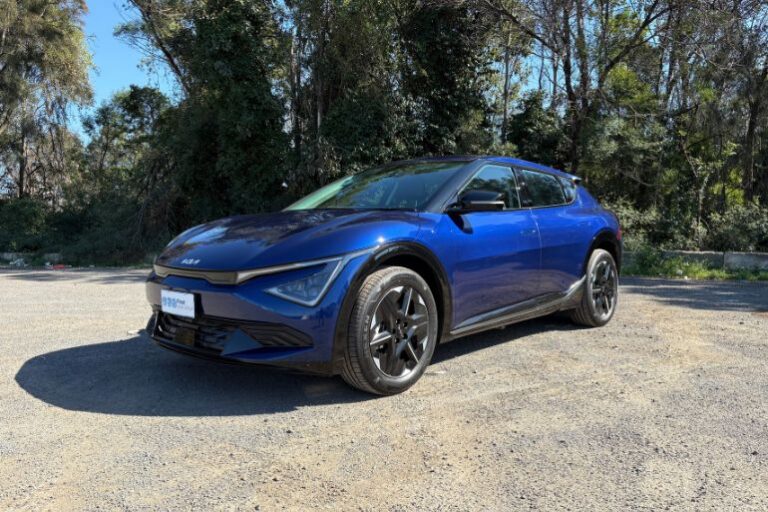
The Kia EV6 is one of those cars I had almost forgotten about.
That sounds harsh, because when the EV6 arrived in Australia in 2022 it was one of the most interesting electric cars on the market. It looked different, it drove properly, and when the EV6 GT started lining up against supercars in drag races, it became something of a halo model for Kia.
More importantly for fleet buyers, the EV6 showed that an electric vehicle didn’t have to feel like a technology experiment on wheels.
Getting back into the MY26 EV6 Air reminded me why I liked it so much in the first place.
And that creates a problem.
Because as much as I like the EV6, at roughly $79,000 for the entry-level Air, the practical fleet manager in me would probably stop the emotional car enthusiast from signing the purchase order.
An EV that still wants to be a car
There’s a comment I kept coming back to while driving the EV6: it feels more like a car than an iPad on wheels.
That might be one of its strongest attributes in 2026.
The EV6 certainly has technology. There’s a curved display combining a 12.3-inch digital instrument cluster and 12.3-inch infotainment screen, wireless Apple CarPlay and Android Auto, navigation, Kia Connect and over-the-air updates.
But Kia hasn’t used technology as an excuse to remove every familiar interaction from the cabin.
One of my favourite features remains the clever dual-purpose control panel beneath the infotainment screen. Touch a button and it switches between audio and climate functions, giving you easy access to the controls you regularly use without filling the dashboard with another row of switches.
It is simple, intuitive and, after driving plenty of newer EVs, refreshingly sensible. The EV6 feels designed around the driver rather than around the screen. That was one of the things that attracted me to the car when it first arrived, and four years later it still works.
The Air is the EV6 stripped back to what matters
The vehicle tested was the rear-wheel-drive EV6 Air.
It uses an 84 kWh battery and a single rear-mounted electric motor producing 168 kW and 350 Nm. Kia quotes a 582 km WLTP range, energy consumption of 159 Wh/km and a 0–100 km/h time of approximately 7.7 seconds.
Those numbers don’t make the Air the headline-grabbing EV6. That’s the job of the 478 kW GT. But the Air doesn’t need to be ridiculously fast.
There is something about a rear-wheel-drive car that still feels right. The steering is direct, the chassis feels composed and the instant response from the electric motor is there whenever you want it.
In the original EV6, particularly the dual-motor versions, that instant torque was part of the attraction. But returning to the single-motor Air highlighted something more subtle: the basic platform itself is good.
It drives like a car developed by a company that knows how a car is supposed to feel.
That’s important because EV buyers now have an enormous number of choices. Straight-line acceleration is no longer unusual. Neither are big screens or long equipment lists.
Good driving dynamics still stand out.
Plenty of space for the working week
The EV6 is also a big, comfortable five-seater.
With a 2,900 mm wheelbase, there is generous rear-seat space and enough room to comfortably carry adults or three teenage kids across the back. The Air provides 490 litres of rear cargo capacity, plus a useful 52-litre front storage compartment.
For somebody spending hours in a vehicle as part of their working day, the ergonomics are excellent.
And there is one EV feature that genuinely adds workplace value: Vehicle-to-Load.
The Air comes with an interior Australian-specification V2L power socket, meaning laptops and other equipment can be powered directly from the vehicle’s battery. The exterior V2L adaptor is reserved for the higher specifications, but even the interior socket is useful for employees who spend significant time working remotely from their vehicle.
From a fleet workplace perspective, that’s a big tick.
The specification exposes the price problem
The EV6 Air isn’t poorly equipped, but its specification also highlights how quickly the EV market has changed.
You get cloth seats — which I personally don’t mind at all — but they are manually adjusted. There’s no heated steering wheel, no heated or ventilated front seats, no Surround View Monitor and no Blind Spot View Monitor.
It also misses some of the assistance technology available on the GT-Line, including Parking Collision Avoidance Assist and Safe Exit Assist.
None of these omissions makes the EV6 Air a bad car.
In some ways, they reinforce its slightly more analogue character. You get the features you need, good ergonomics, comfortable seating, adaptive cruise control and the important active safety systems without feeling as though the car is constantly trying to demonstrate how clever it is.
The problem is what else is sitting in the showroom for less money.
Since the EV6 was launched, the Australian EV market has been flooded with new models, many from brands that barely registered with buyers in 2022.
Some now offer more equipment, larger screens, electric seats, panoramic roofs, cameras everywhere and increasingly competitive range figures while costing considerably less.
That’s where the EV6 Air becomes difficult for the spreadsheet.
Charging remains one of its strongest arguments
There is one piece of engineering that continues to make the EV6 feel premium: its charging architecture.
The EV6 supports both 400-volt and 800-volt charging infrastructure. Kia quotes a 10 to 80 per cent DC charging time of approximately 18 minutes when connected to a 350 kW charger. Even using a 50 kW charger, the same charge takes approximately 81 minutes.
That’s important for fleet operators.
Range gets most of the attention when EVs are discussed, but charging speed can be equally important for vehicles travelling longer distances or operating outside a predictable overnight depot-charging cycle.
The 582 km WLTP range of the Air gives it plenty of theoretical distance, while the fast-charging capability reduces the penalty when you do need to stop.
It can also tow 1,800 kg braked, adding another layer of practicality that won’t matter to every fleet but broadens the vehicle’s potential use cases.
Kia still makes sense as a fleet supplier
There is another part of the EV6 equation that doesn’t appear on the vehicle specification sheet.
Kia is an established fleet supplier.
It has the dealer network, fleet team, parts infrastructure and support structure that Fleet Managers expect from a mainstream manufacturer. The review experience also reinforces the value of Kia’s pricing discipline and established fleet processes.
Those things matter.
Buying the lowest-priced vehicle isn’t necessarily the same thing as buying the lowest-cost fleet vehicle, particularly when support, downtime, parts availability and resale are included in the decision.
But even after giving the EV6 credit for those factors, it’s difficult to ignore the initial price.
The car enthusiast and Fleet Manager disagree
This is where I end up conflicted. I really like the Kia EV6.
I like the way it drives. I like its rear-wheel-drive character. I like the spacious cabin. I like the controls. I like the fact that Kia didn’t decide an electric drivetrain required abandoning everything drivers already understood about using a car.
Four years after its launch, the EV6 still represents what I think an EV that wants to be a car should feel like.
And if somebody handed me the keys, I’d happily drive it every day. But fleet procurement requires a different conversation.
At approximately $79,000 for an EV6 Air, I’d want to run the whole-of-life cost numbers very carefully because the competitive landscape is nothing like it was when this vehicle launched in 2022.
There are now cheaper EVs with higher specification levels competing for the same fleet and novated leasing customers.
That doesn’t suddenly make the EV6 overpriced because it’s a bad vehicle. In fact, that’s what makes the decision frustrating.
The Kia EV6 is still a very good car. I might even like it more now because the market has moved towards increasingly screen-dominated EVs.
But while my car enthusiast brain would happily put one in the driveway, my fleet brain would be standing beside it with a calculator asking me to explain the business case.
And in 2026, that’s a much harder question for the EV6 Air to answer.