
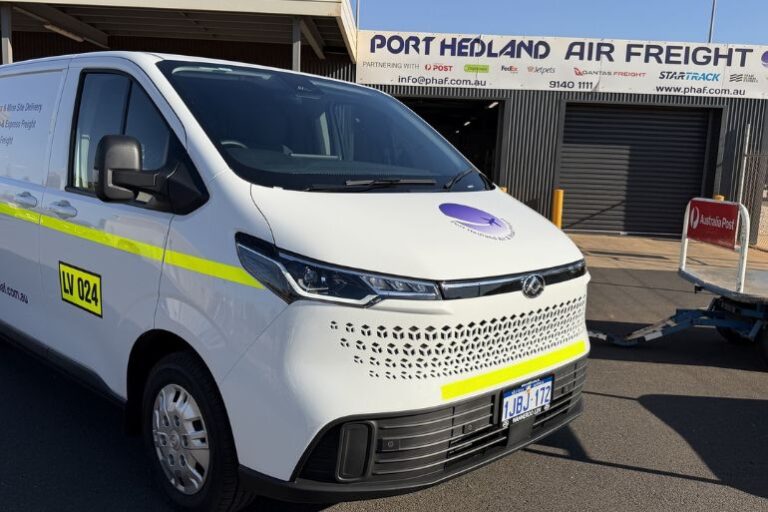
When Port Hedland Air Freight Director Dominic Barlow needed another van for the business, he wasn’t looking for something to impress on a short test drive. He needed a vehicle that could earn its keep.
After buying an LDV Deliver 7 LWB in Perth and driving it 1,890 kilometres north to Port Hedland, he shared his first impressions with Fleet News Group — and explained why business owners should look beyond the purchase price when choosing their next fleet vehicle.
There is a big difference between reviewing a commercial vehicle and owning one.
For Dominic Barlow, Director at Port Hedland Air Freight, the decision to buy an LDV Deliver 7 LWB was ultimately a business decision.
The van needs to carry freight, cope with repeated stops and starts, handle hundreds of door openings every day and operate reliably in the demanding conditions around Port Hedland.
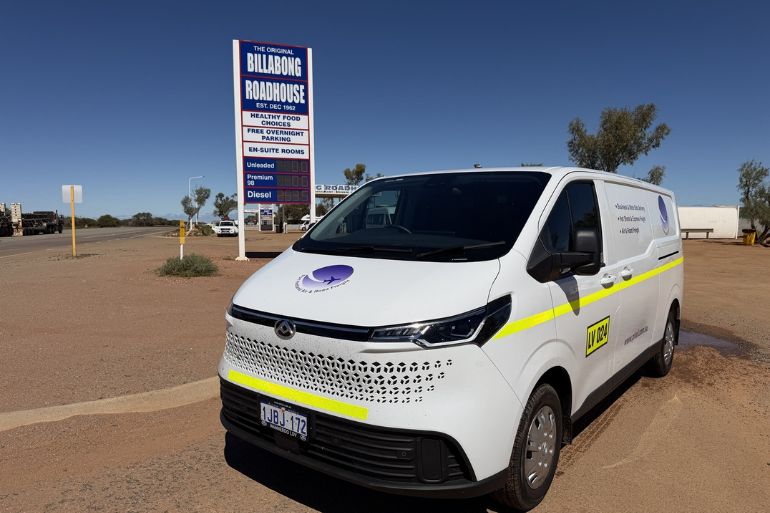
So rather than judging it after a short metropolitan drive, Dominic collected the van in Perth and drove it almost 1,900 kilometres north.
It was an unusual first test for a delivery van, but it gave him plenty of time to understand the vehicle before it started work.
“After 1,890 kilometres from Perth to Port Hedland, the verdict is becoming increasingly clear,” Dominic said. “This is a very good commercial van.
“Not perfect. Not pretending to be premium. But extremely well suited to the job it has been designed to do. And at this stage of ownership, I would absolutely buy another one.”
Range was the first surprise
One of the strongest impressions from the trip was fuel range.
Dominic has driven Toyota HiAces over the same route on numerous occasions, giving him a useful real-world benchmark.
The Deliver 7 travelled approximately 150 kilometres further between fuel stops than the HiAce had typically managed on the journey.
The trip computer showed average fuel consumption of around 8.7L/100km, with an average speed of approximately 111km/h.
Dominic is quick to point out that the van was essentially empty, so those figures shouldn’t be treated as an indication of what operators will see during fully loaded metropolitan delivery work.
But for regional businesses, range has a practical value that goes well beyond an impressive number on a specification sheet.
“Out here, fuel stations can be hundreds of kilometres apart,” he said. “An extra 150 kilometres isn’t simply a fuel economy statistic. It gives you operational flexibility.”
For a business operating across regional and remote Australia, that can mean more options about where vehicles refuel, fewer unnecessary stops and more confidence when routes stretch between towns.
The real fuel economy test will come now that the Deliver 7 has started its intended job. At Port Hedland Air Freight, that can mean upwards of 200 parcel deliveries in a day.
A drivetrain you don’t need to think about
Dominic’s assessment of the Deliver 7’s drivetrain is equally pragmatic. It isn’t about acceleration times or outright performance. The question is whether the van responds when a driver needs it to.
“The Deliver 7 doesn’t feel underpowered,” he said. “Pulling away from junctions is particularly good. There’s no frustrating delay while you’re waiting for the drivetrain to decide what to do.”
There are Eco, Normal and Power driving modes, but after nearly 1,900 kilometres Dominic sees little reason to complicate things. Normal mode was his preferred setting.
Power mode holds higher engine speeds and downshifts more aggressively, while Eco softens accelerator response and appeared to offer a modest fuel consumption improvement during steady highway running.
“For everyday use, I’d leave it in Normal,” Dominic said. “That’s probably the greatest compliment I can give the drivetrain: you don’t need to think about it. It simply does the job.”
For fleet operators, that’s arguably more relevant than headline performance figures.
A commercial vehicle needs to be easy for different drivers to operate without requiring them to adapt their driving style every time they climb aboard.
Cruise control could be better
Dominic isn’t pretending everything is perfect. One area he would like LDV to improve is the cruise-control calibration.
Over long stretches of highway the system tends to repeatedly add and remove small amounts of power. It maintains the selected speed, but the resulting fore-and-aft movement becomes noticeable over several hours.
Compared with the HiAce, Dominic believes the Toyota system feels more polished. But he also puts that criticism into the context of how the vehicle will actually be used.
“This is fundamentally a delivery van,” he said. “If you’re delivering 100, 150 or 200 parcels in a day, you’re accelerating, stopping, parking and moving again. You might barely touch the cruise-control button.”
For Dominic, smoother cruise control belongs on LDV’s improvement list. It doesn’t belong on the list of reasons not to buy the vehicle.
Driver comfort matters when the kilometres add up
One feature that exceeded expectations was the driver’s seat. After 1,890 kilometres, Dominic came away impressed by the seating position, lumbar support, adjustable seat base, recline and armrests.
“The seat is one of the strongest aspects of the vehicle,” he said. “It made a 1,890-kilometre journey surprisingly manageable.”
He rates it equal to, and potentially better than, the standard HiAce seat for long-distance driving. That’s a detail fleet managers shouldn’t dismiss.
For an owner-driver it affects how you feel at the end of a working day. For a larger fleet, seating comfort can influence fatigue, driver satisfaction and the way employees treat a vehicle they may spend hours in every day.
The Deliver 7 does ride relatively firmly when empty, although Dominic found the seat absorbed enough of that movement to keep the overall driving experience comfortable.
The next question is how the suspension behaves with a genuine working load in the back.
Simple technology is probably enough
The Deliver 7 cabin doesn’t try to create the impression of a luxury passenger car. For Dominic, that’s largely a good thing.
The physical rotary controls are tactile and straightforward, although he believes some of the frequently used controls could be positioned closer to the driver.
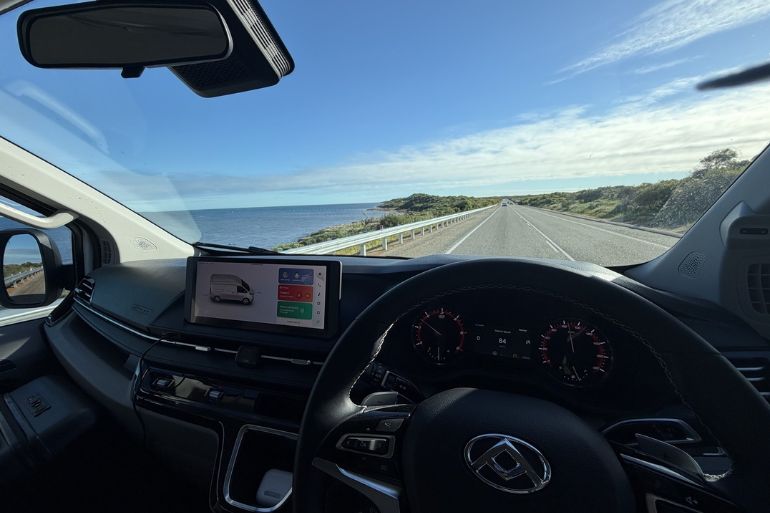
The centre screen is also fairly basic until a smartphone is connected. With Apple CarPlay operating, it becomes a familiar and functional interface for everyday work.
For a commercial vehicle, Dominic thinks that’s probably all it needs to be.
It’s another useful reminder for fleet buyers: more technology doesn’t automatically make a vehicle more productive.
The better question is whether drivers can quickly find and operate the functions they need.
Look at ready-to-work cost, not just purchase price
This is where Dominic’s experience as a business owner starts to make the review particularly relevant for fleet buyers. He believes operators often focus too heavily on the headline purchase price when comparing commercial vehicles.
The Deliver 7 arrived with a lined cargo area and floor-mounted tie-down shackles already fitted.
They’re hardly features that will dominate a brochure, but they matter when the vehicle needs to start earning money.
Dominic estimates that comparable lining and tie-down work on a Toyota HiAce can cost close to $2,000 once supplied and installed.
“A fleet buyer shouldn’t simply compare Van A at one price against Van B at another,” he said. “The more meaningful comparison is what each vehicle costs when it’s actually ready to start earning revenue.”
That means considering fit-out, accessories, modifications and potentially the time a new vehicle spends off the road before it can enter service.
For small business owners in particular, those costs are very real.
A cheaper vehicle that requires thousands of dollars of work before it can be used isn’t necessarily the cheaper vehicle.
Why Dominic loves the dual sliding doors
One of the simplest features on the Deliver 7 could also make one of the biggest differences to Port Hedland Air Freight. It has sliding doors on both sides.
For an operator completing repeated deliveries, the driver’s-side sliding door means freight can be accessed without constantly walking around the van.
“Do that once and it doesn’t matter,” Dominic said. “Do it 200 times a day, five or six days a week, and it becomes a productivity, fatigue and potentially safety issue.”
That’s exactly the kind of detail Dominic believes business owners should think about when choosing vehicles.
The specification that saves a driver 10 or 15 seconds may seem insignificant in the showroom. Multiply it across hundreds of deliveries a day, thousands a month and years of vehicle ownership, and the business case looks very different.
Combined with the rear barn doors, Dominic believes the Deliver 7 is extremely well configured for multi-drop freight work.
Remote driving highlights different safety features
Driving between Perth and Port Hedland also provided an opportunity to test things that may not be obvious during a daytime test drive around a dealership.
A significant portion of the journey was completed at night on remote, largely unlit roads.
Dominic was particularly impressed by the headlights. Both dipped and high beam performed well, while the automatic high-beam system also worked effectively.
Forward visibility is good, the wipers cover virtually the entire usable windscreen and the reversing camera is clear and accurate.
Blind-spot monitoring is another feature Dominic is pleased to have.
The lane assistance system is functional, although he believes Toyota’s calibration is more sophisticated. The Deliver 7 tends to wait until the vehicle gets relatively close to a lane marking before intervening rather than smoothly helping maintain its position.
That led Dominic to an interesting observation about the difference between being the person behind the wheel and being responsible for a fleet.
“As a driver, I may switch some of those systems off,” he said. “As a fleet owner responsible for multiple vehicles and drivers, I am pleased they are fitted.”
That’s an important distinction for fleet managers.
Drivers tend to judge technology according to how intrusive it feels. Fleet operators also need to consider the additional layer of risk management it can provide across multiple drivers and vehicles.
For Dominic, the challenge for LDV is making those systems refined enough that drivers want to leave them switched on.
Would he buy another one?
After 1,890 kilometres, Dominic gives the Deliver 7 LWB 8.8 out of 10. His personal benchmark for the Toyota HiAce sits at approximately 9/10.
“The gap is remarkably small considering the difference in acquisition cost,” he said.
There are certainly things he’d change.
Cruise-control calibration could be smoother. Lane assistance could be more sophisticated. Some controls could be positioned closer to the driver, and the mirrors could provide better coverage for close-quarter manoeuvring.
Suspension performance also remains an unanswered question until the van spends more time carrying its normal working payload.
But none of those issues fundamentally changes his opinion of the vehicle.
Ask Dominic whether he would buy another Deliver 7 based on his experience so far and the answer is straightforward.
“Yes — 100 per cent.”
Now comes the test that really matters
For Dominic, however, this isn’t the end of the review. It’s really the beginning.
The Perth to Port Hedland journey involved plenty of kilometres, but in many respects it was an easy life for a commercial vehicle.
Now the Deliver 7 will face repeated starts and stops, constant loading and unloading, hundreds of door movements, heat, dust, freight and potentially more than 200 parcel deliveries in a working day.
“That’s where commercial vehicles earn — or lose — their reputations,” Dominic said.
And that’s the part of the ownership experience Fleet News Group will be interested in following.
Because for business owners making fleet decisions, the most useful review isn’t necessarily what a vehicle feels like during its first week.
It’s what happens after six months, 12 months and thousands of working kilometres.
The next assessment will look beyond initial impressions to fuel consumption measured fill-to-fill, maintenance, brakes, tyres, suspension, door mechanisms, cabin wear, downtime and ultimately one of the numbers that matters most to any fleet operator: cost per productive kilometre.
For now, Dominic’s first 1,890 kilometres suggest the LDV Deliver 7 has made a strong start. But the real work has only just begun.