

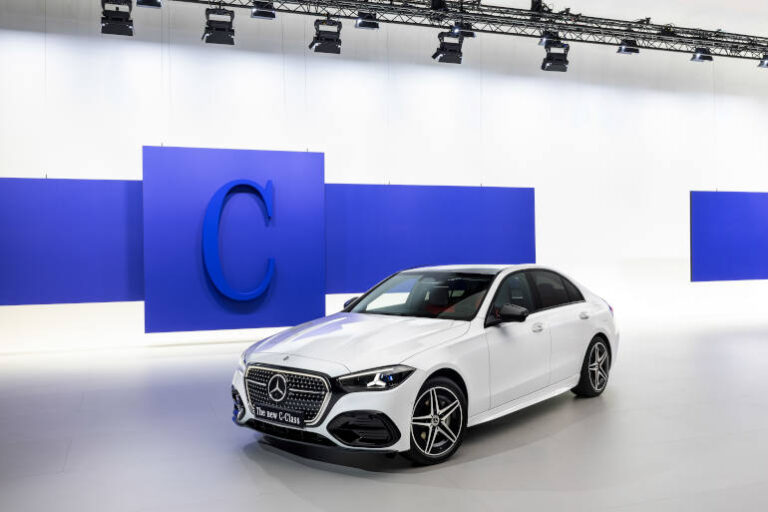
Mercedes-Benz has unveiled a heavily upgraded C-Class Saloon and Estate, bringing new electrified powertrains, artificial intelligence, improved driver assistance systems and greater digital functionality to one of the brand’s most established fleet models.
The update is described by Mercedes-Benz as the most comprehensive technical upgrade in the history of the C-Class, with changes spanning design, powertrains, chassis, safety and in-car technology.
For fleet operators, the most significant development is the breadth of powertrain choice. The new C-Class will continue to offer petrol and diesel engines alongside plug-in hybrid models, giving organisations options for everything from urban duties to high-mileage business travel.
The four-cylinder petrol and diesel engines now use second-generation integrated starter-generator technology, providing up to 17kW of additional output and 205Nm of supplementary torque.
The 48-volt mild-hybrid system also supports functions including coasting and energy recuperation, with Mercedes-Benz focusing on improved fuel efficiency and smoother operation.
Diesel remains part of the C-Class line-up, with the latest four-cylinder engine available in two outputs and compatible with HVO100, B10 and B20 biofuels.
Plug-in hybrid targets everyday electric driving
Potentially more interesting for fleets looking to reduce fuel use without moving immediately to a battery-electric vehicle is the new C-Class plug-in hybrid.
The C 400 e 4MATIC combines a four-cylinder petrol engine with an electric motor for total system output of up to 290kW and 650Nm.
A 19.53kWh usable battery provides an electric driving range of up to 100km under WLTP testing, potentially allowing many daily commuting and business trips to be completed without using the petrol engine.
Charging capability includes up to 11kW AC and 55kW DC, providing additional flexibility for vehicles that may need to recharge during the working day.
Software moves to centre stage
The new C-Class also adopts the Mercedes-Benz Operating System, or MB.OS, which manages multiple vehicle functions while allowing over-the-air software updates.
Mercedes-Benz has incorporated the fourth generation of its MBUX infotainment system, including an AI-powered Virtual Assistant drawing on technology from ChatGPT, Microsoft Bing and Google Gemini.
The system is designed to support more natural conversations, retain short-term context and provide information ranging from navigation and points of interest to weather and other everyday queries.
Navigation is based on Google Maps and includes the Google Cloud Automotive AI Agent, while available MBUX Surround Navigation combines route guidance with a real-time 3D representation of the vehicle’s surroundings.
For fleet managers, the growing role of software also raises the importance of understanding which digital services are included with a vehicle and which require subscriptions or activation during its operating life.
More driver assistance technology
Mercedes-Benz has expanded its MB.DRIVE assistance systems, supported by up to 10 cameras, five radar sensors and 12 ultrasonic sensors depending on specification and market.
Available functions include assistance with steering, maintaining distance, lane keeping, braking and acceleration.
Lane Change Assist can perform a motorway lane change after the driver activates the indicator, while parking systems can help identify suitable spaces and assist with entering and leaving them.
A new Reverse function can also automatically retrace part of a route previously driven forwards under certain conditions — potentially useful when manoeuvring in confined driveways, loading areas or narrow access roads.
Rear-axle steering remains available and can reduce the turning circle by 43cm to 10.64 metres, improving manoeuvrability in tight environments.
Estate keeps fleet practicality in the mix
The C-Class Estate continues to offer an alternative for fleets needing greater carrying capacity without moving into an SUV.
It provides 490 litres of luggage capacity with the rear seats in place and up to 1,510 litres when they are folded.
A standard 40:20:40 split rear seat and powered EASY-PACK tailgate add further flexibility for business users carrying equipment, samples or luggage.
Mercedes-Benz has also worked on reducing cabin noise and vibration, an area that can be important for drivers spending long periods behind the wheel.
Familiar fleet name moves further into the digital era
First introduced in 1982, the C-Class has become one of Mercedes-Benz’s most recognisable models, with more than 12 million sold globally.
The latest update shows how quickly the traditional premium fleet sedan is changing.
Electrification is now integrated across conventional engines, plug-in hybrids are capable of completing increasingly substantial journeys on electric power, and software and artificial intelligence are becoming central parts of the driver experience.