
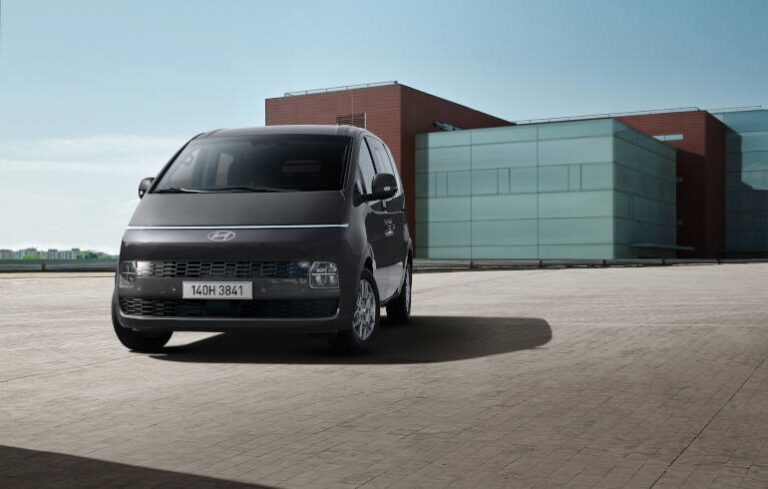
Hyundai is confident its new STARIA Load Hybrid will achieve a five-star ANCAP safety rating, with testing already underway as the company works to extend the existing rating to cover the new hybrid powertrain.
The updated commercial van introduces Australia’s first full hybrid powertrain in the segment, raising questions for fleet buyers about whether the addition of the petrol-electric drivetrain would require fresh crash testing or affect the vehicle’s safety credentials.
At the Australian media launch, Hyundai confirmed the ANCAP assessment process is in progress. When asked by Fleet News Group about the expected safety rating, Hyundai said:
“It’s in the process of being tested, and we’re expecting five star, but we’re not predicting. It’s very likely.”
Updating an existing five-star rating
Rather than undertaking an entirely new ANCAP assessment, Hyundai explained that the process is focused on validating the hybrid variant against the existing STARIA safety rating. During a technical discussion with media, Hyundai clarified the process.
“While the rating is being updated, it’s actually the existing rating is being updated to include the hybrid powertrain, so it’s not being re-rated as such.”
The company said that, if successful, the hybrid would be included under the existing five-star ANCAP rating awarded to the STARIA range. Hyundai also confirmed that the process involves more than simply supplying engineering documentation.
When asked whether ANCAP was relying solely on paperwork, Hyundai responded:
“The documentation still supports it, so we’re not doing the full suite of tests, but there will be some destructive element tests.”
Results expected soon
Hyundai indicated the assessment process is well advanced, with results expected shortly after the Australian launch.
“I think we’re expecting it within a month. Late July or early August.”
For Fleet Managers planning vehicle replacements later this year, that timing should provide clarity before the hybrid becomes widely available.
Why it matters for fleets
Safety ratings are increasingly important in fleet procurement policies across government, corporate and not-for-profit organisations. Many organisations specify a current five-star ANCAP rating as a minimum purchasing requirement for light commercial vehicles.
The STARIA Load already offers a comprehensive suite of active safety technologies, including:
- Forward Collision Avoidance Assist
- Blind-Spot Collision Avoidance Assist
- Rear Cross-Traffic Collision Avoidance Assist
- Lane Following Assist
- Lane Keeping Assist
- Smart Cruise Control
- Seven airbags
These systems are carried into the updated model alongside Hyundai’s latest connected vehicle technology.
Hybrid doesn’t compromise capability
Hyundai says the new 1.6-litre turbocharged petrol-electric hybrid has been engineered specifically for commercial use rather than simply prioritising fuel economy.
Michael Croan, Product Planning Assistant Manager at Hyundai, said the hybrid maintains the capability fleet operators expect.
“This hybrid powertrain maintains a high degree of capability that is demanded of the STARIA Load, delivering a maximum system combined power output of 180 kilowatts and 304 newton metres of torque.”
He added that the hybrid introduces Hyundai’s e-Motion Drive technology to improve ride comfort and stability while providing “EV-like driving smoothness.”
Looking beyond 2027
One point raised during the media briefing was that the STARIA’s current ANCAP rating, originally awarded under the 2021 protocols, is due to expire at the end of 2027.
Hyundai acknowledged this timing, explaining that the current assessment is intended to extend the existing rating to include the hybrid variant rather than establish a completely new rating under future ANCAP protocols.
For fleet buyers, the outcome means the key question is not whether the STARIA Load Hybrid can meet the existing five-star benchmark, but when ANCAP formally confirms that the hybrid powertrain has been incorporated into the current rating.
If Hyundai’s expectations are realised, the STARIA Load Hybrid will enter the Australian market with the same five-star ANCAP safety credentials as the existing range, providing fleet operators with confidence that adopting a lower-emissions powertrain does not require compromising on occupant safety.
- Inside the NRMA fleet team: managing diversity, data and the EV transition
 Managing fleet at the NRMA involves much more than keeping roadside patrol vehicles moving. Fleet Manager Jai O’Keefe and his small team are responsible for approximately 450 vehicles supporting businesses across New South Wales, South Australia and Tasmania. The majority are roadside patrol vehicles, supported by tilt-tray and cradle tow trucks. However, the fleet also
 - IVECO S-Way Takes the ReinsSafety, driver comfort and ease of operation are proving just as important in specialist transport as they are in large commercial fleets, with amateur show jumper Peter Carcary choosing an IVECO S-Way AS 550 to move valuable horses around Australia. Carcary travels to around 25 equestrian events each year, towing a 48-foot Premier horse float
- Novated Leasing Becomes a New Battleground for Car BrandsMcMillan Shakespeare Group (MMS) is expanding its relationships with major automotive brands as novated leasing becomes an increasingly important sales channel for new vehicles, particularly electric vehicles. The salary packaging and fleet services group has strengthened partnerships with BYD, Denza, GWM, MG Motor and GAC Group, alongside finance relationships with Volkswagen Financial Services Australia covering
- From Administering Chaos to Managing Strategy: How Sunwater Transformed Its Fleet FunctionMany fleet teams spend their days responding to problems rather than managing assets. Vehicles break down. Drivers need replacements. Orders are delayed. Suppliers are blamed. Emails pile up. According to Dan Cassidy, Fleet Lead at Sunwater, that’s not fleet management. Over the past two years, Sunwater has transformed its fleet operation into a strategic and
- IVECO Daily Takes Motorcycle Business Up a GearBoutique motorcycle service and repair business Squily’s Moto has replaced its utility with an IVECO Daily 35S van, using the vehicle as a mobile workshop, recovery vehicle, delivery van and day-to-day business transport. Based in regional Western Australia, Squily’s Moto began as a hobby for owner John Lizamore before growing into a business providing motorcycle