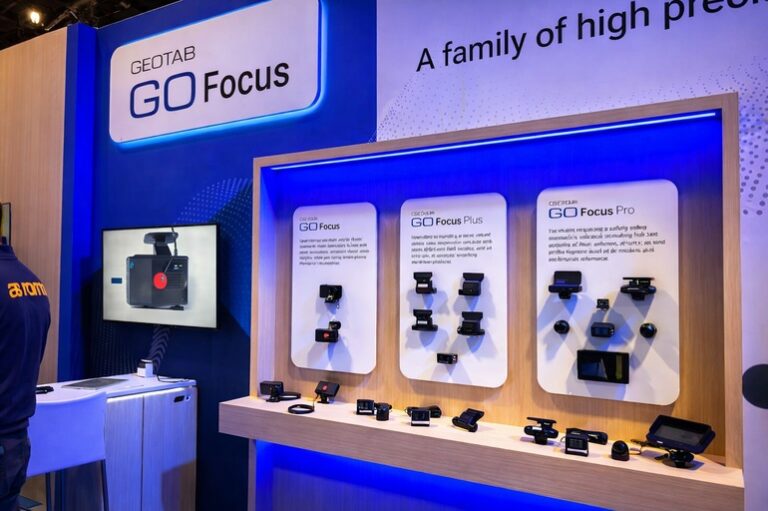
For years, Fleet Managers have debated whether in-cab cameras and video telematics were worth the investment.
Concerns around driver acceptance, privacy and implementation costs often slowed adoption, while many organisations struggled to quantify the return on investment.
According to Chris Martin, Senior Manager, Solutions Engineering – APAC at Geotab, that conversation is changing rapidly.
While video telematics continues to improve driver behaviour and support safety programs, Martin said many fleets are now discovering that the most immediate value comes from protecting drivers and reducing the financial impact of incidents.

Adding Context to Fleet Safety
Telematics has been a cornerstone of fleet safety programs for many years, providing insights into speeding, harsh braking and other driver behaviours. However, Martin believes video has added a critical missing piece.
“I think video is bringing an additional level of context to existing safety programs,” he said.
“Many fleets have run telematics for many years, and often with a strong safety focus, but the ability to layer on video can bring that additional context that works both for the fleet manager, but also for the driver.”
The additional context helps organisations understand what actually happened during an incident rather than relying solely on vehicle data. It also provides valuable information for driver coaching sessions.
“The coaching is such an important part of it, because you can’t just capture the events, you need to try and affect change with your drivers,” Martin explained.
“Walking into a coaching session with that context around video, it can really help tell that story.”
Drivers Are Seeing the Benefits
One of the biggest concerns surrounding video telematics has traditionally been driver acceptance.
Martin acknowledged that cameras can initially be confronting for drivers, but said perceptions often change once employees understand how the technology can protect them.
“We’re seeing some positive responses from drivers, which might initially not be what you expect,” he said.
“In-cab video can be a little bit confronting, but once drivers understand that it can help in terms of exonerating in the event of an incident, if a driver is not at fault, which often with a fleet vehicle that is the case, being able to wrap that context around can bring drivers on that journey.”
Rather than acting solely as a monitoring tool, video telematics is increasingly being viewed as a form of protection for drivers operating in busy traffic environments.
The Insurance Benefits Are Becoming Clear
Martin recently spoke with a local council that experienced first-hand how quickly video telematics can deliver value. The council had a collision involving one of its fleet assets and was able to immediately retrieve the video footage. The result was a much faster and clearer resolution process.
“The driver was no longer at fault,” Martin said. “That’s great from a personnel perspective.”
“The insurance team, or from a claim space, they could immediately accept they weren’t at fault, didn’t have to incur an increase on their ongoing premium.”
The benefits extended beyond the fleet team.
“From a governance perspective of the organisation, it flowed through immediately,” he said.
The experience was convincing enough for the organisation to expand its deployment of video telematics across additional vehicles.
“That was enough to convince that particular customer to then roll out further video telematics throughout their fleet,” Martin said.
“They instantly saw the value and the payback straight away.”
AI Is Making Video More Practical
One of the challenges with video telematics has always been the sheer volume of footage generated by a fleet. Reviewing hours of video is simply not practical for most fleet teams. Martin said artificial intelligence is now solving that problem.
“Video can bring a lot of data, and a Fleet Manager doesn’t really particularly want to sift through lots and lots of footage,” he said.
“That’s where AI is really helping out.”
Rather than requiring managers to review every event, AI can identify the most important incidents and present them for action.
“The power of being able to identify critical incidents that matter, also aggregating them, there’s no point looking at 10 lane departure incidents or 10 distracted driving incidents,” Martin explained. “You only need to review one.”
AI can then provide a representative example that can be used for coaching and training purposes.
“We do have a problem here. Here’s one really good example, and feed that into a coaching session.”
More Than Just Cameras
Video telematics is also helping fleets identify safety risks that were previously difficult to measure. Driver distraction remains one of the most significant concerns.
“Mobile phone use is sadly prevalent,” Martin said. “Those sorts of behaviours are distracted driving as well.”
Video is also providing visibility into advanced driver assistance system (ADAS) events such as lane departures and following distance warnings that may otherwise go unnoticed by Fleet Managers.
“Video can help there with the forward-facing cameras,” Martin said.
“Being able for a Fleet Manager to get notified that there was a tailgating incident, but not just that it happened, there’s an image and an overlay of exactly how far were you following behind.”
That visual evidence creates a more meaningful conversation with drivers and provides organisations with better information to manage risk.
A Different Kind of ROI
Historically, fleet technology investments were often justified through fuel savings, maintenance reductions or productivity improvements.
Video telematics is increasingly delivering value in a different way.
From protecting drivers and reducing insurance disputes to supporting governance, compliance and safety culture, fleets are finding that the business case is becoming easier to justify.
“I think most fleets are starting to see fairly quick ROI and a lot of value from it,” Martin said.
While driver engagement and stakeholder acceptance remain important parts of the implementation process, the question for many fleet operators is no longer whether cameras provide value.
The question is whether they can afford not to have them.