
As organisations look for ways to reduce fuel consumption and emissions without making the leap to battery electric vehicles, hybrid technology is often seen as an obvious solution.
However, according to The NRMA Fleet Manager Jai O’Keefe, the reality is more complex.
Speaking at the AfMA Summit, O’Keefe shared real-world operational data from The NRMA fleet, demonstrating that while some hybrid vehicles have delivered impressive fuel savings, others have produced only marginal improvements or, in some cases, worse fuel consumption than the vehicles they replaced.

The lesson for Fleet Managers is clear: selecting the right powertrain is less about following trends and more about understanding how a vehicle is actually used.
“I hope this at least plants a seed of thought for you guys to take back,” O’Keefe told delegates.
“If you’re in that position of being pressured, and I know this happens a lot, where we’re pressured to go in a certain direction without a thorough research being put to it, I hope this at least plants that seed that you can challenge the notion that what you’re presenting is not the right choice, and we need to do a little bit more work in the hybrid evaluations.”
PHEVs Need the Right Charging Environment
One of the examples presented by O’Keefe involved replacing a diesel vehicle with a Mitsubishi plug-in hybrid electric vehicle (PHEV).
While the vehicle delivered a reduction in fuel consumption from around nine litres per 100km to approximately 6.5 litres per 100km, the result fell well short of what many would expect from a plug-in hybrid.
The reason was simple: the vehicle was only being charged at the depot.
“Whenever it came into our depot, it went on to charge, but there was no home charging at the employee’s home, and therefore we weren’t really taking advantage of the electrical ability of that vehicle.”
Jai O’Keefe, Fleet Manager at The NRMA
The employee lived around 20 to 25 kilometres from work, meaning a fully charged vehicle at both ends of the journey could have completed most daily driving without relying on the petrol engine.
“It’s quite likely that we could, if we had a charger at the employee’s home, they’re around about 20 to 25 kilometres away from work, charging at both ends, there’s really zero chance for the petrol motor to have to kick in.”
For O’Keefe, the experience highlighted a key consideration for fleets evaluating PHEVs.
“I think the PHEV aspect, and this is my opinion, in a fleet scenario is a very hard one to justify if you don’t have charge points at both a depot and a home. You’re just not taking advantage of that technology.”
Highway Driving Favours Diesel
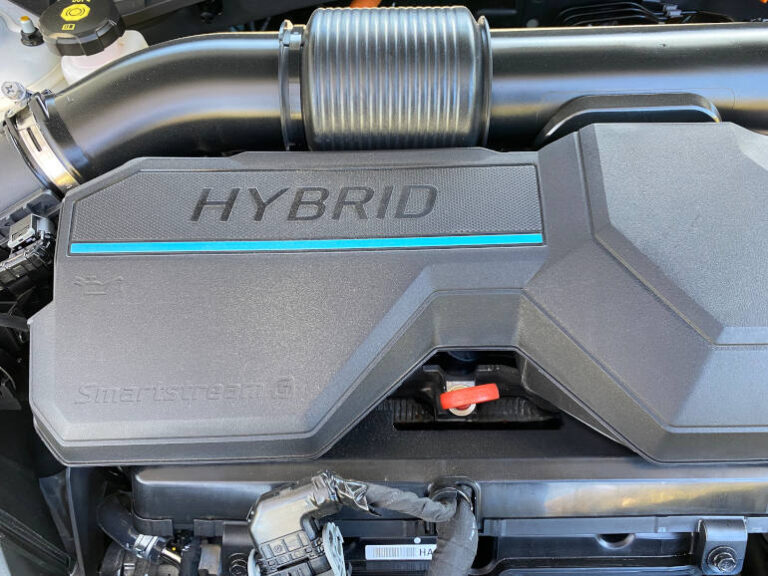
Another NRMA case study involved replacing a diesel vehicle used primarily for regional travel with a hybrid SUV. The original diesel vehicle averaged around eight litres per 100km while travelling predominantly on highways and regional roads.
After transitioning to a Hyundai Santa Fe Hybrid, fuel consumption improved to approximately seven litres per 100km. While technically an improvement, the gain was far smaller than many Fleet Managers might expect when moving to a hybrid powertrain.
“That diesel was just in its nice sweet spot on the freeway, returning around about eight litres per 100. Not bad,” O’Keefe said.
“We moved them into Santa Fe hybrids. There was a need to keep the vehicle large for those roads, and at the time, yes, we thought hybrids, that’s got to be better.”
The results showed that hybrid technology delivers its greatest advantages in stop-start driving rather than long-distance highway operation where modern diesel engines already perform efficiently.
Corolla Hybrid Delivers Significant Savings
The strongest result came from The NRMA’s Safer Driving fleet, where Mazda CX-3 petrol vehicles were replaced with Toyota Corolla Hybrids (currently not rated by ANCAP).
Unlike the regional highway vehicles, these cars spent much of their time in urban environments performing low-speed, stop-start driving. The fuel savings were dramatic.
The CX-3 fleet averaged more than nine litres per 100km, while the Corolla Hybrid reduced fuel consumption into the five-litre range.
“We’ve gotten massive savings with the Corolla hybrids,” O’Keefe said. “A large part of that is because of that low-speed driving. The Corollas love a lot of low-speed manoeuvring on electric.”
The outcome reinforced the strengths of conventional hybrid systems, which are designed to maximise efficiency during urban driving where electric motors can perform much of the work.
Mild Hybrids Are Not a Silver Bullet
The NRMA has also been evaluating the new 48-volt Toyota HiLux mild hybrid in its roadside assistance fleet. These vehicles operate under demanding conditions, carrying approximately one tonne of equipment while travelling through both urban and regional environments.
The results have been mixed. In regional applications, the HiLux performed similarly to or slightly better than the diesel Isuzu D-MAX it replaced.
However, fuel consumption increased in city driving.
“Surprisingly, that mild hybrid system didn’t like what we were doing with it in the city,” O’Keefe said. “You can see the fuel economy in a city went up by three litres per 100.”
O’Keefe believes the constant payload may have limited the effectiveness of the mild hybrid system.
“If you’re really pushing the weight limits of that vehicle, it’s quite likely that the battery systems that’s used there to help with take-off and things like that just don’t have enough punch to really help the motor.”
Understand the Application Before Choosing the Technology
For Fleet Managers, O’Keefe’s presentation provided a valuable reminder that there is no universal solution when it comes to reducing fuel consumption and emissions.
Different technologies suit different operating conditions.
A conventional hybrid may excel in urban driving. A diesel may remain highly efficient on long regional journeys. A PHEV may only deliver its full benefit if charging infrastructure exists at both ends of a journey. Even a mild hybrid may struggle to deliver expected savings when carrying heavy payloads.
Rather than assuming newer technology will automatically produce better results, O’Keefe encouraged Fleet Managers to focus on how vehicles are actually used.
“I want to stress this is just information for you to take into consideration that when you’re making that choice to go from a petrol or a diesel into a hybrid system, be it a standard hybrid or a PHEV or whatever it is, just to check the market and make sure that your hybrid system is the right application for what the vehicle is doing.”
For fleets navigating the growing range of electrified powertrains, that may be the most important lesson of all.

- IVECO Daily 42S: Playing last-mile delivery driver around Melbourne
 I spent a day behind the wheel of the IVECO Daily 42S doing what many vans do every day — short trips, tight streets, constant stops, and plenty of hopping in and out of the cab. It’s the kind of work that exposes the strengths and weaknesses of a delivery vehicle very quickly. Melbourne’s inner
 - IVECO targets heavier-duty van segment with unique 7-tonne capabilityIVECO used the launch of its updated Daily range in Adelaide in March to highlight one of the vehicle’s defining characteristics in the light commercial vehicle market – its ability to operate at weights typically associated with small trucks. While many vans operate in the traditional 3.5-tonne category, the Daily range extends well beyond this,
- Safety upgrades headline IVECO Daily launch in AdelaideIVECO used the launch of the updated Daily light commercial range in Adelaide in March to highlight a suite of new safety technologies designed to bring the vehicle in line with the expectations of modern fleet operators. The launch event included product briefings and drive sessions that allowed media and industry guests to experience the
- New IVECO Daily Raises the BarIVECO has unveiled its updated Daily 4×2 van and cab chassis range for Australia and New Zealand, introducing a suite of new safety technologies, a revised and more functional interior, and further emissions improvements – while retaining the truck-like strength and productivity the model is known for. For fleet buyers, the changes focus squarely on
- One Million Kilometres Later: Why This Driver Stuck With IVECO DailyFor Sydney delivery driver Yarrack Skowron, the end of one chapter and the beginning of another came with a sense of familiarity. After nearly 20 years and more than 1.2 million kilometres, he finally retired his 2006 IVECO Daily 50C van—only to replace it with the latest model from the same brand. Skowron’s first Daily