

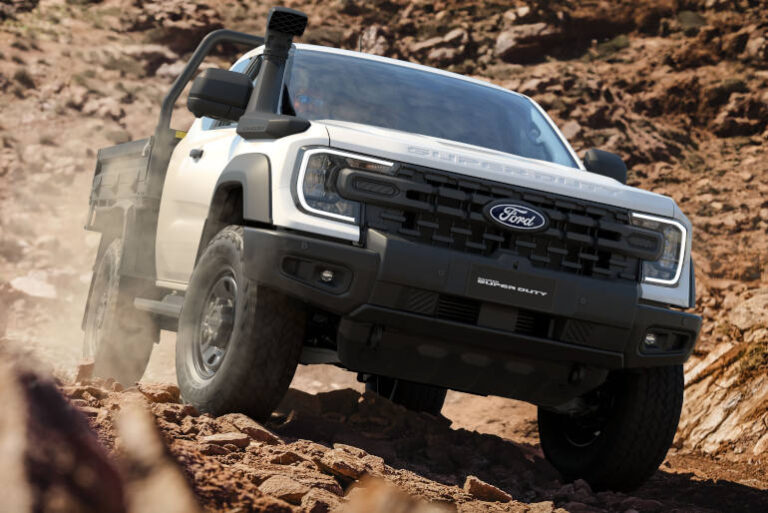
The end of the year is usually a good time to pause, look back, and quietly reassess a few long-held assumptions. In fleet, one of those assumptions is that badges are mostly marketing.
“Super Duty” might sound like one of those labels — bold, confident, and easy to slap on a tougher-looking vehicle. But as Ford’s Ranger Super Duty story shows, this badge wasn’t handed out lightly. In fact, inside Ford, it had to be earned.
And for fleets, that distinction matters more than you might think.
So, with a coffee in hand and a quieter inbox (hopefully), here’s the holiday-read version of why Ford took the Super Duty name seriously — and what that means for fleet buyers.
A Name That Comes With Rules
Within Ford, “Super Duty” isn’t just a trim level. It’s a designation reserved for vehicles that meet strict internal standards around durability, sustained load and real-world work.
Steve Crosby, Director of Product Development at Ford IMG, made that clear at the launch.
“Super Duty is an iconic name in the Ford world,” Crosby said. “You don’t just get it — you have to earn it.”
That mindset immediately separates Ranger Super Duty from the usual “tougher than before” updates fleets see every model cycle. This wasn’t about cosmetic changes or incremental gains. It was about proving the vehicle could handle a fundamentally different workload.
For Fleet Managers, that’s an important signal. It suggests the engineering brief started with capability and repeatability, not marketing differentiation.
The Badge Came After the Engineering
One of the more interesting revelations from the launch presentation was that the Super Duty name didn’t lead the project — it followed it.
Andrew Birkic, President and CEO of Ford Australia, explained that the program began with customer frustration, not branding ambition.
“The genesis of the story is sitting with a fleet customer and talking about what was frustrating them,” Birkic said. “What inhibited productivity, what drove cost into the system, and what drove waste.”
Only once Ford understood those pain points did the engineering work begin. And only once the engineering targets were met did the conversation turn to what the vehicle should be called.
For fleets used to adapting vehicles after purchase, this reversal is significant. It means the badge reflects the capability — not the other way around.
What Fleets Actually Needed (And Why It Changed the Vehicle)
Fleet customers didn’t ask Ford for a tougher-looking ute. They asked for something more practical — a vehicle that could survive daily use at or near its limits without constant compromise.
Justin Capicchiano, Chief Program Engineer for Ranger Super Duty, described how that feedback reshaped the program.
“We realised pretty quickly this wasn’t about peak numbers,” Capicchiano said.
“It was about what the vehicle could do every day, repeatedly, without falling over.”
That thinking drove decisions that fleets will appreciate, even if they never see them directly:
- A heavily reworked structure
- Components designed for sustained load, not occasional use
- Systems validated as a complete package rather than upgraded piece by piece
This is where the Super Duty badge starts to matter — it signals a vehicle designed to live its entire life in the hard lane.
Why ‘Super Duty’ Means Less Downtime
Another theme that runs through the launch discussion is downtime — or more accurately, how to avoid it.
Jeremy Welch, Conversion Development Manager at Ford IMG, acknowledged that fleets often accept downtime as inevitable. But the feedback Ford received challenged that assumption.
“If you’ve got sensors and systems that stop people backing into things, that means the vehicle stays on the road working,” Welch said. “And that’s what fleets want.”
This thinking reframes capability. It’s not just about towing more or carrying more. It’s about reducing the small, everyday incidents that quietly eat into fleet availability.
In that context, the Super Duty badge isn’t about brute force. It’s about operational resilience.
Factory Engineering vs ‘Making It Work’
For years, many fleets have relied on aftermarket upgrades to get the capability they need. It works — but it comes with trade-offs.
Capicchiano was candid about what Ford observed when running vehicles with aftermarket solutions.
“There were always compromises,” he said. “Ride quality, safety system integration, handling when laden — you were giving something up somewhere.”
Ford’s decision to engineer capability into the vehicle from the factory was a deliberate attempt to remove those compromises.
From a fleet perspective, that means:
- Clear warranty coverage
- Simplified compliance
- Less time lost coordinating multiple suppliers
Andrew Birkic described the operational impact of the old approach.
“Quite often these vehicles require multiple fit-outs,” he said. “Supplier A, then B, then C — and it can take four to six months.”
A factory Super Duty solution shortens that timeline — and gets vehicles earning sooner.
Payload, Compliance and Why the Badge Carries Weight
One of the more understated but important aspects of the Ranger Super Duty is how Ford approached payload — not as a marketing number, but as a compliance and safety issue.
Jeremy Welch explained the risk fleets face when things go wrong.
“If one vehicle is found overloaded, the whole fleet can get grounded,” he said.
“That’s a massive issue.”
This is where the Super Duty badge becomes more than symbolic. It represents a vehicle designed to manage weight properly, with systems that help drivers and supervisors understand what’s happening in the real world.
Andrew Birkic summed it up neatly.
“Now there’s science behind it,” he said. “That peace of mind is important for OH&S.”
Why This Matters to Fleet Buyers
At first glance, the Super Duty badge might look like just another label. But for fleets, it signals something deeper:
- The vehicle has been engineered for sustained heavy use
- Capability has been validated as a system, not patched together
- Fleet feedback shaped the final product
- Risk, uptime and compliance were prioritised over headline specs
As Steve Crosby put it:
“When you understand why each decision was made, it’s really purposeful,” he said.
A Quiet Lesson Heading Into the New Year
As the year wraps up, the Ranger Super Duty story offers a quiet lesson for the fleet industry.
Badges don’t matter — unless they’re earned.
Specs don’t matter — unless they work every day.
And vehicles don’t become fleet-ready by accident.
Ford didn’t just name this ute Super Duty. They worked backwards from fleet reality until the badge made sense.
For Fleet Managers planning 2026 replacements, that might be worth reflecting on — preferably somewhere quiet, away from the phone, before the inbox fills up again.