
There are moments in this job when you realise how lucky you are. Being part of the small group of local journalists invited to preview the new Toyota HiLux design and take an exclusive first drive before the global premiere was one of those moments.
Toyota doesn’t often give the Australian media early access like that, but this was different. The Australian design team — based at Toyota Design Australia in Altona — had led the exterior design for the first time in HiLux history. The new look was literally born here, and the team wanted local journalists to see it before anyone else.
As a fleet journalist, I was also listening for the big news about what’s coming next. When they told us a BEV HiLux would be launching in 2026, that was my highlight. Finally, confirmation that Toyota’s most important model for fleets is going electric.
But then they pulled the cover off the clay model, and my attention went straight to the grille.
My First Thought: “Is This the BEV?”
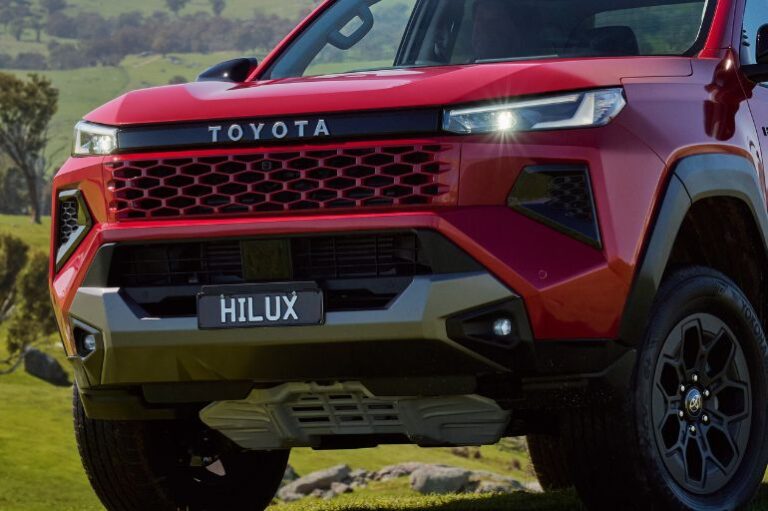
The first time I saw the new HiLux face, my immediate thought was that they’d mixed up the models. The grille looked so clean, so closed, so EV-like that I genuinely thought I was looking at the battery-electric version.
The surface treatment is smooth and minimal, with a compact mesh opening that barely looks like it’s designed for airflow. The outer frame is body-coloured, the mesh pattern is restrained, and the overall effect is aerodynamic and contemporary — the sort of design language we associate with vehicles that don’t need to breathe.
I remember thinking, “Okay, they’ve left some gaps — maybe to keep traditional buyers happy.” It was only when I saw the actual BEV grille later that the penny dropped. That one is completely sealed, as you’d expect.
So, if the BEV version is closed off, what we’re seeing on the diesel HiLux is clearly a preview of Toyota’s design future — a transition point between the tough, functional face we all know and the smoother, efficiency-driven shapes that define electric vehicles.
A Softer Face for a Broader Audience
The new grille is a clear break from the macho, industrial look of past models. It’s more sculpted, more technical, and, dare I say, a little softer. The HiLux has always worn its capability on its face — broad grilles, thick bars, and open vents that signalled strength and purpose.
This new one? It’s more considered, more urbane. You can tell Toyota wanted it to appeal to a wider audience — the latte-sipping lifestyle set who buy a HiLux Rogue because it looks good in the driveway, not because they’re planning to drive it up a fire trail.
And I don’t mean that as criticism. The ute market has changed. The HiLux now serves tradies, families, adventurers, and executives all at once. The grille is simply reflecting that reality — it’s a nod to both worlds.
But I can’t help thinking the new face is also a quiet nod to what’s coming. Maybe it’s a design bridge — easing buyers from the air-hungry diesel era into the cleaner, sleeker shapes of BEV and FCEV HiLux models of the future.
Designed in Australia, with Global Intent
When I spoke with members of the Australian design team, they told a fascinating story about how the new HiLux face was conceived. The design theme, codenamed “Cyber Sumo,” aimed to combine strength with balance — that poised moment before a sumo wrestler engages.
That theme flows through every surface: the squared-off wheel arches, the forward stance, and, yes, the grille. It’s muscular without being brutish. Toyota Design Australia was tasked with modernising the HiLux without losing its toughness — not an easy brief when you’re designing for a global audience that includes everyone from outback contractors to inner-city tradies.
And in that sense, the grille makes perfect sense. It’s not timid; it’s measured. It’s a HiLux that’s ready for the next generation of propulsion — whether that’s hybrid, BEV, or hydrogen fuel-cell.
Will the Aftermarket Approve?
Of course, there’s one test that will reveal whether Toyota’s new direction hits the mark — the aftermarket industry.
If bullbar and accessory manufacturers rush to release tougher, bolder front-end kits, then maybe Toyota has gone a little too refined. But if the market embraces the new design and works around it, that will prove Toyota’s instincts were right — that strength today looks different to strength ten years ago.
Personally, I’m on the fence. I admire the design for its sophistication, but a small part of me misses the unapologetic toughness of the old face. Maybe that’s just nostalgia — or maybe I’m old enough to still equate a big open grille with a serious off-roader.
A New Face for a New Era
What’s certain is that this new grille represents a turning point. It’s a visual signal that the HiLux — and Toyota — are moving into the electrified era. The design doesn’t just serve airflow; it serves identity.
If the goal was to create a HiLux that looks ready for the future without alienating the present, Toyota’s Australian team has nailed it. The new face may be smoother, but it still carries intent.
And who knows? If the aftermarket starts adding bars, mesh and auxiliary lighting to make it look meaner, I’ll know I was right to call it soft.
If not — maybe I’ve just lost touch with what “tough” looks like in 2025. Either way, the HiLux grille has done what good design should do: it’s made me think.