

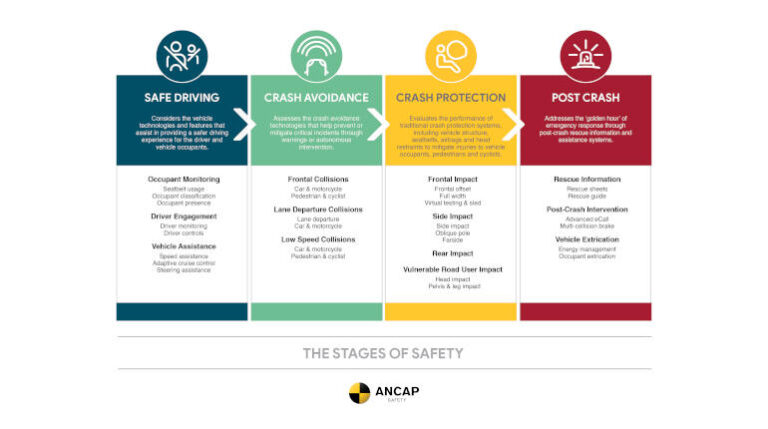
ANCAP has confirmed a major shift in vehicle safety assessments from 2026, with a new “Stages of Safety” framework that evaluates how vehicles perform before, during, and after a crash. For fleets, it represents one of the most significant updates to safety ratings in a decade—and it expands the way safety performance will be measured across passenger vehicles, utes, vans and SUVs.
The changes arrive at a critical time, with 1,592 Australians and New Zealanders losing their lives in vehicle-related crashes last year, a figure ANCAP describes as “a bleak reminder of the need… to keep pushing for improved outcomes.”
A more complete view of safety
From 2026, ANCAP will assess vehicles based on four updated categories:
- Safe Driving – technologies that support drivers behind the wheel
- Crash Avoidance – systems that prevent or mitigate incidents
- Crash Protection – structural and restraint performance
- Post-Crash – features that support rapid and effective emergency response
Each will carry a score out of 100 with percentage results shown in addition to traditional star ratings. Minimum thresholds will remain in place.
ANCAP Chief Executive Carla Hoorweg said the shift follows extensive feedback:
“You’ve spoken and we have listened. The Stages of Safety approach will allow ANCAP to incorporate useful feedback, enhance existing tests and incorporate new areas of focus.”
She added that the new structure “can adapt to the technological developments that will shape the automated driving future.”
Key changes fleets should note
1. Driver-assistance systems judged on smoothness—not just capability
Fleet drivers regularly complain about abrupt lane-keeping and other ADAS interventions. ANCAP will now reward systems that operate “smooth, intuitive” features, not just technical performance.
This will help Fleet Managers differentiate between brands with driver-friendly calibration and those with intrusive systems that contribute to driver fatigue.
2. Crash-relevant design details to be scrutinised
Electric vehicles with flush door handles must remain operable after a crash. High-voltage batteries must automatically isolate after severe impacts. The vehicle must also be able to notify first responders.
These changes reflect the rapid shift toward electrification across Australian and New Zealand fleets.
3. Real-world testing to complement controlled crash tests
ANCAP will introduce broader on-road testing, examining how vehicles interpret actual road conditions. This will give fleets a clearer picture of how safety systems perform outside ideal test-track scenarios.
4. Post-crash capability becomes a major score area
Post-crash response is often overlooked in procurement decisions. ANCAP’s new protocols elevate its importance, particularly through a stronger focus on emergency call systems.
More than 40% of new vehicles sold in Australia in 2024 already include eCall capability—but fewer than 10% in New Zealand.
Hoorweg said:
“Our updated protocols set a clear benchmark for emergency call systems fitted in vehicles. We want to encourage manufacturers to enhance existing systems and provide an incentive for all brands to fit this life-saving technology.”
For local government, utilities and essential services fleets—where vehicles often operate alone or in rural conditions—this change will be significant.
Why this matters for fleets
Fleet Managers rely on ANCAP ratings for procurement, WHS compliance and risk assessments. The expanded focus on post-crash performance, intuitive driver assistance and EV-specific safety features aligns closely with operational fleet priorities:
- Duty of care obligations increasingly extend beyond crash protection.
- Insurance partners often expect evidence of modern safety systems.
- EV transition strategies require reassurance about battery isolation, rescue information and first responder compatibility.
- Mixed-use fleets (solo driving, remote areas, night operations) benefit from embedded emergency call capability.
The shift also reinforces fleet safety as a lifecycle consideration—not just a purchase-time metric.
A safer future, but more complexity for procurement teams
Hoorweg summarised ANCAP’s role clearly:
“Our role is to continually push for improvements in all areas of vehicle safety… The outcome will be better protection of vehicle occupants and those around them.”
For Fleet Managers, the updated protocols mean:
- procurement frameworks may need updated safety weighting criteria
- policy documents may require revised ANCAP threshold settings
- training programs should include driver-assistance system behaviour
- tender responses will need more detail on post-crash and connectivity features
The new standards aim to ensure fleets are adopting vehicles that protect drivers and the community across the entire incident timeline—from prevention to emergency response.