

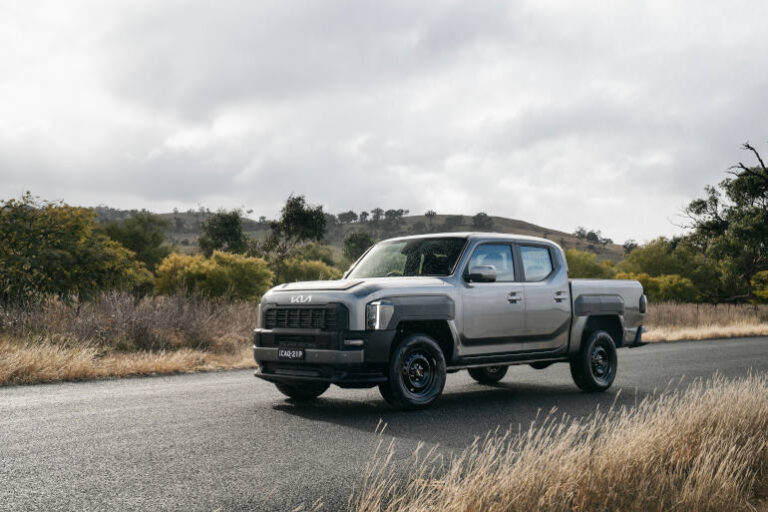
Kia entered the ute market with bold ambitions — 20,000 Tasman sales in its first year. But with early retail uptake falling well short, a bruising public reception, and 4×4 enthusiasts refusing to budge from the Hilux/Ranger duopoly, the real challenge is only beginning. And for fleet buyers, who value fit-for-purpose decision-making and predictable whole-of-life cost outcomes, the Tasman’s road to acceptance is even steeper.
This isn’t an issue of capability. It’s an issue of reputation — and reputation takes years, not months, to build.
Retail Misses Set the Tone for Fleet Hesitation
One thing painfully clear: Kia brought mainstream media and key influencers into its development journey expecting buy-in. Instead, they “piled on,” labelling the Tasman “ugly” and dismissing its design before a single fleet manager turned a wheel.
In a ute market driven as much by emotion as engineering, first impressions matter. Retail buyers didn’t warm to the styling, 4×4 enthusiasts dismissed it for not looking like a Ranger, and the narrative snowballed. The Tasman was different — and the market wasn’t ready for different.
Fleet buyers watch retail sentiment closely because it shapes the used-vehicle market, driver acceptance, and ultimately whole-of-life costs. A ute that struggles at retail rarely becomes a fleet favourite.
Fleet Managers Are Conservative — And the Tasman Asks Them to Be Brave
Kia now turns its attention to fleets, but this is not an audience known for risk-taking. Fleet buyers traditionally aren’t adventurous. They’re conservative, if anything.
The Tasman has positive attributes: good driveability, space, comfort, and capability. It does everything a ute needs to do.
But capability alone won’t overcome the two biggest barriers:
- Driver influence – Many organisations have drivers who firmly believe a ‘real’ work ute is a Hilux or Ranger. Fleet Managers rarely win popularity contests by forcing drivers into unfamiliar brands.
- Unproven whole-of-life costs – With no resale history and a public narrative around the Tasman’s looks, future demand in the used market is unclear at best.
A Fleet Manager may personally think the Tasman is fit for purpose. But selling that story internally? That’s a battle.
Residual Value: The Tasman’s Biggest Weakness
Here lies the heart of the Tasman problem. Leasing companies and fleet buyers depend on predictable residuals. But there’s no historical data… ‘Who’s going to want to buy a second-hand Tasman… and pay Hilux or Ranger residuals?’
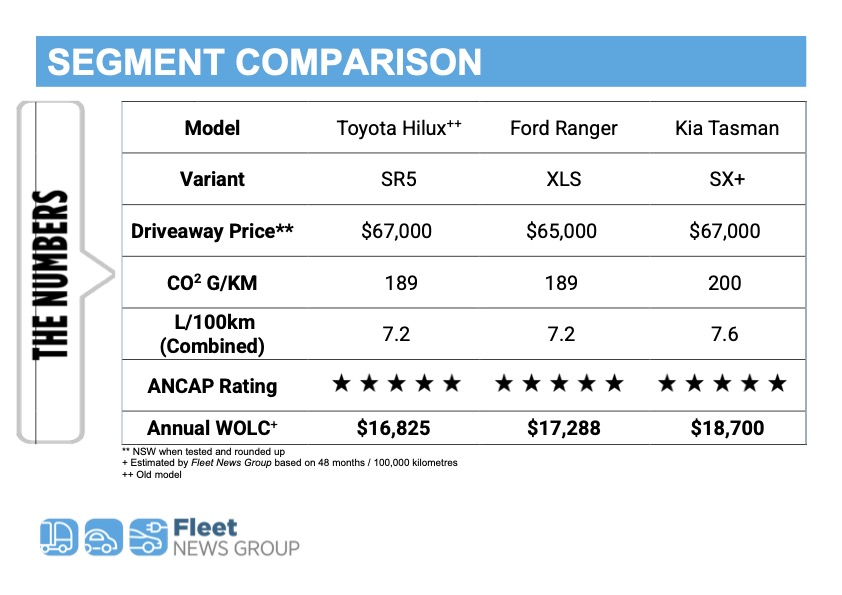
Even a small downward adjustment in forecast resale can wipe out any upfront price advantage. But here, Kia didn’t even launch with a sharp fleet price — they went all in with the most expensive, fully optioned ute on launch. That decision now haunts them.
WOLC modelling is brutal. A 15–20% lower RV compared with Hilux or Ranger destroys whole-of-life cost competitiveness of the Tasman.
And FMOs? They’re even more cautious than fleets. Leasing companies aren’t going to take a punt… Why would they when they can just steer people into a Hilux and consider it money in the bank?
Unless Kia backs the Tasman with guaranteed buy-backs or aggressive fleet RV support, the maths simply won’t work.
A Parallel to EV Uptake — And a Warning
This draws a compelling comparison to EVs in their early years, the Tasman suffers from a lack of data, entrenched customer beliefs, and a conservative finance ecosystem.
Until fleets see actual sales of used Tasmans, positive real-world operating feedback and stable demand in the used market, the Tasman will remain a niche proposition.
The lesson from EVs? Change is possible — but slow, deliberate, and expensive.
Can Kia Turn It Around? Yes — But Not Quickly
Kia has engineering talent. They have marketing resources. They have a ute with real capability. But reputation in the work-ute market isn’t bought; it’s earned through:
- years of reliability data
- thousands of real-world fleet kilometres
- positive used-vehicle market performance
- consistent driver acceptance
Toyota and Ford didn’t build trust overnight. Kia can’t shortcut that process. A sales target of 20,000 units per annum is going to be a challenge, and it’s going to take a while to build a reputation.
Absolutely. Fleet buyers are open-minded — but only when the numbers stack up.
Right now, the Tasman is a vehicle searching for a narrative strong enough to overcome its early public backlash. Until it has proven whole-of-life performance and a stronger retail base, Kia will continue fighting an uphill battle.
And in fleet, uphill battles usually end the same way: buyers stick with what they know.
Final Thought: Hope Isn’t a Strategy
Kia deserves credit for taking a risk and offering the market something genuinely different. But breaking into the ute sector — especially the fleet sector — requires more than bold styling and a confidence-filled launch.
It requires:
- strategic RV support
- transparent lifecycle testing data
- aggressive fleet positioning
- long-term commitment
Kia has started a journey many brands have attempted — and few have won. The Tasman might eventually find its footing. But today, the market has spoken, and fleets are listening.
If Kia wants fleet buyers to choose Tasman over a Hilux or Ranger, it needs to fight harder, support fleets deeper, and rebuild the story from the ground up.
Because right now, the Tasman isn’t just selling a ute — it’s selling trust. And trust is the hardest thing of all to win.