
Whole-of-Life Cost (WOLC) has always been the discipline that separates fleet procurement from private buying decisions. It forces Fleet Managers to look beyond the purchase price and consider fuel, maintenance, utilisation, resale value and risk.
But in 2026, the WOLC conversation has changed. NVES regulations, rising diesel prices, and the introduction of emissions reporting requirements are reshaping how fleets evaluate vehicles — particularly in the medium van segment where predictable duty cycles make electrification practical.
And that’s where the disruption begins.
The WOLC Reality Check: Farizon vs HiAce vs Transit Custom
The numbers tell a very clear story.
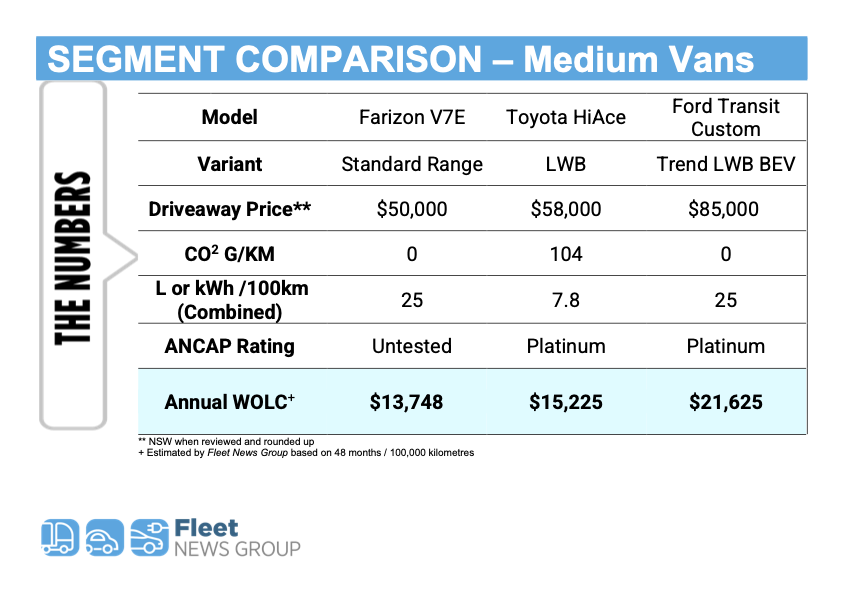
Based on a typical fleet lifecycle of 48 months and 100,000 kilometres, the new electric entrant — the Farizon V7E — delivers the lowest annual WOLC in the segment, comfortably ahead of the long-standing segment leader and well clear of the premium-priced electric alternative.
Medium Van WOLC Comparison (48 months / 100,000km)
- Farizon V7E: $13,748 per year
- Toyota HiAce: $15,225 per year
- Ford Transit Custom BEV: $21,625 per year
These figures are drawn from Fleet News Group modelling of the medium van segment and reflect typical operating assumptions for Australian fleets.
The difference is not marginal — it’s structural. The Farizon wins the WOLC comparison primarily because of two factors:
- A significantly lower purchase price
- Zero fuel costs in day-to-day operations
Together, those two inputs overwhelm the traditional advantages of brand strength and resale performance.
Toyota HiAce: The Benchmark That Set the Standard
The Toyota HiAce remains the default choice for many fleets — and for good reason. It has earned its reputation through decades of consistent performance in demanding fleet applications. Reliability is proven, maintenance costs are predictable, and resale values are among the most stable in the commercial vehicle market.
For Fleet Managers, that predictability has always been valuable. In many organisations, the HiAce is not just a vehicle — it’s a risk management strategy. But the operating environment has changed.
In 2026, the question is no longer simply: “Will it be reliable?”
It’s now: “Will it meet emissions targets and operating cost expectations over the next five years?”
That shift is opening the door to new competitors — particularly in fleets with:
- Urban or metropolitan duty cycles
- Predictable daily kilometres
- Centralised depots
- Corporate emissions targets
Ford Transit Custom BEV: Premium Technology, Premium Price
The Ford Transit Custom BEV represents the traditional OEM response to electrification — high specification, strong brand recognition, and a price that reflects both.
At around $85,000 drive-away, it delivers capability and credibility. But it struggles to compete on WOLC.
Most fleets won’t be paying the full sticker price — but they also won’t be acquiring it for anything close to the $50,000 price point of the Farizon.
That gap matters. Because in fleet procurement, the purchase price is not just a cost — it’s a risk multiplier.
Higher capital cost increases:
- Financing exposure
- Residual risk
- Budget pressure
- Business case scrutiny
And those pressures show up clearly in the WOLC calculation.
The Resale Question: Managing Risk in a New Market
Resale value remains one of the most sensitive assumptions in any WOLC model. In this comparison, the resale estimates for both electric vans are deliberately conservative — and that’s appropriate. There are two reasons.
1. Limited brand history – The Farizon is a new entrant with no established resale performance in Australia.
2. Limited EV resale data – While the EV market is growing rapidly, long-term resale trends for commercial electric vans are still emerging.
The same logic applies to the Ford Transit Custom BEV. Even with a well-known badge, the resale forecast remains cautious because the technology is still relatively new in this segment. That conservative approach reflects good fleet governance — not pessimism.

Why WOLC Matters More Than Ever in 2026
WOLC has always been important for Fleet Managers. But it becomes critical when preparing a business case for electrification. That’s because EV adoption decisions are rarely operational — they’re strategic.
They involve:
- Finance teams
- Sustainability teams
- Executive leadership
- Risk and compliance stakeholders
And increasingly, they are being driven by external forces:
- NVES compliance pressure on manufacturers
- Rising diesel pump prices
- Corporate emissions reporting requirements
- ESG and sustainability commitments
In that environment, WOLC becomes the language of decision-making. Not ideology. Not technology. Not brand loyalty. Just numbers.
The Bigger Shift: Vans vs Utes
This comparison also highlights a broader transition underway across fleet operations. For decades, the dual-cab ute has dominated Australian fleets — often selected as a default solution rather than a fit-for-purpose asset.
But the economics are changing. In many applications where:
- Four-wheel drive is not required
- Off-road capability is unnecessary
- Passenger carrying is minimal
A van delivers:
- Lower operating costs
- Lower emissions
- Better cargo security
- Higher utilisation efficiency
Electrification is accelerating that shift. And WOLC is making the decision easier.
The Bottom Line for Fleet Managers
The Toyota HiAce remains the benchmark. It is reliable, predictable and well understood. But the arrival of a sub-$50,000 electric van changes the economics of the segment.
The Ford Transit Custom BEV demonstrates what premium electric capability looks like — but at a price point that limits its competitiveness in cost-focused fleet environments.
The Farizon V7E introduces something different. Not just a new vehicle. A new pricing model. And potentially, a new WOLC benchmark.
For Fleet Managers building a business case to reduce emissions, manage operating costs, and comply with emerging reporting requirements, the message is straightforward:
The lowest risk decision is no longer always the safest one.
- From the Workshop to the World Stage
 mycar Tyre & Auto apprentice Edie Thurtell’s rise to Australia’s WorldSkills team highlights the importance of investing in the technicians who will keep the country’s fleets moving. The 21-year-old earned her place at WorldSkills Shanghai 2026 after winning gold at the 2025 National Competition, representing New South Wales and mycar. She followed that achievement with
 - One fleet, many applications: why tyre management can’t be one-size-fits-allFrom passenger cars and utes to buses, trucks and waste vehicles, fleet applications can vary dramatically. Bridgestone Australia says the starting point for effective tyre management is understanding what each vehicle is being asked to do. There is no such thing as a single fleet application – and Bridgestone Australia says there should not be
- Why Fleet Managers Need Real-Time Visibility of Vehicle ServicingKeeping vehicles serviced on time sounds like one of the most basic fleet management tasks. In practice, maintaining visibility across a large fleet can be much more difficult. Vehicles may be approaching a service interval, drivers may already have made bookings, workshops may have completed work, and fleet managers can still be left trying to
- Why Bridgestone says the real cost of a tyre isn’t the tyreFor mature fleet operations, tyre management is no longer just a question of purchase price or kilometres travelled. Bridgestone Australia says the bigger opportunity is to reduce downtime, improve utilisation and manage the true cost of keeping vehicles on the road. Fleet managers have spent years shifting procurement conversations away from purchase price and towards
- More Payload, Less Red Tape for HiLux FleetsFleet operators looking to increase Toyota HiLux payload capacity without adding unnecessary compliance costs are being encouraged to consider GVM upgrades that keep vehicles within the 3500kg NA category. Pedders says selecting the highest available payload upgrade is not always the most cost-effective answer, with fleet operators needing to balance legal compliance, operational efficiency and