
With a goal of retaining a top-three position in total cost of ownership (TCO) rankings, Mitsubishi Motors Australia Limited (MMAL) has developed a white-label telematics data solution to provide fleet operators with precise driver behaviour insights. While MMAL currently offers a dongle-based solution, our long term goal is to provide fleet operators with precise driver behaviour insights via an API.
Positioning the advanced telematics system explicitly as a level operators can pull to reduce their TCO by curbing wasteful driving habits, like aggressive throttle, braking and steering inputs, MMAL says it recognised a need to meet demand from Australian fleets for much more data.
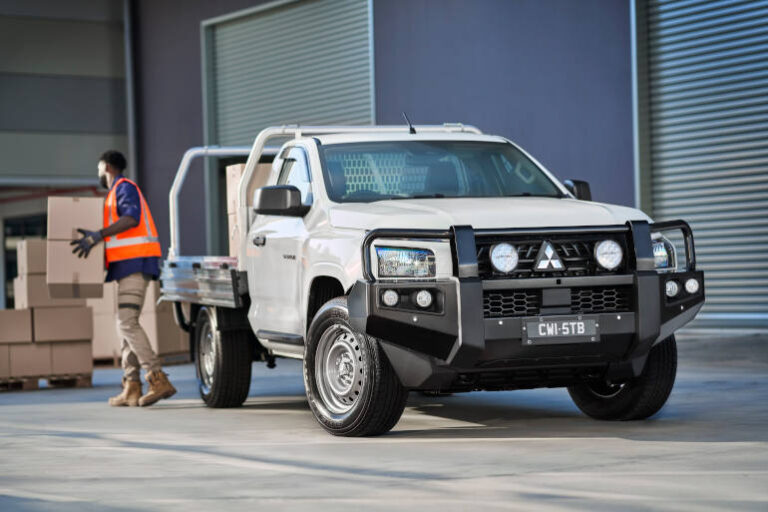
Should a customer opt in, the integrated telematics system can pull data from the current-generation Mitsubishi Triton ute and the facelifted Outlander midsize SUV, with more models to follow.
The system allows API integration with existing fleet management solutions software, while Mitsubishi itself also markets an online dashboard product called Fleet iQ, which provides Fleet Managers with insights presented on online dashboards including:
- Instant GPS location
- Driver and vehicle metrics
- Historical trip data for fleet utilisation
- Custom maintenance calendars based on actual vehicle usage
- Detailed reports on driving behaviour for wear and tear
- Automated FBT reporting
Almost Half of Australia’s Fleet Operators Rely on Telematics
In an interview conducted exclusively with Fleet News Group, MMAL deputy director of fleet management Fulvio Fattore said nearly half of Australia’s fleet vehicle operators were now relying on data-driven insights.
“Australia has been slow to catch up to the rest of the world in terms of general telematics use. We’re now at a stage where almost 45 percent of fleets are using telematics devices in order to maximise a number of aspects, including TCO,” Mr Fattore said.
“TCO has always been at the fore of fleet management, because [operators] spend millions per year on managing a fundamental asset. One of the best ways to do that is by introducing data.
“Telematics in terms of fleet has been a significant driver to fleets making better decisions.”
“Are you cornering too hard? Are you braking too hard? Why? That has a significant bearing on TCO, which has been a key foundation which we have built our strategy upon. We have historically had a portfolio that sat within the top three TCO-led frameworks,” said Mr Fattore.
While raw data from vehicle systems has been available for many years via hard-wiring at first, and then OBD2 dongles more recently, there are significant benefits to connected and online telematics systems that are fully integrated from the factory, including:
- It is not possible for individual drivers to deactivate the systems
- Factory fitment means delivery delays can be avoided
- Additional devices do not need to be purchased and fitted
Fleet Managers take note
Considerable TCO savings are there for the taking for fleets if the way vehicles are used is taken into account.
Telematics Software and Dashboards Make Raw Data Actionable
A missing link that is corrected by third parties (which can access the Mitsubishi telematics data, should an operator choose), or the MMAL Fleet iQ software suite, is the interpretation of thousands of lines of raw data transmitted from the vehicle while it is being driven.
The corresponding fleet management software suites convert the raw data into actionable insights—typically programs that can help drivers change their habits away from high fuel consumption and aggressive braking/cornering that increases wear on consumables and thereby TCO.
“It is also about understanding I might be a leadfoot. It is about educating me as a driver to make sure that I understand the ramifications of that and that I adapt my behavioural inputs,” explained Mr Fattore.
Beyond merely aggressive driving, more mundane habits (like long idle times, speed limit compliance or excessive cold-temp acceleration) can also be seen in a system of scorecards.
Beyond telematics data and corresponding safety suites is the role of artificial intelligence (AI), which is being adapted into some fleet management software suites to not only assess past behaviour, but predict future driving behaviour and maintenance outcomes.
“We are starting to see some trends across the fleet industry with leading FMOs intervening with AI, and the fact they can understand what preventative maintenance is required to prevent VOR. The introduction of AI is going to continually shape the fleet arena,” said Mr Fattore.
AI may be able to provide heatmaps for fleet managers of riskier days, times and routes based on driver and real-time traffic data or predict component failure based on an order of system fault codes.
Advice to fleets
Operators should make clear what objectives they are seeking from their use of telematics data and any insights derived from them, including by AI.
Final Word for Fleets: Investing in Data Can Save Money
The benefits of data-driven insights for understanding vehicle TCO scale with the size of a vehicle fleet, in which factors like variation between drivers can reduce the useful life of a vehicle and its components.
While individual drivers may feel a natural degree of suspicion about their habits being tracked by Fleet Managers, operators can engage in mutual conversations about what the objectives behind safe and efficient driving styles.
- HERE and Octave Target Faster Fleet Response
 HERE Technologies has partnered with Octave to improve incident response across Australia, integrating its mapping and location services into Octave’s OnCall Dispatch platform. The partnership aims to help dispatchers locate incidents, identify available service vehicles and coordinate assistance using more current road network and traffic information. For fleet managers supporting incident response operations, the integration
 - Connected vehicles put data security on the fleet agendaThe recent Four Corners program examining connected vehicle security may have been eye-opening for many motorists, but for Fleet Managers it should reinforce an issue that has been developing for years: a modern vehicle is increasingly a connected device as well as a transport asset. Connectivity is becoming standard across the automotive industry. Vehicles can communicate
- Why Euclidic believes fleet telematics shouldn’t be self-serviceFleet telematics platforms have become more capable, but Euclidic Systems believes giving fleet teams more technology does not automatically give them better fleet management. The company’s view is that telematics should not be treated as a self-service software purchase where customers are left to configure the system, interpret the data and maintain the internal knowledge
- Before buying more fleet technology, define the problem you’re trying to solveFleet managers considering their next technology investment should start with the business problem rather than the product, according to Summit Fleet Leasing and Management Managing Director Darren Gore. Speaking on the Fleet News Group podcast about technology and fleet management excellence, Gore was asked what good use of fleet technology looks like. His starting point
- Bigger trucks, older bridges and new drivers are reshaping bridge strike riskAustralia’s bridge strike problem is not simply a question of drivers failing to read a clearance sign. The combination of growing freight volumes, pressure for more productive heavy vehicles, an ageing road network and a changing driver workforce is making the issue more complex for fleet operators. That was one of the themes to emerge