

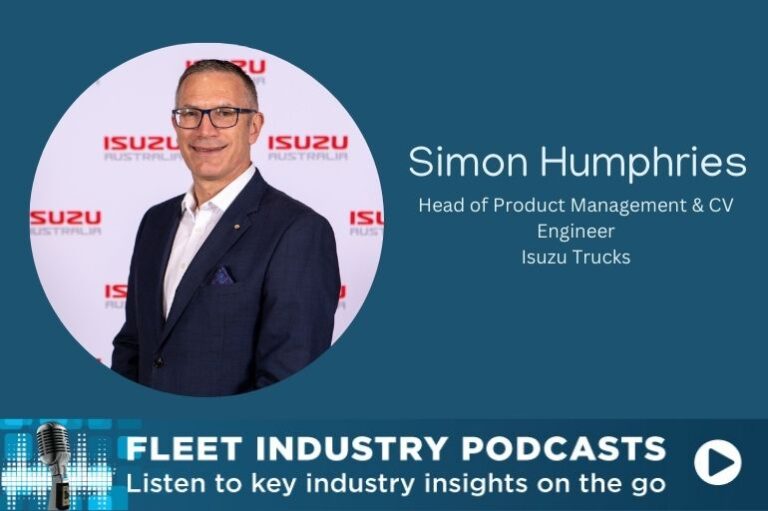
For the first time in almost two decades, Isuzu Trucks Australia has launched an all-new range—from the light-duty N Series to the heavy-duty FY Series. And according to Simon Humphries, Head of Product Management and Chief Engineer, it’s the most significant update the company has delivered since 2007.
In the latest episode of the Fleet News Group Podcast, Simon shared detailed insights into the new range, the engineering effort behind it, and the timing that aligns perfectly with three major changes in Australian Design Rules (ADRs) coming into effect in 2025.
“The experience of driving these trucks is what will sell it to you,” said Humphries. “It’s quite a revelation compared to any truck that you’re driving now.”
A Rare Full-Range Refresh
While car manufacturers typically refresh models every four to eight years, truck updates are much more spaced out. For Isuzu, the last full-range model change was introduced in 2007 and rolled out locally in 2008. Since then, there have been regular updates, but nothing of this scale.
“This is a complete renewal across the entire range,” said Humphries. “The last time we did something this comprehensive, I was also working at Isuzu—it’s exciting and exhausting all at once.”
Isuzu’s long-standing success in the market—36 consecutive years as Australia’s top-selling truck brand—hasn’t come from frequent facelifts but from deep knowledge of the Australian market and strong support from Japan.
Local Insight Built Into Global Products
One of Isuzu’s not-so-secret weapons is its tight feedback loop between local operations and Japanese engineers. Key R&D staff from Japan rotate through Australia, spending up to four years embedded in Isuzu Australia Limited (IAL) teams.
“Each of the chief engineers for light, medium, and heavy-duty trucks in Japan has spent time working in Australia,” explained Humphries. “They understand what our market needs, and that gets built into the product at a very early stage.”
And while the trucks are global platforms, higher GVM models are tailored more specifically for Australian conditions. From chassis specs to component integration, Isuzu ensures its trucks work in the real-world environments that local customers operate in.
Designed Around ADR Changes
The 2025 model launch comes at a time when three ADRs are reshaping the commercial vehicle landscape. These include mandatory requirements for:
- Electronic Stability Control (ESC)
- Advanced Emergency Braking (AEB)
- Euro VI (ADR 80/04) Emissions Compliance
“The timing for our market being 2025 is driven by those changes,” said Humphries. “But we were fortunate that the new models from Japan became available at the same time. These are not features you can just tack on to an old platform.”
Meeting the ADR changes required a complete redesign of electronic architecture. The new trucks feature up to 12 separate CAN networks and support for advanced driver assistance systems (ADAS) like adaptive cruise control and stereo camera-based collision avoidance—technologies also seen in the D-MAX and MU-X.
From the D-MAX to the N Series: A Family Look
If the new Isuzu truck face looks familiar, that’s because it is. A deliberate design decision has brought a unified brand identity across commercial and passenger vehicles.
“The design centre in Japan made a conscious effort to align the styling,” said Humphries. “You can see the family resemblance in the grille, headlights, and even the badge orientation.”
But it’s not just about looks. The stereo camera in the new N Series is a close cousin of the system used in the D-MAX, bringing car-level safety features like lane departure warning, forward collision warning, and pedestrian detection into the truck world.
A Leap Forward in Drivability
One of the standout features of the new N Series is a completely new powertrain combination. The previous 5.2-litre engine has been replaced with a more efficient, more powerful 3.0-litre diesel, matched to a new nine-speed dual-clutch transmission with a torque converter.
“The shift quality is a game changer,” said Humphries. “It’s smooth, fast, and feels more like driving a car than a truck.”
Podcast host Marc Sibbald confirmed the difference was noticeable behind the wheel. “The responsiveness surprised me,” he said. “Once I used the adaptive cruise control and the stop-go function, it was easy to drive assertively. It just worked.”
Supporting the Technology Shift
With more electronics, more safety tech, and new drivetrains, Isuzu has invested heavily in after-sales support and customer care. That includes a six-year standard warranty, six years of roadside assist, and service care programs that offer fixed-price maintenance.
“There’s a complete shift in the skill set required in workshops now,” said Humphries. “Technicians need to be part mechanic, part IT specialist. But our dealer network is ready. We’ve got over 70 service sites nationwide and some of the best people in the business.”
Isuzu has also introduced service packages that allow customers to smooth out monthly running costs, helping fleet operators and small businesses alike with budget certainty.
The Message to Fleet Buyers
With Australia facing a driver shortage and increasing pressure to improve safety and compliance, Humphries believes the 2025 range delivers everything today’s operators are asking for—without compromising on performance.
“If you’re stepping up from a ute into a light-duty truck, you don’t need to give up on creature comforts anymore,” said Humphries. “The new models have it all—comfort, safety, and real drivability.”
And for those looking to test the trucks for themselves?
“Don’t just read the spec sheet. Drive it. That’s when you’ll really understand what’s changed.”
Listen to the full interview with Simon Humphries on the Fleet News Group Podcast, now available on Spotify, Apple Podcasts, and YouTube.




