
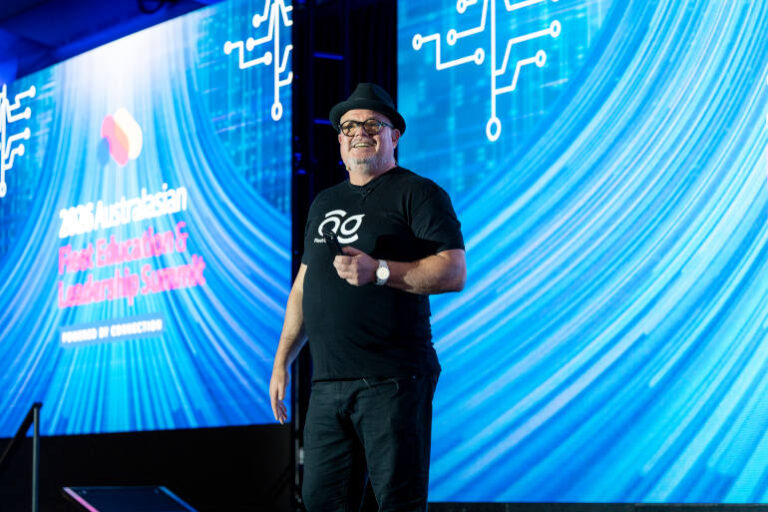
When Eden Shirley, Co-Founder and Managing Director of FleetGuru.ai, took to the stage last year at the 2025 AfMA Fleet Summit, he challenged the audience to think differently about fleet maintenance.
At the time, many fleet professionals were still trying to understand how artificial intelligence might fit into their organisations. Shirley’s presentation demonstrated the scale of data available through the AutoGuru and FleetGuru platforms and painted a picture of a future where AI could help fleet managers make better maintenance decisions.
Twelve months later, he returned to the AfMA stage and took that vision one step further. Rather than talking about AI, Shirley demonstrated it live.
The 2026 keynote featured “MIC”, an AI maintenance specialist developed using the vast maintenance and repair datasets accumulated through the AutoGuru and FleetGuru platforms. In front of a live audience, MIC analysed repair quotes, identified pricing anomalies, highlighted overdue servicing, scheduled bookings, communicated with service providers, and even handled conversations across multiple languages.
For an industry that has historically been cautious about adopting new technology, the demonstration provided a glimpse into how quickly AI is changing the way fleets may be managed in the future.
From Data to Decisions
The foundation for MIC is significant.
According to the live demonstration, the AI has been trained on more than 15 years of maintenance and repair activity, including 3.4 million transactions, $1.2 billion in servicing and repair work, billions of parts-price changes, and hundreds of thousands of labour-rate movements.
During the keynote, MIC explained how it could analyse quotes against peer benchmarks, identify unusual pricing patterns, review maintenance histories, and assist fleet controllers with approval decisions.
Rather than replacing people, the technology was presented as a digital co-worker capable of handling repetitive analysis while escalating exceptions to human decision-makers.
The message resonated with an audience facing increasing pressure to manage costs, improve vehicle uptime, and deal with growing fleet complexity.
Breaking Down Traditional Barriers
Perhaps the most powerful moment of the presentation came when Shirley demonstrated AI’s ability to remove two long-standing barriers in fleet management: geography and language.
Using a live interaction in Japanese with the help of Kota Tsuda, the newly appointed General Manager of FleetGuru.ai in Japan, MIC translated the conversation in real time, captured vehicle and repair information, and converted the discussion into structured maintenance data.
The demonstration highlighted a reality that many fleet organisations are only beginning to appreciate.
Historically, managing maintenance across regions, countries, languages and supplier networks has required significant administrative effort. AI is rapidly reducing that complexity.
What once required multiple people, specialist language skills, and considerable manual data entry can now be completed through automated conversations that generate usable fleet data instantly.
For multinational fleets and service networks, the implications are significant.
The Evolution of FleetGuru.ai
The keynote also marked an important milestone for the company itself.
What many fleet professionals previously knew as AutoGuru’s fleet platform officially evolved into FleetGuru.ai, reflecting the growing role artificial intelligence now plays in the company’s strategy.
The rebrand follows rapid growth across Australia and New Zealand, with the platform now supporting hundreds of thousands of vehicles and thousands of service providers.
Speaking at the AfMA Summit awards dinner, Shirley described AI as a force that is accelerating learning, driving efficiency, and enabling businesses to achieve outcomes that were previously impossible.
He positioned FleetGuru.ai as an Australian-developed technology company building globally relevant solutions while remaining focused on the practical challenges faced by fleet operators.
A Glimpse of the Next Decade
The fleet industry has spent decades digitising paper processes, introducing telematics, and improving data collection.
What the audience witnessed at the AfMA Fleet Summit suggests the next phase will be fundamentally different.
Rather than simply collecting information, AI systems are now capable of understanding it, acting on it, and communicating with humans and other systems in ways that were unimaginable only a few years ago.
Whether it was analysing maintenance spend, scheduling services, contacting drivers, or speaking multiple languages, MIC demonstrated that many routine fleet management activities can now be assisted by AI agents.
The technology is not a future concept. It is already here.
For fleet professionals attending the 2026 AfMA Fleet Summit, Shirley’s keynote was more than a technology demonstration. It was a reminder that the pace of change is accelerating and that the organisations willing to embrace AI today may gain a significant advantage tomorrow.
If the reaction from the audience was any indication, the fleet industry may have just seen a preview of how maintenance management will operate over the next decade.