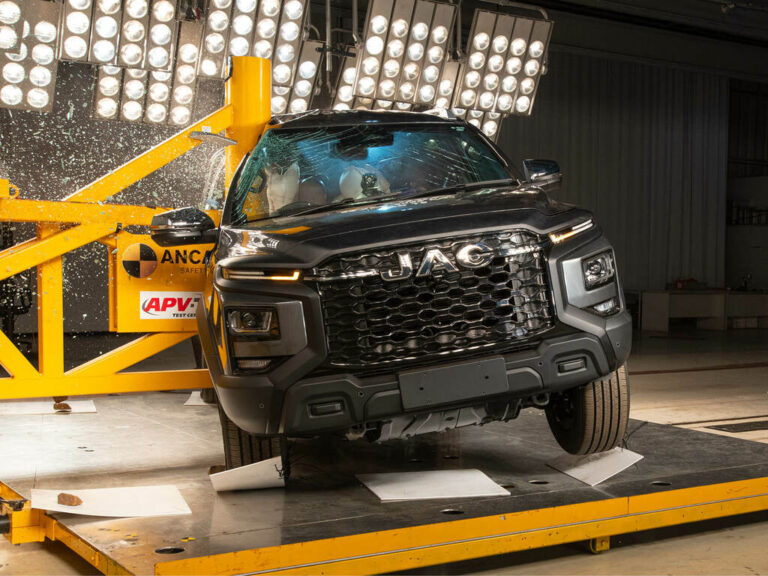
In Australia’s highly competitive dual-cab ute market, a five-star ANCAP safety rating is often enough for fleet buyers to tick the safety box and move on. But the recent five-star ratings for selected Kia Tasman models has sparked deeper scrutiny amongst the automotive media. The controversy surrounding its tested variants has unintentionally highlighted the JAC T9 as possibly the safest ute fleets can buy in 2025.
Same Stars, Different Stories
Both utes scored five stars, but a closer look at their detailed safety performance reveals key differences:
| Category | Kia Tasman (2025) | JAC T9 (2024) |
|---|---|---|
| Adult Occupant Protection | 85% (34.14/40) | 85% (34.29/40) |
| Child Occupant Protection | 85% (41.86/49) | 87% (43.00/49) |
| Vulnerable Road User (VRU) | 74% (46.82/63) | 87% (54.93/63) |
| Safety Assist | 80% (14.42/18) | 89% (16.15/18) |
| ANCAP Protocol Year | 2023–2025 | 2023–2025 |
At face value, the scores suggest the JAC T9 edges out the Kia Tasman across three of the four safety categories, particularly for vulnerable road user protection and active safety technologies.
What Makes the JAC T9 Stand Out?
ANCAP praised the JAC T9 for delivering “strong overall safety performance” with full points awarded in key crash protection tests like side impact, whiplash, and child occupant safety.
Where the JAC T9 especially shines is in active safety systems:
- AEB Backover, Motorcycle, and Cyclist detection performed exceptionally well.
- Full points for Emergency Lane Keeping (ELK) and Junction Assist.
- Minimal safety assist compromises across the board.
The 6.22-point penalty for crash compatibility was a blemish, particularly when compared to the Mitsubishi Triton’s 3.16-point penalty. But overall, the T9’s result confirms that Chinese brands are closing the gap on legacy manufacturers—if not surpassing them in some areas.
Kia’s Safety Win Undone by Confusion?
The Kia Tasman earned its five-star result with commendable performance in most physical crash tests, but not without caveats:
- A pelvic submarining issue in the full width frontal test earned a significant penalty.
- Its VRU score (74%) was noticeably lower than the JAC’s due to the lack of AEB Backover and lower head protection ratings.
Most notably, only the 4×4 S, SX, and SX+ variants are covered by the rating. The more rugged X-Line and X-Pro variants, as well as 4×2 and cab chassis models, remain unrated.
To obvious difference between the models appears to be a specific front bumper bar with a pedestrian-friendly scoop to the SX variant. This strategy may not reflect real-world fleet use where bull bars are added almost immediately—effectively removing the pedestrian protection feature that helped Kia secure the rating.
Legacy Models: Not Apples to Apples
Some of the most popular utes—Toyota Hilux (2019), Ford Ranger (2022), and Isuzu D-MAX (2022)—also hold five-star ratings, but were tested under older, less demanding protocols. The comparison chart in ANCAP’s release clearly illustrates the issue:
| Ute Model | Protocol Year | VRU Score |
|---|---|---|
| Kia Tasman | 2025 | 74% |
| JAC T9 | 2024 | 87% |
| Toyota Hilux | 2019 | 88% |
| Ford Ranger | 2022 | 74% |
| Isuzu D-MAX | 2022 | 69% |
While Toyota’s high VRU score looks impressive, it was achieved under pre-2023 protocols and isn’t directly comparable. This inconsistency fuels confusion for fleet managers trying to align purchases with strict five-star policies.
The Bradbury Moment?
In a twist of Olympic-scale irony, it looks like Kia may have pulled a Stephen Bradbury—not in celebration, but by accident. Bradbury, the Australian speed skater who famously won gold at the Winter Olympics after all his competitors crashed out in front of him, wasn’t even featured in Kia’s star-studded Tasman pre-launch campaign. Yet the brand’s strategic play to secure a five-star ANCAP rating—by fitting a pedestrian-friendly bumper scoop to the SX model—has unintentionally cleared the path for the JAC T9 to emerge as the real safety standout.
With confusion swirling over which Tasman models are actually covered by the rating, and most fleets likely to modify the vehicle with bull bars that compromise its tested safety setup, the spotlight has shifted. While Kia executed a clever move to top the safety leaderboard, it’s JAC that now appears to be crossing the line first in real-world safety relevance.
In the end, Kia’s moment in the spotlight may have made JAC the surprise winner—a true Bradbury moment, just not the one they scripted.
Rethinking the Five-Star Tick Box
Fleet managers have long relied on ANCAP ratings as a clear-cut guide to vehicle safety. But in 2025, the nuance between what’s tested, what’s excluded, and what happens when vehicles are modified is more important than ever.
Both the Kia Tasman and JAC T9 deserve their five-star ratings—but for now, the JAC T9 may be the more honest reflection of real-world fleet use, especially for those fitting bull bars, towing frequently, and relying on comprehensive safety technology.