
In a market where utes dominate sales, vans still make more sense for many fleets. For couriers, tradies and service operators, the extra cargo space, lower running costs and driver-friendly cabins give them an edge.
We put three of Australia’s most popular mid-size vans to the test: the Ford Transit Custom, the Renault Trafic and the Hyundai Staria Load.
Comfort and Tech
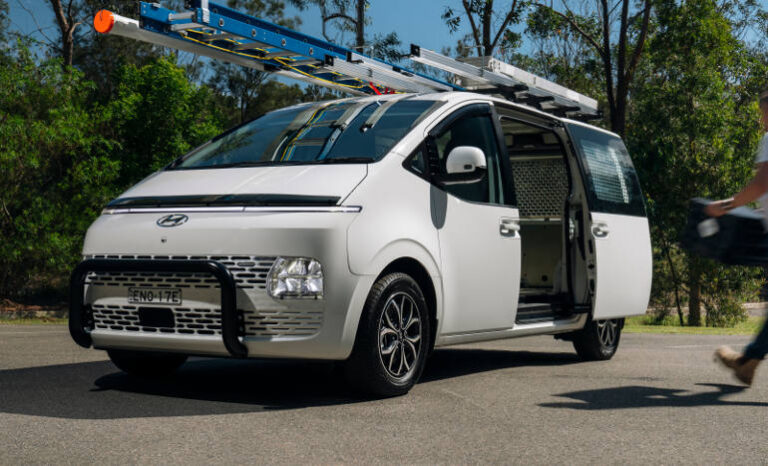
The Transit Custom feels the most car-like, with heated, adjustable seats, armrests and a 13-inch SYNC 4 system. The Trafic surprises with its premium-feeling cabin and clever fold-down seat that doubles as a laptop workstation. Meanwhile, the Staria Load looks and feels futuristic, with an SUV-like driving position, overhead storage, and wireless charging.
Engines and Efficiency
All three are diesel-powered, but differ slightly in output and efficiency:
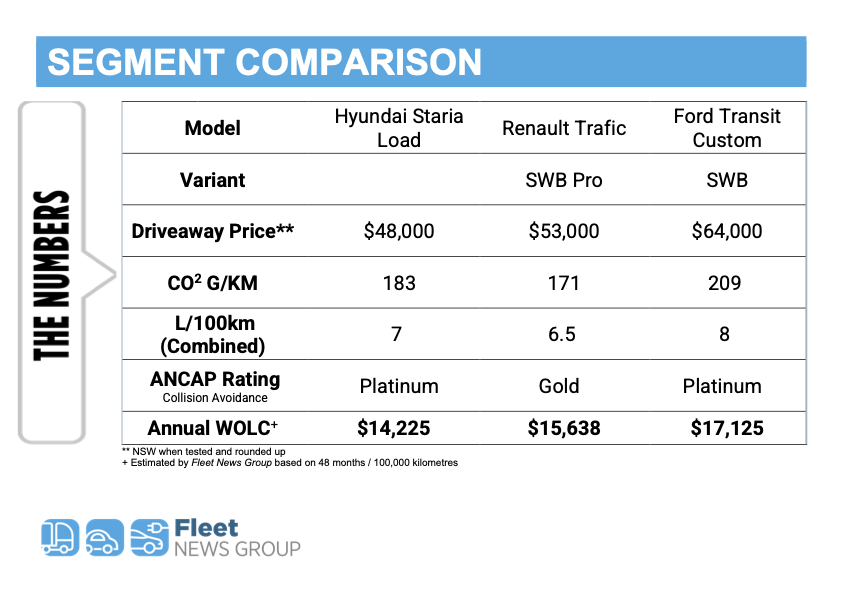
- Transit Custom: 2.0L, 125kW/390Nm, 8.0L/100km (real-world closer to 7.2).
- Trafic: 2.0L, 125kW/380Nm, 7.2L/100km (manual) or 6.5L/100km (auto).
- Staria Load: 2.2L, 130kW/430Nm, 7.0L/100km.
Emissions are all competitive, with the Hyundai leading on paper at 183g/km CO₂.
Cargo and Capability
For cargo, the Transit Custom and Trafic both offer 5.8m³ in short wheelbase, while the Staria Load makes do with 4.9m³ but wins points for its flat, wide floor. Renault’s clever load-through flap extends to 3.75m, making it the best for long items. Payloads range from 1,072kg (Staria) to over 1,200kg (Transit and Trafic). All three tow up to 2,500kg, though the Trafic auto is limited to 1,680kg.
Driving and Safety
On the road, the Transit Custom delivers sharp handling and a tight turning circle. The Trafic feels composed with smart lane departure warnings, while the Staria Load surprises with SUV-like refinement and smooth ride quality.
Safety is strong across the board: Ford offers adaptive cruise and blind spot assist, Renault includes AEBS and driver attention alerts, and Hyundai leads with its SmartSense suite and blind spot camera view in the cluster.
Verdict
All three vans are excellent fleet options. The Trafic is the cleverest for load flexibility, the Staria Load feels the most refined, but the Transit Custom edges ahead on driver comfort and tech.
“All would be an excellent choice for tradies, couriers and fleets alike. But for me, the Transit… makes it the winner in this comparison.“
- Subaru Uncharted review: Familiar Subaru strengths meet a new electric direction
 The Subaru Uncharted arrives at an interesting point in the Australian new-car market. Electric SUVs are no longer unusual, but the challenge for established brands is convincing existing customers that moving to an EV doesn’t mean giving up everything they already like about their current car. That is where the Uncharted makes sense. For people
 - Kia PV5 review: An electric van that feels ready for workThe Kia PV5 arrives with an unusual job to do. It has to convince businesses that an electric van can deliver the practicality expected from a commercial vehicle while also offering the quieter, smoother driving experience that comes with an EV. After driving the PV5 at its Australian launch, the first impression is that Kia
- Kia EV6 Air review: My heart says yes, but my fleet brain says noThe Kia EV6 is one of those cars I had almost forgotten about. That sounds harsh, because when the EV6 arrived in Australia in 2022 it was one of the most interesting electric cars on the market. It looked different, it drove properly, and when the EV6 GT started lining up against supercars in drag
- LDV Deliver 7 LWB Review: After The First 1,890kmWhen Port Hedland Air Freight Director Dominic Barlow needed another van for the business, he wasn’t looking for something to impress on a short test drive. He needed a vehicle that could earn its keep. After buying an LDV Deliver 7 LWB in Perth and driving it 1,890 kilometres north to Port Hedland, he shared
- Geely Starray EM-i review: Big on space, strong on value and easy to live withThe Geely Starray EM-i arrives in Australia with a fairly simple proposition: give buyers the smoothness and convenience of electric driving around town, add a petrol engine for longer journeys, wrap it all in a roomy SUV and keep the price within reach of mainstream buyers. After spending time with the Starray EM-i around Sydney