

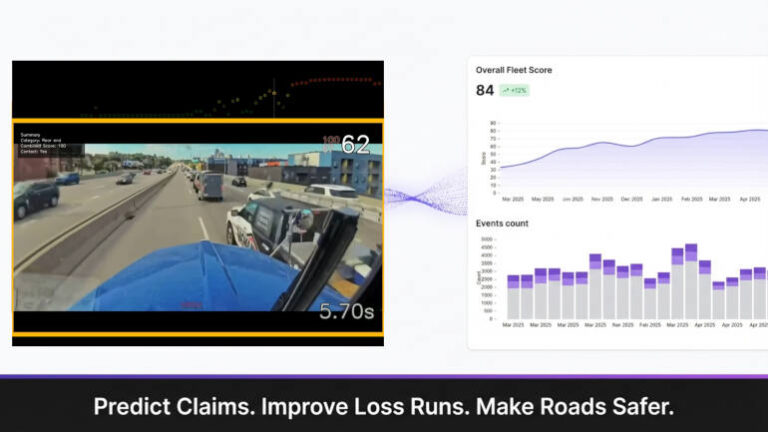
Video telematics provider Waylens has become the first company to integrate InsureVision’s VisionScore™ technology across its entire North American customer base, giving fleets access to AI-powered crash detection, risk scoring and claims intelligence without requiring any new hardware.

The cloud-based integration will be rolled out across Waylens’ installed base of more than 150,000 cameras, allowing fleet operators to access VisionScore™ capabilities overnight.
Unlike traditional crash detection systems that rely on vehicle telemetry such as G-force readings, harsh braking or sudden stops, VisionScore™ uses end-to-end transformer AI to analyse dashcam footage directly. The system can confirm crashes, estimate severity, generate first notice of loss (FNOL) alerts and assess driver risk from video data.
According to InsureVision, the technology is designed to overcome a key limitation of existing video telematics platforms.
InsureVision Chief Executive Officer Mark Miller said fleets and insurers are increasingly questioning the value generated by the vast amounts of video data being collected.
“Fleets and insurers are starting to ask their fleet customers harder questions about what their dashcam data is actually delivering – and the honest answer, for most of them, is not much,” said Miller.
“The accelerometer threshold is the crux of the problem. Set sensitivity high and you generate thousands of clips that tell you nothing. Set it low and you go blind to low-speed, high-consequence incidents.”
Miller said the next phase of the video telematics market would be defined by providers that can transform video footage into actionable risk intelligence.
“It looks like a process problem but it’s just the wrong technology. The dashcam providers that bring genuine risk intelligence to their platforms will own the next generation of this market. Waylens understood that, which is why they moved first.”
VisionScore™ provides three primary functions: crash confirmation and FNOL notification within seven minutes of an incident, AI-generated crash severity estimation and driver risk scoring, and the ability for fleets to activate the service on a per-camera basis.
For fleet operators, faster incident notification could streamline claims processes, reduce investigation delays and improve visibility into safety performance.
Waylens President Jon Verhaeghe said the industry has long struggled to convert video footage into meaningful operational insights.
“The question we’ve been hearing from insurance carriers and fleet operators for years is how to turn footage into decisions,” said Verhaeghe.
“That’s a problem the industry has had challenges solving with existing technology. Waylens advanced edge detection coupled with VisionScore™ brings a new dimension for what’s possible.”

Verhaeghe said the combined solution enables insurers to receive verified crash information, footage and severity estimates within minutes of an incident.
“For the first time, we can tell an insurer there was a crash, here is the severity, here is the footage, all within five minutes of impact. That’s a fundamentally different product than anything running on a dashcam platform today.”
The announcement comes as commercial motor insurers continue to face significant profitability challenges. InsureVision noted that commercial auto insurance has recorded underwriting losses in 13 of the past 14 years in the United States, while large liability claims continue to increase in size and complexity.
The company argues that earlier and more accurate crash notification can help reduce claims costs by enabling faster investigations and reducing the time between an incident occurring and action being taken.
InsureVision said its enviromatics technology has been independently reviewed by Dr Neale Kinnear, former Head of Behavioural Insights at Aon, and Dr Johnathon Ehsani, Associate Professor at Johns Hopkins University.
The company claims its combined AI approach delivers a threefold improvement in predicting at-fault claims compared with traditional predictive detection methods.
For fleet managers, the development highlights the growing shift in telematics from recording events after they happen to using artificial intelligence to identify risk, support claims management and provide insurers with more timely and accurate information.