
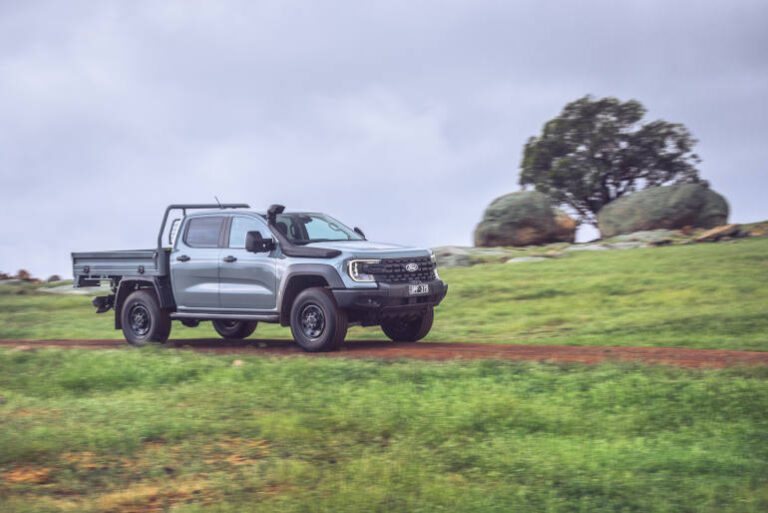
When Ford engineers started developing the Ranger Super Duty, they didn’t begin with a clean sheet of paper. They began with conversations — long, honest, and sometimes blunt chats with fleet customers about what actually matters when vehicles spend every day at GVM, towing hard, working remotely, and racking up kilometres in punishing conditions.
The result? A heavy-duty Ranger that isn’t just a tougher version of the familiar model. It’s a ute that has been reinforced, re-engineered and re-imagined underneath, all because fleets said: “We need more capability, more durability, and more uptime.”
Below is how that fleet feedback shaped some of the most important changes.
1. Uptime Over Everything: Why the Frame Was Almost Entirely Rebuilt
One of the loudest messages from fleets was simple: keep us on the road.
A standard ute chassis wasn’t going to cut it for the loads Ford knew customers were carrying daily, so the engineering team effectively rebuilt the underbody. Only around six percent of the frame carries over from the existing Ranger. Everything else — thicker sections, longer beams, reinforced crossmembers — came directly from real-world fleet expectations around durability and lifecycle performance.
As Ford’s engineer explained, a move to a 4.5-tonne GVM meant “exponential increases” in load transfer through the frame and even the engine mounts. Fleets needing long-term reliability were the catalyst behind this transformation.
2. The 130-Litre Fuel Tank: Because Fleets Hate Coming Back to Base
Long days in remote areas or busy delivery schedules mean every stop costs time and money. Fleet customers made this crystal clear.
Ford responded with a 130-litre fuel tank, a massive upgrade requiring new crossmembers and clever packaging just to squeeze it in. The message from customers was: give us more operating hours between refills. Ford listened — and engineered accordingly.
3. Heavy-Duty Hubs, Axles and Driveline: Built “Because Fleets Needed It”
The decision to fit F-250 eight-stud hubs wasn’t about marketing — it was about clamping force, durability and compatibility with heavy-duty steel wheels. Fleet operators told Ford they needed real strength, not just promises.
The rear axle, originally based on a Transit unit, was completely redesigned with upgraded tubing, new internals, and a driveline calibrated for a rear diff lock. Both front and rear locking differentials were added for off-road capability — something that matters to fleets working on rural properties, in emergency services, and in mining or utility applications.
One particularly useful fleet-driven feature: the ability to lock the front diff independently. That’s not a novelty — it helps prevent the rear stepping out when extracting a vehicle from tricky terrain.
4. Longer Leaf Springs and Better Dynamics: Fleet Loads Don’t Lie
Fleet feedback also influenced suspension tuning. Operators who regularly travel fully loaded said they needed predictable handling at weight.
Ford’s engineering team designed longer leaf springs to improve load spread, ride comfort, articulation and stability — and then tuned dynamic rates to ensure the ute behaves safely as weight increases. In fact, during long-haul tests with fleet customers, the feedback from Ford’s dynamics team was surprising even to itself: the laden handling exceeded expectations.
5. Safety Tech Over “Cheapest Spec”: Fleets Want to Reduce Incidents
One of the most interesting insights from Ford’s underbody walkthrough had nothing to do with hardware — it was behavioural.
Engineers admitted they assumed fleets would prefer a lower-cost model. Instead, customers said the opposite: give us the safest configuration, because fewer collisions means more uptime.
That feedback directly supported the integrated driver-assist rear bar, complete with sensors, cameras, and trailer-assist tech. Fleets told Ford that not everyone is confident reversing trailers — so features that reduce the chance of a mistake increase productivity and cut repair downtime.
6. Thoughtful Details for Harsh Conditions: Because Fleets Go Anywhere
Ford also raised components like diff breathers and electronics to ensure they sit above the 850 mm wading depth — critical for utilities, councils, emergency services and rural operators. These are small details, but they’re the details that matter when a vehicle becomes a tool of trade.
A Super Duty Shaped by the People Who Use It
While the Ranger Super Duty is engineered to a global standard, the transcript makes it clear: fleet feedback directly shaped the design — from the structure and fuel tank to axle selection and safety technology. This isn’t a ute built in isolation; it’s a ute built in partnership with the people who rely on it.
For Fleet Managers, that means a vehicle designed around uptime, reliability and real-world use cases — not just lab conditions.
And as the fleet industry continues to push OEMs for more capability, Ford’s approach here shows what happens when the feedback loop is taken seriously: you don’t get a small update… you get a ground-breaking vehicle.