
The story of the Ford Pro Converter Program, recently launched in Australia, began more than a decade ago in Europe with a simple but powerful insight — that the people modifying vehicles are just as important as the people building them.
Speaking to Fleet News Group in Frankfurt during the international launch of the E-Transit Custom in 2024, a Ford spokesperson explained how the original Qualified Vehicle Modifier (QVM) program evolved to support Europe’s growing network of specialist vehicle modifiers and upfitters.
“Around ten to twelve years ago, Ford of Europe recognised that keeping the Transit at the top of the commercial vehicle market meant more than just making a great van,” said a Ford spokesperson. “It required building strong relationships with the people who adapt and convert those vehicles for real-world use.”
That recognition led to the development of a structured accreditation process for body builders, racking specialists, and service body manufacturers. The goal was to support modifiers — not control them — by sharing technical data and providing engineering guidance to help them deliver safer, more consistent conversions.
“If a modifier prefers working on a Transit, they’re more likely to recommend one to their customers,” the spokesperson explained. “By helping them do their best work, we help ensure Transit remains their platform of choice.”
Building Collaboration, Not Control
The European QVM framework gave accredited modifiers access to Ford’s Body Builders’ Manual, early CAD data, and vehicle specifications before new model launches — a level of collaboration that was rare at the time. Ford engineers would also assess how each modifier approached design, fabrication, and installation to ensure their processes met Ford’s quality and safety standards.
“We don’t tell converters how to build their solutions,” said the spokesperson. “We review how they do it, share engineering best practice, and make sure the outcome is safe, reliable, and consistent. It’s a partnership, not a policing exercise.”
That philosophy led to the creation of an extensive European network of more than 200 accredited Ford Pro Converters— companies certified for specific categories such as tippers, refrigerated vans, racking systems, and emergency service vehicles. Accredited converters can promote their status through Ford’s own marketing materials, giving customers confidence that their vehicle modification is OEM-recognised and backed by engineering oversight.
How It Influenced Australia’s Program
The success of the European QVM and Ford Pro Converter programs laid the groundwork for similar collaboration in Australia. Ford Australia’s Special Vehicle Engineering and Fleet teams have quietly been applying the same principles over recent years — engaging local body builders and service body specialists well before the release of major models such as the Next-Gen Ranger and E-Transit.
Ahead of the Next-Gen Ranger’s launch, Ford invited dozens of local modifiers to preview the vehicle in person and begin designing compatible service bodies and electrical systems.
“No other manufacturer in Australia had engaged so directly with downstream suppliers before,” the spokesperson said. “We gave them early access and technical guidance so they could start engineering solutions before the vehicle hit the showroom floor. That meant our customers could get on the road faster.”
This engineering-first approach proved valuable, supporting partnerships such as the Victoria Police prisoner pod project — a collaboration between Ford Australia, the fleet department, and a local body builder that resulted in a safer, more functional rear pod for operational Rangers.
From Engineering Project to Commercial Program
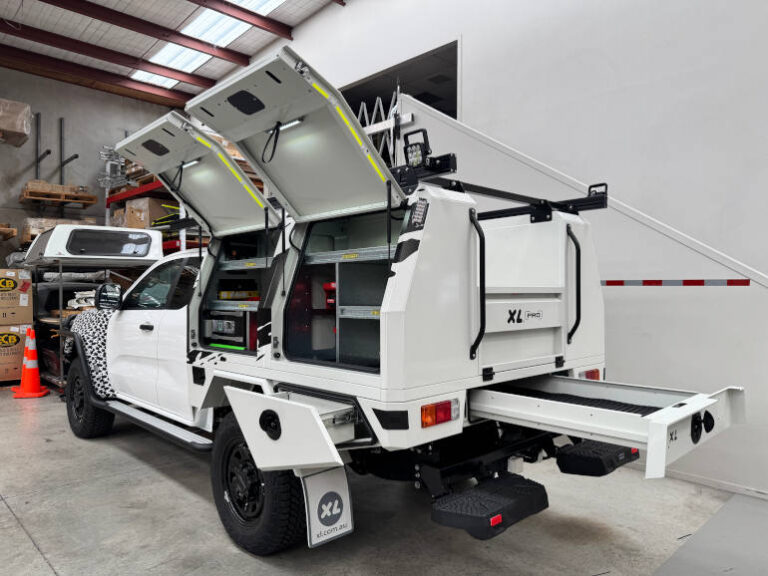
The newly launched Ford Pro Converter Program in Australia now formalises that collaborative process, connecting fleet customers with Ford-certified convertors such as Bull Motor Bodies, Duratray, Hidrive, Mits Alloy, Norweld, and XL Service Bodies.
Each convertor is independently audited by Ford engineers to ensure their capabilities and installation methods meet Ford’s standards, with warranty alignment to Ford’s new vehicle coverage — a crucial reassurance for fleet buyers.
“We’re turning years of behind-the-scenes engineering work into a fully-fledged commercial program,” said the spokesperson. “It’s about giving fleet customers confidence that their vehicles and conversions are done right, with full factory backing.”
What It Means for Fleet Customers
For Australian fleets, the Ford Pro Converter Program represents a significant shift in how commercial vehicles are delivered and supported. It ensures faster turnarounds, reduces post-delivery downtime, and provides greater assurance that modified vehicles maintain their factory integrity.
“Fleet Managers want vehicles that are fit for purpose and ready to work,” the spokesperson added. “By working with approved convertors, we’re helping them achieve exactly that — safely, efficiently, and without compromising warranty or quality.”
Just as Ford of Europe’s QVM evolved into a comprehensive ecosystem of accredited partners, Ford Australia’s rollout of the Ford Pro Converter network signals the next step in its commitment to commercial customers.
It’s a strategy that shifts the conversation from whole-of-life cost to whole-of-life value — prioritising uptime, reliability, and customer satisfaction over purchase price alone.
“For us, it’s not just about moving metal,” said the spokesperson. “It’s about ensuring that every Ford commercial vehicle, from the Transit to the Ranger, delivers maximum value through the entire ownership experience. That’s what the Ford Pro Converter philosophy is all about.”