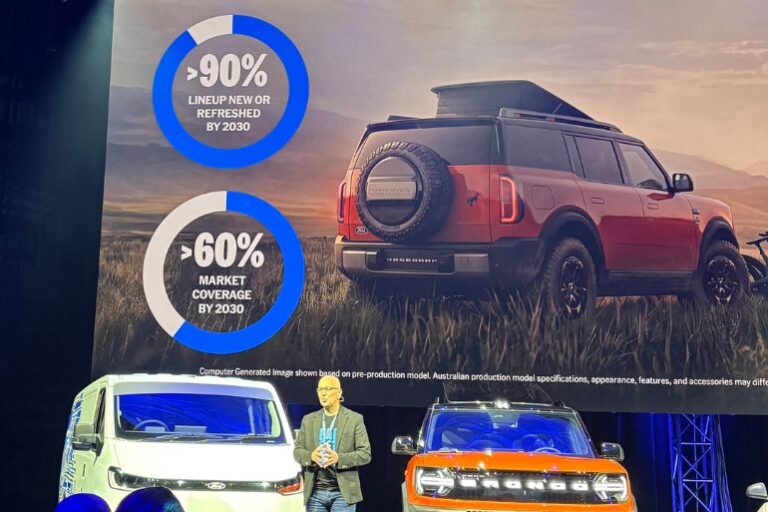
Ford Australia has used its Ford Uncovered event in Melbourne to outline a broader product and market strategy that stretches well beyond the vehicles revealed on the day.
The headline ambition is to increase the proportion of the Australian new-vehicle market covered by Ford products to more than 60 per cent within three years, while having more than 90 per cent of its sales volume coming from all-new or significantly refreshed vehicles by the end of 2030.
For fleet buyers, the significance is less about the percentage itself and more about what Ford says will sit behind it: a wider model range, more powertrain choice, a stronger commercial support offer and continued use of Australian design and engineering alongside vehicles sourced from Ford’s global network.

A broader portfolio
Ford’s current Australian position is heavily anchored by Ranger and Everest. Ranger has been Australia’s best-selling vehicle for three consecutive years, while Everest leads the large SUV segment year-to-date. Mustang also remains an important part of the brand’s performance identity.
The next phase is intended to broaden that base. At Ford Uncovered, the company confirmed the all-electric Transit City van, the Bronco Basecamp range-extender SUV, an Australian-exclusive Mustang Dark Horse T8-Spec Pack and the local rollout of Ford Pro.
Fadi Mawal, President and CEO of Ford Australia and New Zealand, said: “We’ll get there by broadening our portfolio and bringing in more zero-tailpipe and low-emission vehicles, without asking customers to compromise on capability, lifestyle or quality.”
That is a useful marker for fleet procurement teams. Ford is not presenting its future as an all-electric transition. Instead, the product plan combines battery electric vehicles, plug-in hybrids, conventional powertrains and other lower-emission options depending on the application.
Local engineering remains part of the pitch
Ford says it employs around 1,500 people in Australia and has invested $5 billion in local research and development over the past decade. Ranger and Everest remain locally developed products sold into more than 180 markets.
At the same time, Ford is making greater use of its global manufacturing footprint. Transit City and Bronco Basecamp involve collaboration with JMC in China, illustrating how the company intends to add vehicles more quickly and at price points that can compete with an expanding field of brands.
Mawal said: “We will keep designing and engineering vehicles right here that are made for Australian drivers and our tough conditions, while leveraging the best of Ford’s global portfolio to move fast and stay affordable for local customers.”
What the 2030 ambition means for fleets
Fleet buyers will ultimately judge the strategy on the gaps it fills rather than the number of models Ford launches. A broader range could give organisations more opportunity to standardise procurement, service and account management with one manufacturer, but only if the vehicles match operational requirements and whole-of-life cost targets.
Ford is also tying the product expansion to aftersales support. Ford Pro brings vehicles, customisation, finance, service and software under one commercial banner, while a new conditional seven-year unlimited-kilometre warranty adds another whole-of-life consideration for fleets.
Mawal described the direction simply: “Our future direction is clear: greater choice for customers, deeper loyalty to the Ford brand, more foot traffic into our dealerships and a much more diverse lineup to sell.”
The 2030 target is therefore best viewed as an ambition rather than a completed business plan. Ford has not disclosed a detailed Australian volume forecast for 2030. What it has made clear is that it expects a wider and much newer product portfolio to carry more of the load than Ranger and Everest do today.