

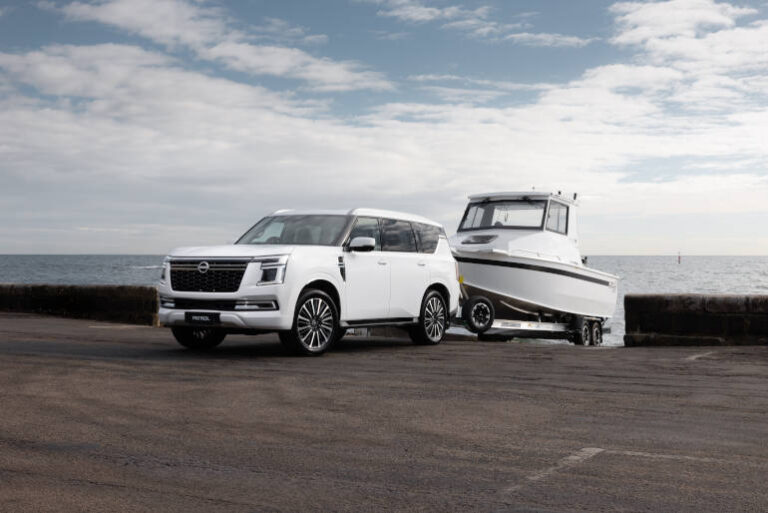
Nissan has revealed further details of the next-generation Patrol ahead of its Australian launch, with the new model receiving significant changes to its interior packaging, load-carrying ability and towing capacity.
The new Patrol will offer up to 2,749 litres of cargo space with the rear seats folded, while maximum braked towing capacity increases to 3,700kg across the range.
For fleet operators, particularly those working in regional areas or industries where vehicles need to carry passengers, equipment and trailers, the changes make the Patrol more versatile than the outgoing Y62.
Nissan Oceania Managing Director Steve Milette said improving passenger space and usability had been a major focus during development.
“The Patrol has always been valued by Australian families for its space, comfort and versatility,” Milette said.
“With the all-new model, we’ve taken those attributes to another level.”
More room across all three rows
The new Patrol has been designed to provide more usable passenger space throughout the cabin.
Front-seat occupants receive Nissan’s new ‘Zero Gravity’ seat structure using high-damping foam, which is designed to reduce uncomfortable vibration when travelling over rough or corrugated roads.
Hip, shoulder and legroom have also been increased, while the driver sits higher for a more commanding view of the road.
Second-row passengers receive the same Zero Gravity seat structure, but one of the biggest practical improvements is a new sliding second-row seat.
With the seats in their rearmost position, Nissan says second-row occupants gain up to 250mm more legroom than in the outgoing Y62 Patrol.
That flexibility could be useful for fleets moving between passenger-focused and cargo-focused applications, allowing operators to change the balance of cabin and luggage space depending on the task.
The third row has also been redesigned to make it more practical for regular use.
A new tilt-and-glide mechanism replaces the Y62’s tumble-seat arrangement, making it easier to access the third row, including when a child seat remains fitted to the second row.
Third-row occupants gain 75mm more hip room and 66mm more knee room, while moving the second row forward can provide up to 253mm of additional legroom. A flatter floor also creates more heel space for outboard passengers.
More usable cargo capacity
The increased passenger room has not come at the expense of luggage capacity.
With all seats in use, the new Patrol provides 577 litres of cargo space, up 110 litres from the Y62.
Folding the third row increases capacity to 1,594 litres, an improvement of 181 litres, while folding both the second and third rows creates up to 2,749 litres of space — 127 litres more than before.
Nissan has also worked to create a near-flat load floor when both rear seating rows are folded, which should make it easier to carry bulky equipment.
PRO-4X and Ti-L Reserve models add adaptive air suspension that can lower the vehicle to make loading and unloading easier.
Towing capacity climbs to 3,700kg
The other major change for fleet buyers is towing capacity.
All versions of the new Patrol will be rated to tow up to 3,700kg braked, an increase of 200kg over the outgoing model. Nissan will offer a range of tow tongue and tow ball configurations, including an accessory setup capable of supporting the full 3,700kg rating.
That additional capacity moves the Patrol beyond the 3,500kg figure common among large SUVs and dual-cab utilities, potentially giving fleet operators more flexibility when matching vehicles with heavier trailers.
As always, the headline towing figure is only part of the calculation. Nissan notes that actual towing capacity will depend on factors including vehicle mass, accessories, driving conditions and maximum towball download.
The new Patrol also receives more technology aimed specifically at towing.
Trailer Blind Spot Warning will be standard across the range alongside Trailer Sway Control, while PRO-4X and Ti-L Reserve variants gain Trailer Docking Support, which assists the driver when aligning the tow bar with a trailer coupling.
Those two grades will also come standard with an electric trailer brake controller.
For fleet managers, these features may prove just as important as the increase in towing capacity, particularly where vehicles are regularly shared between drivers with different levels of towing experience.
The all-new Nissan Patrol is scheduled to reach Australian customers in the first quarter of 2027. Final Australian specifications and equipment details will be confirmed closer to launch.