

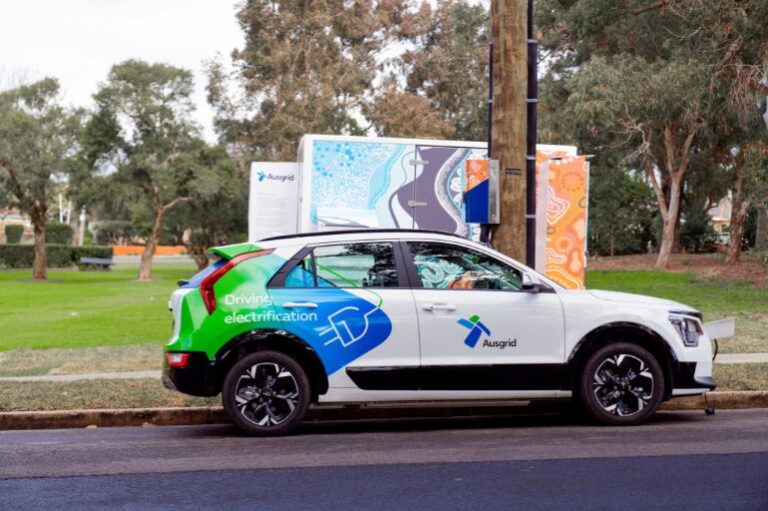
Ausgrid is a finalist in the Fleet of the Year category in the 2026 Fleet News Group Awards.
In the third article in our six-part series, we look beyond the electric vehicles and examine how Ausgrid is designing a charging system around the way its fleet actually operates.
Fleet electrification is often discussed as a vehicle replacement program. For a large operational fleet, the charger can be just as important as the vehicle.

Charging starts at the depot
Ausgrid’s fleet team described its charging strategy as a hierarchy. Depot charging sits at the top, followed by charging at substations, then employee homes, with public charging providing another option when required.
Depots are the logical foundation because vehicles can be charged where they are based and where Ausgrid has greater control over infrastructure, access and energy supply.
However, Ausgrid operates across a large geographic area, and vehicles can spend significant time away from their home depot.
Why substations are part of the solution
Ausgrid has been testing 40kW DC charging at substations to create another layer of flexibility.
On paper, substations appear to be an obvious opportunity because they are part of an electricity network and are distributed across the operating area.
But the fleet team also highlighted an important safety consideration: substations are operational electricity facilities, not places where employees should spend unnecessary time waiting for a vehicle to charge.
That is one reason faster DC charging is being explored for these locations.
Vehicle-to-vehicle charging as a backup
Ausgrid is also testing the potential for vehicle-to-vehicle charging. If an electric fleet vehicle was unable to reach a fixed charger, another suitable vehicle may be able to provide enough energy to help it continue.
This type of contingency planning becomes more relevant as EVs move into essential operational work, where an unexpected charging problem can affect more than an individual driver.
Home charging without the paperwork
Take-home vehicles create another challenge. If an employee charges an Ausgrid vehicle at home after travelling a long distance, the organisation needs a practical way to reimburse the electricity used.
Ausgrid is investigating whether this process can be automated using data from its in-vehicle monitoring systems.
The concept described during the Awards interview would calculate the electricity used to charge the work vehicle and reimburse the employee through payroll.
If implemented, this would remove one of the administrative barriers that can arise when work vehicles are regularly charged at private residences.
Public charging still has a role
Public charging sits lower in Ausgrid’s hierarchy, but it remains part of the overall system. For a fleet that moves across a large geographic area, there will always be journeys or circumstances where an organisation-owned charger is not the most practical option.
The key difference is that Ausgrid is not relying on public charging as the foundation of its strategy.
Why this matters for Fleet of the Year
Ausgrid’s charging strategy shows the depth of planning required when fleet electrification moves beyond a small pilot.
Depot, substation, home and public charging each solve different operational problems, while vehicle-to-vehicle charging provides another possible layer of resilience.
Ausgrid is a finalist in the 2026 Fleet News Group Fleet of the Year Award. You can support the organisation by voting on the Fleet News Group Awards website.
Vote for Ausgrid in the Fleet of the Year Award
The winners will be announced in Sydney on 14 October 2026.
Register your interest for the Fleet News Group Awards Night
Next week: Ausgrid is also using fleet data to influence the person behind the wheel. We look at its move towards risk-based driver safety.