

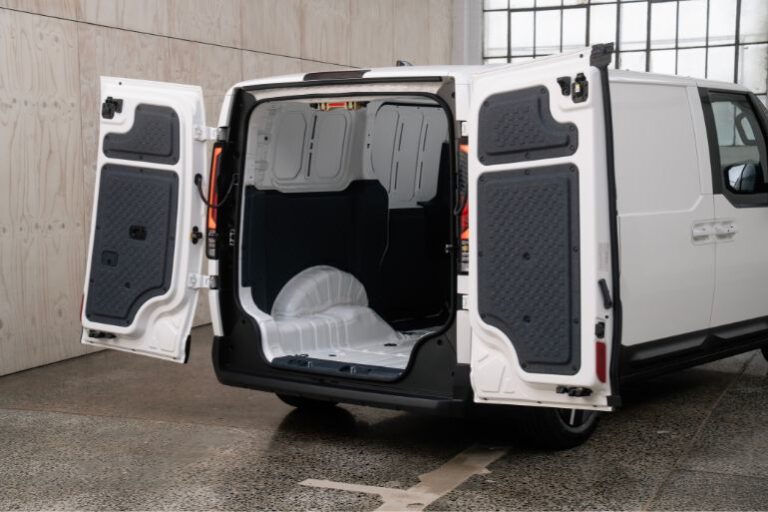
Kia has returned to the Australian van market after a long absence, but rather than easing its way back in with a conventional petrol or diesel model, it has chosen to start with a dedicated electric commercial vehicle.
The PV5 arrived in Australia in earlier this year as Kia’s first dedicated battery-electric light commercial vehicle and the first model from its broader PBV, or Platform Beyond Vehicle, strategy.
Several months later, the decision appears to be paying off. The PV5 has been well received, with sales exceeding Kia’s initial expectations and strong demand across fleet segments.
For Fleet Managers, the significance goes beyond another electric van joining the market. Kia is signalling that commercial vehicles will become a bigger part of its Australian product range, and it is using electrification as the entry point.
Why return to vans now?
The question was put directly to Kia during the Australian launch: after spending years building its passenger-car and SUV range, why return to commercial vans now?
Kia Australia CEO Dennis Piccoli explained that the PV5 forms part of a much larger global strategy.
“In terms of what it represents, it’s part of a global strategy, a Plan S strategy that was developed a number of years ago,” Piccoli said.
He pointed to the expansion of the global van market, particularly as e-commerce increases demand for commercial vehicles.
“The van market, with the amount of product going through with e-commerce and what have you, is exploding, and there’s huge opportunity at a global level,” he said.
For Kia Australia, that also means expanding into another segment as the brand looks for its next source of growth.
At the launch, Piccoli said broadening the model range was important if Kia wanted to maintain momentum in an increasingly competitive Australian market.
“It’s quite important that we stay ahead in that technological race, and that we have a wide array of product into as many segments as possible,” he said.
The PV5 therefore isn’t simply an electric derivative of an existing Kia van. It is effectively the beginning of a new commercial vehicle business for the brand.
Starting with electric changes the proposition
Kia could have returned to the van market with a conventional internal-combustion vehicle and added an electric version later. Instead, the PV5 was designed as an EV from the outset.
Kia Australia Product Planning Manager Raymond Pok described it at launch as “our first dedicated battery electric light commercial vehicle”.
It sits on Kia’s dedicated E-GMP.S architecture, which is designed to support different commercial and passenger body configurations.
“Our PBVs are a total mobility solution that combine a fit-for-purpose EV with technology and software,” Pok said. “Under the skin of every PBV, whether it’s a cargo or a passenger, is a dedicated EV platform.”
For fleet buyers, that dedicated architecture matters because it influences packaging as much as propulsion.
The PV5 Cargo offers 4.4 cubic metres of cargo capacity and a 740kg maximum payload, while the 71.2kWh battery provides a claimed 416km WLTP range. A front-mounted motor produces 120kW and 250Nm.
The platform also gives the van a relatively low loading floor, dual sliding side doors and wide-opening rear doors.
That makes the PV5 easier to assess as a commercial vehicle first and an EV second — an important distinction for Fleet Managers who need the vehicle to fit an existing task rather than changing the task to suit the powertrain.
Kia believes mainstream buyers are ready
At launch, Kia was already seeing interest from businesses that may previously have remained with diesel vans.
Kia Australia General Manager of Fleet Chris Forbes said the PV5 gave customers an opportunity to consider electric without moving away from a mainstream vehicle brand.
“This is, I guess, the first time a mainstream brand brought out an electric van, and it gives them an opportunity now to very much look at that and move away from the diesel,” Forbes said.
The customer base Kia identified was also broader than early EV adopters.
Dealers were seeing interest from electricians, solar installers and battery businesses, while Kia’s fleet operation was targeting larger corporates, utilities, governments and last-mile delivery operations.
That distinction is important because the long-term opportunity for electric vans isn’t just with businesses wanting to make an environmental statement. It depends on Fleet Managers being able to integrate them into ordinary fleet operations.
The fleet opportunity was evident before deliveries started
Kia’s original expectations for the PV5 were relatively conservative.
At the June launch, Piccoli suggested around 500 vehicles annually, depending on supply. But he was already indicating that demand could exceed that target.
“The early uptake from the network and early feedback from the fleet space has been very, very positive,” he said.
In a separate conversation at the launch, Piccoli said the dealer network had been asked several times to nominate how many vehicles it wanted and believed the number had already exceeded 300 before customer deliveries had properly begun.
“The indicators based on expressions of interest, network’s confidence, are all leading to this thing,” Piccoli said. “This thing’s actually going to go better than the original estimates, I think.”
The stronger-than-expected market response since launch suggests that prediction was well founded.
PV5 is only the beginning
Perhaps the more interesting issue for fleet buyers is what comes next. The PV5 was presented as the first member of a broader family rather than a standalone experiment.
A seven-seat passenger version was displayed at the Australian launch, while Kia also discussed a high-roof cargo model that would increase load volume from 4.4 cubic metres to around 5.1 cubic metres.
Piccoli also indicated that further PBV products could follow.
That means Kia’s return to vans is potentially much bigger than the launch of one electric model.
For Fleet Managers, greater competition in the commercial vehicle market should ultimately mean more choice, particularly as organisations look for practical ways to reduce fleet emissions without sacrificing vehicle capability.
Kia spent years concentrating on passenger vehicles and SUVs before returning to the van market.
Now it is back — and rather than looking to the commercial vehicles of the past, it has started with one designed around where the market may be heading next.