

Parkes Shire Council is a finalist in the Fleet of the Year category in the 2026 Fleet News Group Awards.
Its approach to fleet purchasing goes well beyond tender price, using actual operating costs, whole-of-life analysis and documented financial tests to decide whether an asset should be repaired, replaced or disposed of.

The fifth story in our Parkes Fleet of the Year series
The previous article in this series went inside the Parkes workshop. This week, the focus moves to the numbers that sit behind procurement and replacement decisions – and why the cheapest option on day one may not deliver the best value to the community.
Down to dollars per kilometre
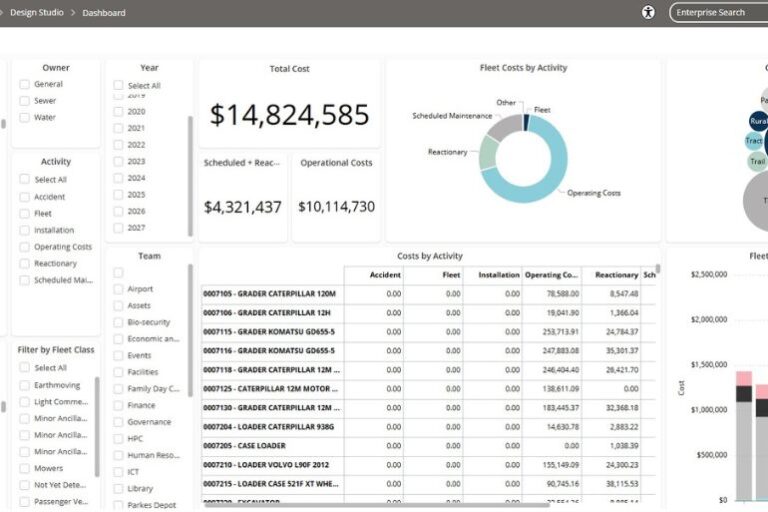
Parkes Shire Council uses its fleet data to compare the actual operating performance of different vehicles and equipment. For trucks, the analysis can be taken down to a cost-per-kilometre figure.
During the finalist interview, O’Shannessy described comparing different heavy-truck models using actual fleet results. The calculation is not just fuel. It considers the wider cost of owning and operating the asset so the fleet team can see what it has genuinely cost to deliver each kilometre of service.
This provides a stronger basis for future procurement because the council can use its own operating experience rather than relying only on manufacturer specifications or purchase price.
Whole-of-life value in a regional environment
The council’s evaluations consider price, suitability, safety, warranty, service support, lead time, resale value and whole-of-life costs. Regional support receives particular attention because travel for specialist repairs can quickly erode a purchase-price saving.
Parkes also monitors internal hire rates and recoveries to make sure assets are contributing enough over their life to support future replacement. If a machine is not being used, the answer may be to change the internal rate, move the asset, extend its replacement date or dispose of it.
The recovery dashboard uses colour coding to show which assets are ahead of or behind their expected position. That makes it easier for the fleet team and managers to focus on the exceptions rather than manually reviewing every asset.
The $17,000 grader decision
A particularly strong example came from an external audit recommendation. Parkes introduced a formal assessment for reactive repairs costing more than $10,000 when an asset is due for replacement within the following 12 months.
The process was tested when a Komatsu grader suffered a brake failure and required around $17,000 in repairs. Rather than automatically repairing the machine or disposing of it with the fault, the fleet team obtained market valuations for both scenarios.
The council concluded that repairing the grader before sale produced the better financial result. After the work was completed, the asset sold for around $15,000 more than its estimated repaired value. The fleet team described the overall difference between disposing of the machine with failed brakes and repairing it before sale as roughly a $30,000 turnaround.
The important point is not the individual windfall. It is that Parkes created a documented process so future decisions can be tested in the same way.
Governance that supports commercial judgement
Fleet governance is sometimes portrayed as paperwork that slows decisions down. The Parkes approach shows another possibility. A clear process can give fleet managers permission to make a commercially sensible decision because the assumptions, evidence and approvals are visible.
Major fleet purchases are documented and considered through the plant procurement committee. Policies and procedures guide procurement thresholds and evaluation requirements, while TechnologyOne stores the asset and financial information behind the recommendation.
That structure reduces reliance on individual memory and makes decisions easier to explain to executives, councillors, auditors and the community.
Value for money is an ongoing test
For Parkes, value is not established when the purchase order is signed. The team continues to monitor maintenance, utilisation, recoveries and resale throughout the asset’s life.
That continuous feedback loop helps improve the next procurement decision. If one truck costs materially more per kilometre than another in the same application, that becomes evidence for the next replacement. If an asset is sitting idle, the council can challenge whether ownership remains the right model.
This is the kind of whole-of-life thinking the Fleet of the Year Award is designed to recognise: not just buying well, but managing the asset so it continues to deliver value after it enters service.
Next week: using data to change driver behaviour
In the final article in this Parkes series, we’ll look at safety – including weekly driver scorecards, a dramatic reduction in seatbelt-related events, near-miss data changing depot traffic flow and the council’s investment in electronic braking capability for heavy trailers.
Vote for Parkes Shire Council
Vote for Parkes Shire Council in the 2026 Fleet News Group Fleet of the Year Award
Industry voting is now open. Visit the Fleet News Group Awards voting page to cast your vote.
Awards Night – 14 October 2026, Sydney
The winner of the Fleet of the Year Award will be announced at the Fleet News Group Awards Night in Sydney on 14 October 2026. Register your interest to attend the Awards Night.