

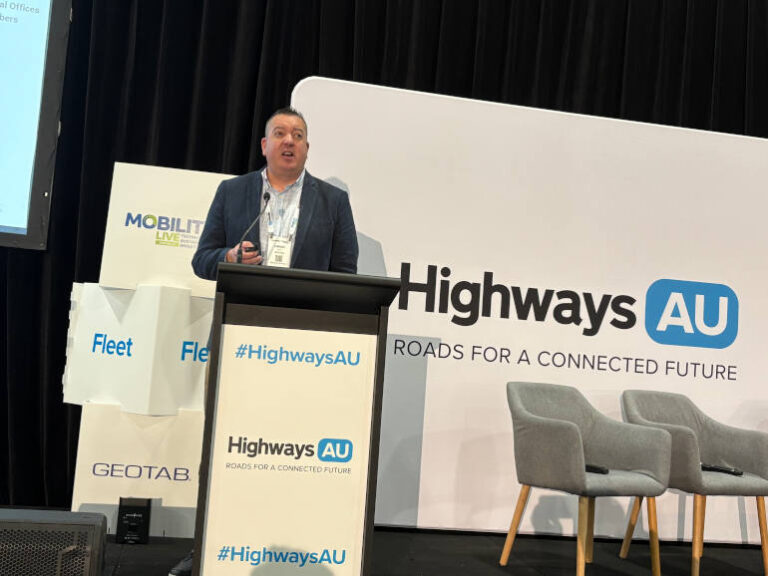
At Mobility Live 2025 in Sydney, David Brown, Associate Vice President of Sales – APAC at Geotab, opened the conference with a clear message for the transport and fleet community: the challenge isn’t collecting data anymore — it’s understanding what to do with it.
“There’s a lot of data coming through, but today is really about how do I use that data? How do I make it meaningful within my business?” Brown said.
Drawing on more than 15 years in telematics, Brown outlined the dual pressures facing fleet operators in 2025 — the urgent need to reduce emissions and the ongoing challenge of keeping vehicles safe, reliable, and cost-efficient.
Two paths to lower emissions
Fleet practitioners, he said, are balancing two key strategies: transition to electric vehicles (EVs) or optimise existing internal combustion engine (ICE) fleets to reduce emissions.
“Some organisations are swapping ICE vehicles for EVs straight away, while others are focused on getting the most out of what they already have,” Brown explained. “There’s no single path — the key is understanding your data and using it to make smarter decisions.”
Brown spoke about the growing importance of battery health, charging behaviour, and vehicle range as operational metrics, stressing that energy management is now as important as fuel management once was. “The battery is usually the most expensive component on an EV,” he said. “Keeping it maintained and understanding its state of charge is essential to protecting that investment.”
For fleets yet to transition, Brown highlighted how telematics can still support sustainability goals by improving route efficiency, reducing idling, and identifying vehicles due for replacement. “If you can reduce wear and tear through better maintenance and driver behaviour, you’re cutting CO₂ before you even buy your first EV,” he said.
Maintenance and the hidden cost of downtime
One of the recurring pain points for Fleet Managers, Brown noted, is maintenance. He cited research showing that dashboard fault lights can go unreported for up to two weeks — long enough to cause serious damage.
“Maintenance is extremely hard to do when you’ve got a lot of vehicles out there,” he said. “Fault-code detection and automated work orders take the guesswork out of it. You know exactly what needs attention and when.”
Brown also discussed how digital maintenance systems can prioritise repairs by severity and trigger automatic reminders, helping workshops stay proactive rather than reactive.
Safety and behaviour at the centre
For Brown, the foundation of telematics remains safety. “The reason I came into telematics many years ago was because of safety — you wanted to help save lives and make an impact,” he said.
He reminded the audience that 80% of road incidents and accidents are caused by brake failure or human error, highlighting how predictive analytics now allow fleets to identify drivers most at risk of an incident. By benchmarking against five million connected vehicles worldwide, fleets can compare their own performance to industry peers and best-in-class operators.
“Predictive analytics can tell you who’s at risk of having an accident in the next 100,000 kilometres,” he said. “It’s about seeing risk before it happens, not after.”
Cameras, coaching, and culture change
Brown also introduced the growing role of video telematics and real-time feedback. Cameras now offer in-cab alerts for distracted or unsafe driving, helping build awareness and accountability. “If you’re looking at your phone or having a drink while driving, the system will tell you,” he said. “It’s coaching in real time, not at the end of the month.”
The focus, he added, isn’t about surveillance — it’s about context. “Video helps exonerate drivers too. If a harsh brake event shows up, the footage can show why it happened. It’s not about blame; it’s about understanding.”
Rewarding safe and efficient driving
One of the more innovative initiatives Brown outlined was a driver reward program that links telematics data to real-world incentives. Drivers earn points for safe driving and can redeem vouchers from partners such as Bunnings and Coles.
“It encourages drivers to do the right thing and gives them something back for it,” he said. “Everyone starts at bronze, and as they improve, they move up through silver, gold, and platinum. It’s a great way to engage drivers and improve retention.”
Early results from overseas trials show promise: after one month, safe driving habits improved by 15%, maintenance costs fell 14%, and fuel efficiency improved 12%.
A shift from information to action
Brown’s keynote underscored a broader shift in fleet management — from collecting information to driving action. In a world where fleets generate billions of data points daily, success now depends on how effectively that data is turned into safety improvements, cost savings, and emission reductions.
As Brown summed up:
“Yes, we want to save lives and reduce emissions — but the key is understanding how drivers behave, how vehicles perform, and using that insight to make change happen. That’s where the real impact begins.”
For fleet professionals, Brown’s presentation served as a reminder that telematics has evolved beyond tracking. It’s now about foresight, not hindsight — connecting people, vehicles, and insights to drive safer, smarter, and more sustainable operations.




