
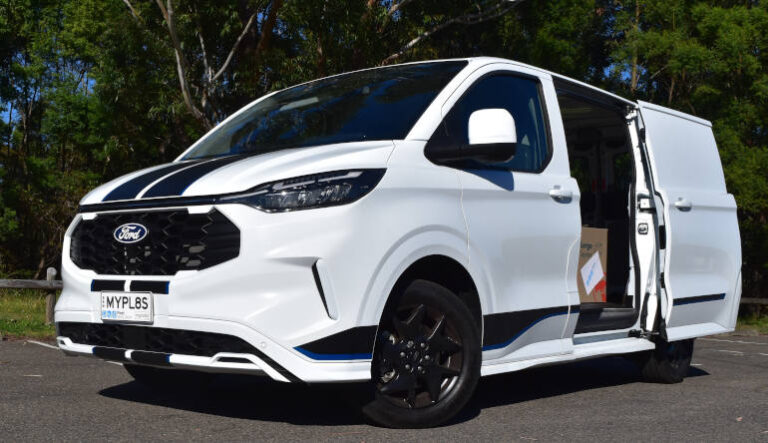
The Ford Transit nameplate has been a staple of Australian roads for decades, and the latest Transit Custom continues that tradition. Sitting in the mid-size van segment, the short wheelbase Transit Custom is designed to meet the needs of businesses and fleet buyers who want a balance of comfort, efficiency and cargo flexibility. With strong tech, safety features and competitive running costs, it remains one of the strongest contenders in its class.
Who’s it for
This van is built for small businesses, tradies, service providers and larger fleets that need a dependable and efficient workhorse. Its 5.8m³ cargo space, clever load-through hatch, and wide-opening rear doors make it suitable for carrying tools, equipment, or even pallets. With towing capacity of up to 2.5 tonnes, it adds versatility for operations that need to move more than just what fits inside the van.
Powertrain
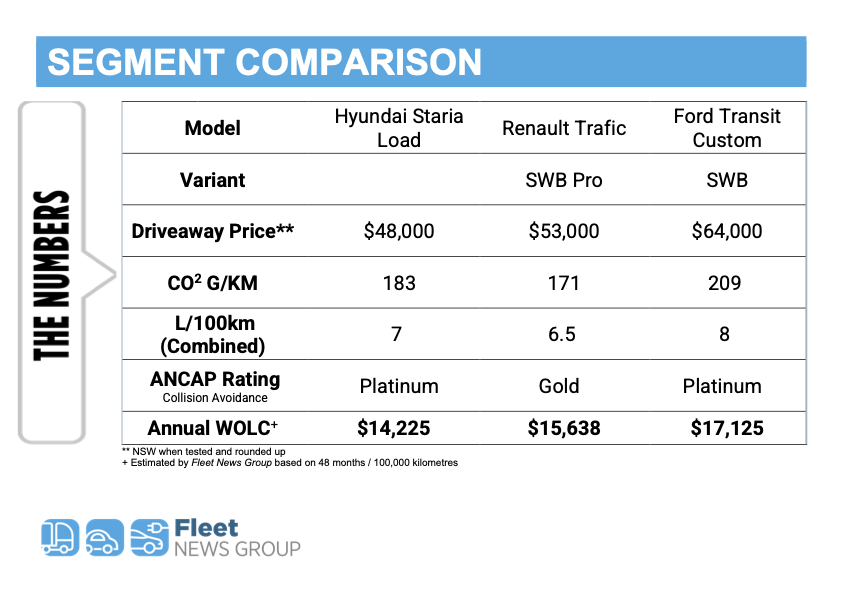
Under the bonnet sits a 2.0-litre EcoBlue diesel engine producing 125kW and 390Nm, paired with an eight-speed automatic transmission. The drivetrain feels refined and capable, with selectable drive modes including Eco, Tow/Haul and Slippery to suit varying conditions. Official combined-cycle fuel use is 8.0L/100km, but real-world driving can deliver closer to 7.2L/100km. Emissions are listed at 209g/km CO₂, with an AdBlue system helping meet Euro standards. Service intervals of 12 months/30,000km and Ford’s capped-price servicing program enhance predictability for whole-of-life costs.
Tech & Safety
Driver comfort is a highlight, with an eight-way adjustable seat (including lumbar), armrest and heated front seats. A 13-inch display with Ford’s SYNC 4 system comes standard, offering wireless Apple CarPlay, Android Auto, and sat-nav. Large mirrors with convex sections support excellent visibility, backed by blind-spot monitoring. Safety is comprehensive with six airbags, stability control, lane keeping assistance and adaptive cruise control. The Transit Custom carries a Platinum ANCAP rating, giving fleet managers peace of mind.
On the Road
Behind the wheel, the Transit Custom drives more like a car than a van. Light steering, independent rear suspension, and a tight 10.9m turning circle make city work stress-free. On the highway it feels composed and confident, with selectable drive modes adapting performance to suit the task. It’s smooth, comfortable and surprisingly agile for its size, making long shifts less tiring for drivers.
Fleet Verdict
The Ford Transit Custom ticks all the major boxes for fleet buyers: efficiency, comfort, safety and practicality. Its blend of low running costs, advanced driver assistance and clever cargo solutions make it a versatile choice for both small operators and large fleets. The only drawback is the single sliding door on the short wheelbase model (the driver’s side option is reserved for the long wheelbase Sport), but overall, this is a van that deserves serious consideration from anyone in the market.
Ford Transit Custom Quick Specs
Engine: 2.0-litre EcoBlue turbo-diesel
Power: 125kW
Torque: 390Nm
Transmission: 8-spd automatic
Fuel use: 8.0L/100km (7.2L real-world)
Emissions: 209g/km CO₂
Cargo volume: 5.8m³ (up to 3.05m load length with hatch)
Towing: 2.5t braked
Warranty: 5 years / unlimited km
- New Nissan Patrol Enters Production
 Production of the all-new Nissan Patrol has commenced in Japan, with the first right-hand-drive vehicles destined for Australia rolling off the line at the Nissan Shatai Kyushu plant. First Australian customer deliveries are scheduled for the first quarter of 2027, giving fleet buyers a timeframe to consider the new-generation SUV in upcoming replacement plans. For
 - Honda Makes its Next Hybrid MoveHonda will begin rolling out its next-generation hybrid system globally from 2027, promising improved fuel efficiency, a new vehicle platform and electric all-wheel-drive technology. Named Honda Hybrid, the system builds on the company’s existing two-motor e technology. Honda plans to launch 15 next-generation hybrid models globally by the end of its financial year on 31 March 2030,
- Green Comeback for Mazda MX-5Mazda has expanded the MX-5’s driver assistance equipment for 2026, adding cyclist detection to its autonomous emergency braking system and introducing lane-keep assist across the range. The changes cover both the Roadster and retractable-roof RF models, alongside new seats and interior trim for the GT RS and an additional exterior colour. The autonomous emergency braking
- MINI Countryman Unleashes its Untamed SideMINI will add a new Untamed Edition to its Australian Countryman range in early 2027, giving fleet and novated lease buyers a distinctive design option across petrol and fully electric models. The edition will be available on the Countryman S ALL4 and all-electric Countryman SE ALL4, pairing all-wheel drive with exclusive exterior finishes, interior materials
- Chery Stockman Ute Adds a New TwistChery has revealed further specifications for its upcoming Stockman ute, combining diesel power with plug-in hybrid technology in a new option for Australian fleet buyers. Customer deliveries are scheduled to begin on 1 February 2027. The indicative specifications include all-wheel drive, 350kW of combined power, 800Nm of torque and a braked towing capacity of 3,495kg.