
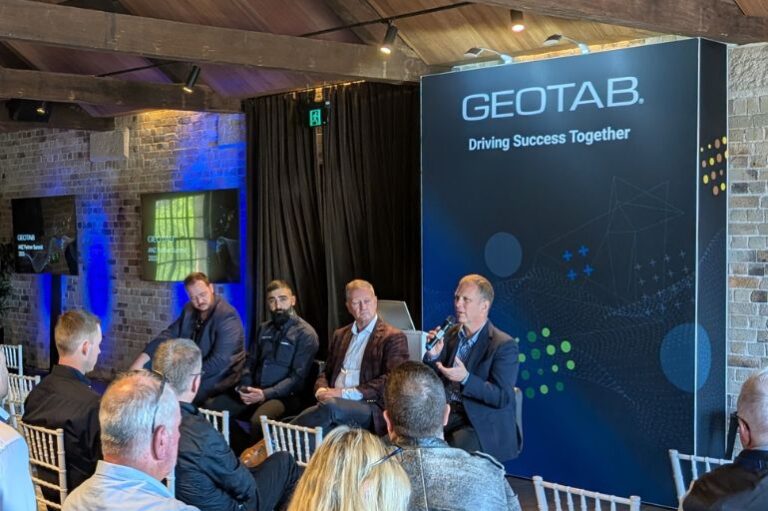
At the 2025 Geotab Partner Day in Sydney, a panel of fleet industry experts discussed how evolving regulations, data insights and new technologies are reshaping the way organisations manage vehicles. The session featured Mike Costello, Corporate Affairs Manager at Cox Automotive Australia; Mace Hartley, Executive Director at the Australasian Fleet Management Association (AfMA); and Marc Sibbald, Director Fleet at IPWEA and Editor at Fleet News Group. The discussion was moderated by Alkan Ciftci from Geotab.
Policy pressures and procurement opportunities
The introduction of Australia’s New Vehicle Efficiency Standard (NVES) featured prominently in the discussion, with Mike Costello noting it would transform how Original Equipment Manufacturers (OEMs) approach the local market.
“Because of this decade, there will be a tightening requirement for all OEMs to have a fleet average CO₂ amount across all of their vehicles under a certain threshold,” Costello explained. “If it’s not under it, they’ll have to pay a fine or buy a credit from a manufacturer that is in a positive — harder and harder as the decade goes on.”
Costello said the regulation would likely lift the price of internal combustion vehicles but create new opportunities for fleet buyers. “Manufacturers who sell too many combustion vehicles are going to have to pass on the fines, but it could also create some really good deals for fleet managers towards the end of the year,” he said. “They’ll need to move a certain number of EVs or plug-in hybrids, so November and December could become the new discount period.”
Data and lifecycle decisions
Marc Sibbald encouraged fleet managers to use tools such as Geotab’s EV Suitability Assessment to plan procurement around these seasonal windows. “If there’s a deal coming to the market in November or December, it’s probably a great time to talk to your customers and look at that EV suitability tool to see which ones you can buy or replace your fleet with,” he said.
When asked how electric powertrains change whole-of-life cost calculations, Sibbald said the fundamentals stay the same — the key variable is resale value. “The big issue is what am I going to sell it for? That’s where the unknown is with electric vehicles,” he said. “You’ve got to be embedded in the industry — come to events like this, talk to manufacturers, suppliers — to really understand market trends.”
Hartley agreed Fleet Managers should revisit traditional replacement cycles. “ICE vehicles might have been turned over every three to five years, but an EV could remain in service longer,” he said. “With over-the-air updates, the vehicle keeps getting better — unlike a combustion engine, which is at its best the day it leaves the dealership.”
Costello added that used EV performance is stabilising, with hybrids leading resale performance. “Hybrids are actually the best performers on residual values of any vehicle type,” he said. “EVs take a bit longer to sell, but they’re still achieving between 96 and 98 per cent of their seller reserve.”
Using telematics to drive smarter asset management
Sibbald highlighted the role of telematics data in improving replacement planning. “A lot of fleet managers have gotten lazy over the years — replacing every three or four years just because the last guy did,” he said. “But with tools like Geotab, you can move from a time-based replacement model to a risk-based one. You can look at utilisation, fault codes, and battery health to decide which vehicles to replace and when.”
“If an EV is only two or three years old with high kilometres, that’s not a huge problem. The age is the bigger factor because the technology improves so quickly,” Costello added.
Building influence within organisations
When asked how fleet professionals can elevate their profile, Sibbald offered simple but effective advice: “My number one tip is start doing a monthly report. Doesn’t matter what’s in it, just send it to your executive or CFO. After a few months, they’ll start asking questions — and that’s when you become part of the conversation.”
He suggested concise communication was key. “Executives only want to see good, bad or emerging issue — traffic light type scenarios,” he said. “Don’t send them a spreadsheet; show them what’s working, what’s not, and what the risk is.”
Plug-in hybrids and the path to electrification
The panel also discussed the transition technologies bridging combustion and electric drivetrains. Costello said plug-in hybrids (PHEVs) and extended-range EVs (EREVs) will play an important role until battery technology catches up with commercial needs. “Plug-in hybrids are converting traditional diesel owners,” he said. “They’re a stepping stone to full electrification.”
However, Sibbald warned fleets to manage them properly. “Plug-in hybrids are fantastic — but only if you charge them,” he said. “If fleets buy them just to tick a box, and they’re never charged, they’re actually the worst emission-producing vehicles you can select. Geotab’s software can help monitor how often they’re charged and how they’re used.”
Hartley noted that for fleets targeting net zero by 2030, PHEVs alone won’t be enough. “If you just buy a plug-in hybrid, that’s not going to get you there, because your next replacement cycle will already take you past 2030,” he said.
A changing commercial landscape
The panel closed by exploring new entrants and technology trends in the light commercial segment. Costello said the next few years will see a wave of new electric vans and utes. “Vans are already the perfect vehicles to electrify,” he said. “They have predictable routes, low payloads, and usually a base to charge at.
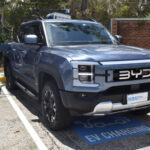
He also noted the growing influence of Chinese manufacturers. “They use Australia as a test bed and respond quickly — sometimes making running changes between shipments,” Costello said.
Sibbald added that telematics data could help fleets evaluate downtime and repair performance across brands. “Downtime is a massive thing for fleets, and most don’t measure it because they don’t know how,” he said. “Geotab can help them understand which brands are reliable and how long vehicles are off the road after an accident.”
The 2025 Geotab Partner Day panel provided a clear message: policy, data and people are all key to fleet transformation. Whether navigating NVES, managing electric lifecycles, or elevating internal influence, the experts agreed that access to accurate data and continuous learning will define the next phase of fleet management in Australia.
- Connected vehicles put data security on the fleet agenda
 The recent Four Corners program examining connected vehicle security may have been eye-opening for many motorists, but for Fleet Managers it should reinforce an issue that has been developing for years: a modern vehicle is increasingly a connected device as well as a transport asset. Connectivity is becoming standard across the automotive industry. Vehicles can communicate
 - Why Euclidic believes fleet telematics shouldn’t be self-serviceFleet telematics platforms have become more capable, but Euclidic Systems believes giving fleet teams more technology does not automatically give them better fleet management. The company’s view is that telematics should not be treated as a self-service software purchase where customers are left to configure the system, interpret the data and maintain the internal knowledge
- Before buying more fleet technology, define the problem you’re trying to solveFleet managers considering their next technology investment should start with the business problem rather than the product, according to Summit Fleet Leasing and Management Managing Director Darren Gore. Speaking on the Fleet News Group podcast about technology and fleet management excellence, Gore was asked what good use of fleet technology looks like. His starting point
- Bigger trucks, older bridges and new drivers are reshaping bridge strike riskAustralia’s bridge strike problem is not simply a question of drivers failing to read a clearance sign. The combination of growing freight volumes, pressure for more productive heavy vehicles, an ageing road network and a changing driver workforce is making the issue more complex for fleet operators. That was one of the themes to emerge
- Fleet Risk Alerts Move Closer to Real TimeInfoAgent has launched a new subscription service designed to help fleet, leasing and finance operators keep track of changes to vehicles in their portfolios without relying on periodic audits. The new Automated Vehicle Monitoring service continuously checks vehicle status and alerts customers when key details change, giving organisations greater visibility over vehicles they may not