

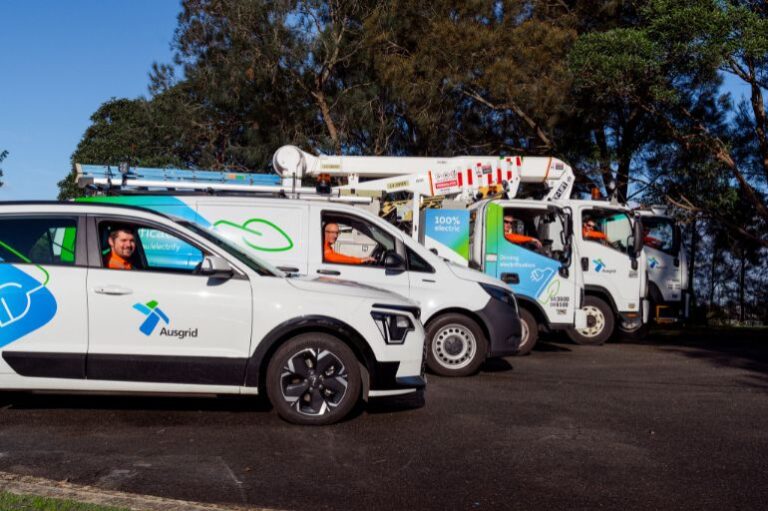
Ausgrid is a finalist in the Fleet of the Year category in the 2026 Fleet News Group Awards.
Over the coming weeks, Fleet News Group is looking at the work behind its nomination and the fleet management practices that have put the organisation in contention for the award.
For Ausgrid, one of the most important fleet management questions is also one of the easiest to misunderstand: how do you measure utilisation when some vehicles and plant must be available for the day everything goes wrong?
Ausgrid distributes electricity to more than four million customers across Sydney, the Central Coast, Newcastle, the Hunter and Upper Hunter. Supporting that network requires approximately 1,600 vehicles and another 700 items of plant and equipment.

A fleet built for more than the average day
The fleet includes ordinary passenger and light commercial vehicles, but also elevated work platforms, pole borers, cable-handling equipment, prime movers, specialist off-road vehicles and boats used to reach customers along the Hawkesbury River.
That diversity reflects the work Ausgrid crews perform every day, but it also reflects the role the fleet plays when storms damage the electricity network.
In many fleets, low utilisation can be an obvious trigger for disposal. If a vehicle is rarely used, the business may reasonably ask why it is still on the books.
Ausgrid has to ask a second question: will that vehicle or piece of plant be needed when a major network event occurs?
Utilisation has to be balanced with resilience
Fleet Strategy Manager Nick Black explained during the Fleet News Group Awards interview that Ausgrid has to balance everyday utilisation with enough fleet capacity to respond when storms create widespread outages.
Reducing the fleet too aggressively could improve a utilisation percentage while weakening the organisation’s ability to restore power quickly.
At the same time, simply keeping excess fleet assets in case would create unnecessary cost.
The challenge is to understand which assets are genuinely required for operational resilience and which ones can be better allocated, shared, replaced or removed.
Fit for purpose means more than specification
This thinking sits within one of the four pillars of Ausgrid’s CEO-endorsed fleet strategy: fit for purpose.
The other pillars are safe to work, value for money and electrification.
For Ausgrid, fit for purpose includes ensuring a vehicle or piece of plant suits the job, but it also includes allocation, utilisation and emergency availability.
A specialist asset may never achieve the same utilisation as a passenger vehicle, yet it can still be essential to the organisation because of the role it performs during a storm response or network repair.
Data supports the judgement
Ausgrid uses SAP, telematics and Power BI reporting to understand the fleet and support these decisions.
That data allows the fleet team to examine asset age, operating activity, maintenance, fuel use and other information while still applying judgement about the operational role of the asset.
It is an important distinction. Fleet utilisation is a valuable KPI, but the purpose of the fleet is not to generate a high utilisation score. The purpose is to ensure the organisation has the right vehicles and equipment to deliver its services safely and efficiently.
Why this matters for Fleet of the Year
Ausgrid’s fleet supports an essential service relied upon by millions of people. Managing it requires a constant trade-off between cost, utilisation, specialist capability and emergency readiness.
The organisation’s approach demonstrates why mature fleet management goes beyond simple benchmarks and looks at the operational purpose behind each asset.
Ausgrid is a finalist in the 2026 Fleet News Group Fleet of the Year Award. You can support Ausgrid by casting your vote on the Fleet News Group Awards voting page.
Vote for Ausgrid in the Fleet of the Year Award
The winners will be announced in Sydney on 14 October 2026. Fleet and automotive industry professionals can also register their interest to attend the Fleet News Group Awards Night.
Register your interest for the Fleet News Group Awards Night
Next week: Ausgrid has already electrified most of its passenger fleet. We look at why the bigger challenge is moving electric vehicles into vans, trucks and operational applications.