

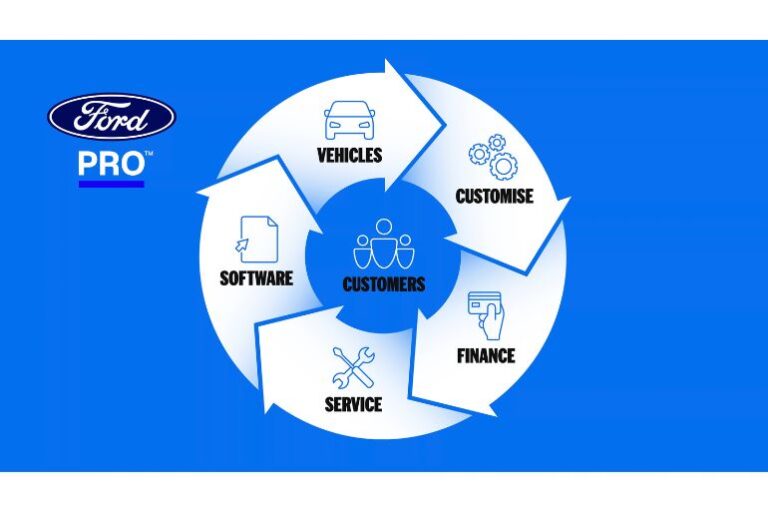
Ford Pro has officially launched in Australia, bringing a broader commercial vehicle support model that aims to combine vehicles, finance, conversions, servicing and software into a more integrated offering for fleet customers.
For Fleet Managers, however, the important question is not simply what Ford Pro promises globally, but which parts of that ecosystem are available in Australia today.
Ford is positioning Ford Pro as a way to reduce the number of separate suppliers commercial customers need to manage, while putting greater emphasis on vehicle uptime, productivity and total cost of ownership.

Australian rollout is only beginning
Ford Pro is already established in North America and Western Europe, but the Australian operation is being introduced progressively rather than launching with every service available overseas.
Michael Elias, General Manager – Ford Pro Australia, said the local operation remained at an early stage.
“We are in the first year of a multi-year journey for Australia,” Elias said.
That distinction matters for fleet operators.
Rather than judging Ford Pro against everything available internationally, fleets will need to assess the services included in their Australian arrangements today, along with how those services compare with their existing suppliers and fleet management processes.
More than just supplying vehicles
One of the key components of Ford Pro is its vehicle conversion capability.
Ford says its converter network spans 52 locations and completed almost 5,000 conversions during 2025.
Ford Finance can also support eligible conversions, while fleets can access genuine accessories, licensed accessories and bespoke engineering solutions depending on the operational requirement.
For fleet customers buying Rangers, Transits and other work vehicles, that potentially creates a more coordinated path from vehicle order through to fit-out and delivery.
Uptime becomes a central focus
Servicing is another major part of the Ford Pro proposition.
Ford has more than 220 service outlets across Australia, is developing a mobile servicing program and is using an Uptime Command Centre to help dealers identify and address issues affecting major fleet customers.
Ford Motor Company Director of Marketing Ambrose Henderson summarised the commercial reasoning behind the program during the Australian launch.
“If their vehicle isn’t on the road, they’re not earning,” Henderson said.
It is a straightforward fleet argument.
Downtime affects productivity, replacement vehicle requirements, operating costs and customer service, particularly where vehicles form part of revenue-generating or operationally critical fleets.
The real measure of Ford Pro will therefore be whether its combined servicing and support model can genuinely reduce vehicle downtime and administration compared with the systems fleets already have in place.
Connected services are not universal
Software and connected vehicle data also form part of the Ford Pro model, although functionality will vary by vehicle.
Ford says its connected-data strategy is open and multi-make, allowing telematics providers to develop services using vehicle data.
The initial Ford data-services rollout is focused on Ranger and Everest, while Transit City will not initially be connected to that platform.
For fleets operating multiple Ford models, that means connected functionality should be assessed vehicle by vehicle rather than assuming every model will offer the same level of integration.
Charging remains outside the Australian offer
Charging infrastructure provides another example of the difference between the global Ford Pro proposition and the Australian rollout.
Ford said charging support forms part of Ford Pro internationally, but it is not currently part of the Australian offer.
Fleet operators electrifying vehicles today will therefore still need to manage depot charging infrastructure as a separate procurement, installation and operational project.
What Ford Pro means for fleets
Ford Pro has the potential to give fleet customers a more consolidated way to manage vehicle acquisition, conversions, finance, servicing and connected services.
That could be particularly valuable for fleets looking to reduce supplier complexity and place more responsibility for vehicle availability with the manufacturer and dealer network.
But Ford Pro Australia should currently be viewed as an evolving fleet service model rather than a finished, all-inclusive product.
For Fleet Managers considering the offer, the important questions remain practical ones: which services are available for each vehicle, how they integrate with existing fleet systems, and whether the model delivers measurable improvements in uptime, administration and whole-of-life operating costs.