

Toyota has warned that tighter emissions targets from 2027 could place upward pressure on commercial vehicle prices as it balances continued demand for diesel models with its obligations under the New Vehicle Efficiency Standard (NVES).
The manufacturer has not announced any price increases or provided details on affected models, amounts or implementation dates. However, its comments raise a consideration for Fleet Managers and Procurement Managers preparing future replacement budgets.
Speaking at Toyota’s latest Australian business update, Vice President of Sales, Marketing and Franchise Operations John Pappas said the company supported the NVES but considered the light commercial vehicle targets increasingly challenging.
“The big challenge comes from 2027 when it comes to light commercial vehicles,” Pappas said.

Emissions targets tighten
The NVES places emissions obligations on manufacturers and vehicle suppliers across the new vehicles they supply to Australia.
For Type 2 vehicles, which include utes, vans and certain off-road SUVs, the headline emissions limit falls from 180 grams of CO₂ per kilometre in 2026 to 150 in 2027. Vehicle targets are adjusted for mass, meaning the headline figure is not a uniform limit for every model.
Toyota says meeting the tightening targets while maintaining supply of vehicles required by commercial customers presents a challenge.
Its warning does not establish that price increases are inevitable. The standard does not set retail prices, and the Australian Government says it is designed to encourage more efficient vehicles while supporting continued choice, including utes and 4WDs.
The eventual impact on fleet acquisition costs will depend on manufacturers’ product offerings, compliance strategies and pricing decisions.
Diesel demand continues in regional fleets
Toyota says nearly 54% of purchases across its combined HiLux and LandCruiser family come from customers outside major metropolitan cities.
Pappas pointed to long distances, towing requirements, off-road conditions and charging infrastructure as reasons some customers continue to require diesel vehicles.
In a separate interview with Fleet News Group, he said that demand was also evident among fleet buyers.
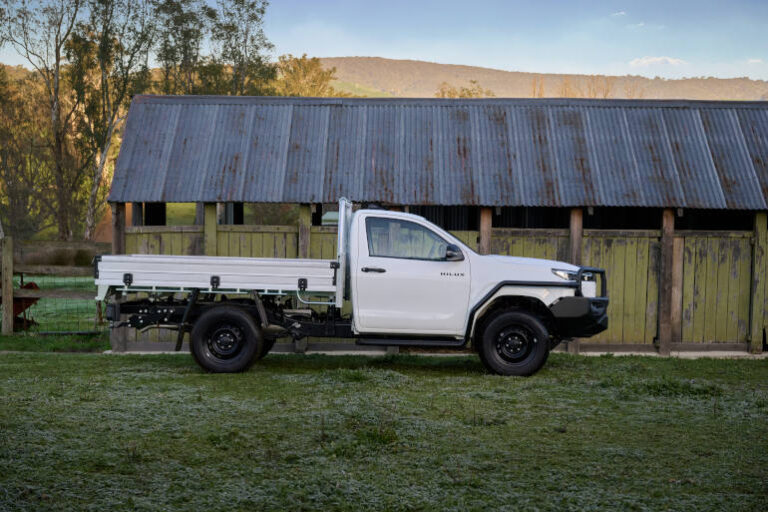
“Hilux is going very well into fleet because fleets need Hilux. They need that type of capability,” Pappas said.
Toyota’s position is that these requirements will continue alongside growing demand for electric and plug-in hybrid vehicles.
For Fleet Managers, the practical question remains which vehicle can perform the assigned task. Travel distances, loads, towing, charging access and operating conditions can vary considerably within the same organisation.
That makes replacement planning more complex than applying one powertrain choice across an entire fleet.
Toyota will seek changes through consultation
Pappas said Toyota intended to contribute to an upcoming NVES review and seek light commercial vehicle targets it considered more appropriate for Australian conditions.
Toyota’s argument centres on the pace of change for customers who still rely on diesel vehicles as tools of trade, particularly in regional and rural areas.
When asked whether the company would consider purchasing emissions credits from other manufacturers, Pappas said Toyota wanted to manage its compliance position internally as much as possible.
“We want to be self managed as much as possible.”
He did not outline a detailed compliance strategy or quantify any potential costs.
Toyota is also expanding its lower-emission range. Pappas said the HiLux BEV remained on a sales plan of approximately 500 vehicles for 2026, with mining and construction among its targeted applications.
That provides an electric option for selected operations, while Toyota continues to report strong fleet demand for diesel HiLux models.
What fleet buyers should consider
For organisations preparing 2027 replacement programmes, Toyota’s comments highlight uncertainty rather than a confirmed increase to purchasing costs.
There is no announced amount to add to budgets and no indication of which models might be affected. Fleet buyers can nevertheless discuss quotation validity, pricing conditions and delivery timing with suppliers when planning orders.
Any potential acquisition cost change should also be considered within a whole-of-life assessment covering fuel or electricity, maintenance, downtime, residual value and operational suitability.
For a fleet with suitable charging access and predictable daily travel, a lower-emission vehicle may warrant closer evaluation. Other applications may continue to require capabilities that narrow the available replacement choices.
Toyota’s warning gives Fleet Managers a reason to review cost assumptions and monitor supplier announcements as 2027 approaches. Purchasing decisions should continue to follow operational needs and replacement plans, with any future price changes assessed when details become available.