Fleet telematics platforms have become more capable, but Euclidic Systems believes giving fleet teams more technology does not automatically give them better fleet management.
The company’s view is that telematics should not be treated as a self-service software purchase where customers are left to configure the system, interpret the data and maintain the internal knowledge needed to keep it working.
Instead, Euclidic has built its model around providing ongoing support, implementation expertise and practical fleet knowledge alongside the technology.
It is an approach that has helped Euclidic become a finalist in the 2026 Fleet News Group Fleet Supplier of the Year Award.
Founder Chris Witt says one of the weaknesses of the self-service model is that it relies heavily on knowledge staying inside the customer’s organisation.
A fleet employee may champion a system, learn how to configure it and become the internal expert. But when that person changes roles or leaves the business, much of that knowledge can disappear with them.
“You’ll have an enthusiast who will say, ‘Hey, I know how we can do something.’ They advocate, they get approval, they get started,” Witt said.
Then staff turnover can leave the organisation trying to administer a complex system without the person who originally understood it.
The platform is only the starting point
Witt contrasts Euclidic’s approach with large telematics ecosystems that provide customers with broad functionality and extensive marketplaces.
Those platforms can offer fleet operators enormous capability, but extracting that capability can require internal skills, external consultants or a significant amount of experimentation.
For Euclidic, the problem is not necessarily the technology itself.
It is the gap between buying the technology and achieving the outcome the fleet expected when it purchased it.
“Our hope, our ambition, is to be a one-stop shop,” Witt said.
“You bring the problem to us, and we’ll help shepherd you to a landing spot.”
He says the objective is straightforward: the completed implementation should deliver “what the brochure promised”.
That means Euclidic sees its role as extending beyond hardware supply or access to software.
The company works with fleets on configuration, implementation, installation, reporting and ongoing administration, while also providing guidance on how telematics can support operational efficiency and work health and safety.
Fleet knowledge matters
The difference becomes important when fleet operators start using telematics for more than vehicle location.
Modern systems can monitor speeding, harsh braking, acceleration, fatigue, duress events, accidents and other indicators. They can also generate large quantities of data that require interpretation before a fleet can decide what action to take.
Euclidic’s own Journey To Safer Roads 2026 research demonstrates why context matters.
The company analysed more than 33 million trips covering approximately 379 million kilometres and 12 million driving hours between 2019 and 2025.
One of the findings is that driver risk can vary significantly depending on where a vehicle is being operated and its Gross Vehicle Mass.
Euclidic found that a WC4 driver experienced 112 per cent more risk events when moving from major-city operations to very remote regions.
When region was held constant, a very remote driver moving from the lightest WC1 category to WC4 experienced 149 per cent more risk events.
For Fleet Managers, that raises an important question about whether every driver should be compared against the same generic benchmark.
Euclidic instead groups drivers using regional and vehicle-weight classifications so performance can be compared against more relevant peer groups.
More alerts do not always mean better management
The same principle applies to speeding.
Telematics platforms can easily generate alerts whenever a speed threshold is exceeded, but Euclidic’s research suggests that simply counting those events can produce misleading results.
The company tested a system that differentiated between momentary speeding and sustained speeding by requiring two consecutive speeding samples before classifying an event as deliberate or patterned behaviour.
The method was trialled across 764 vehicles during September and October 2024.
Euclidic concluded that 42 per cent of the observed speeding samples were momentary, while 58 per cent involved consecutive measurements that suggested a more persistent pattern.
That distinction matters because Fleet Managers ultimately need to know where intervention is required rather than simply receiving more notifications.
Euclidic’s approach is therefore increasingly focused on anomalies, benchmarking and identifying the drivers or situations that warrant attention.
Technology still needs implementation
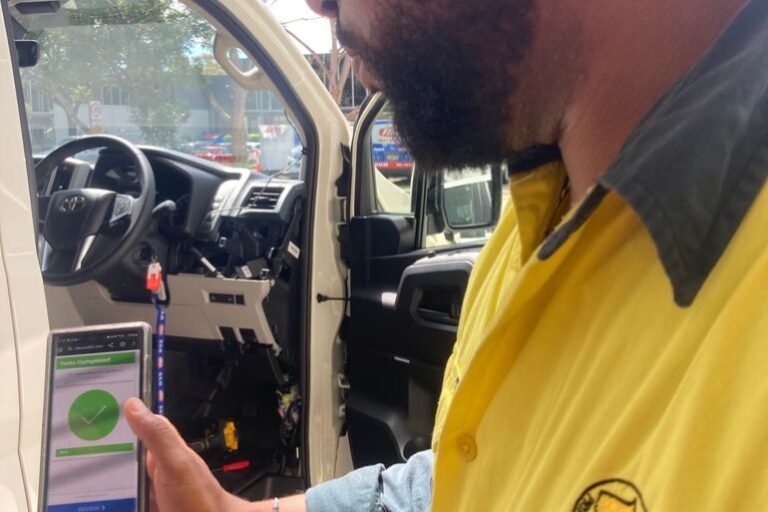
The company’s service model was demonstrated during a major telematics migration for SRG Global.
Approximately 650 vehicles across Australia had to be upgraded from 3G OBD plug-in devices to 4G hardwired technology.
The fleet included vehicles in remote locations and on client-controlled sites where access could be difficult and tightly restricted.
Euclidic worked with SRG Global and Orix to coordinate installations around operational requirements, manage changing site conditions and minimise vehicle downtime.
Simone Angelos from Euclidic said the customer was able to hand the complexity of the rollout to the supplier.
“They all had different problems,” Angelos said. “Some of them had other old systems in them and needed to be removed. She basically spoke to us, handed the problem to us, and we managed it.”
The migration was completed with minimal operational disruption despite the size and complexity of the fleet.
It is also a practical example of Euclidic’s argument that implementation capability can be just as important as the underlying technology.
Building Fleet Gate around a service model
Euclidic started in 2018 and subsequently developed its own Fleet Gate platform.
Witt said the business had the opportunity to design the system around 4G communications and cloud architecture from the outset rather than adapting older 2G, 3G or server-based systems.
It also placed a strong emphasis on light commercial vehicles, which Witt identified as a major part of the fleet market.
Fleet Gate has since developed into a platform supporting operational monitoring and WHS functions including driver behaviour, fatigue, duress and accident reporting.
But Euclidic’s differentiation is not simply the software.
The company believes the value comes from combining the platform with people who understand fleet operations and can help customers apply the technology to their own operating environment.
For fleet teams already stretched across procurement, maintenance, safety, compliance and vehicle replacement, that distinction can be significant.
Telematics can provide enormous amounts of information.
The harder task is deciding what matters, what requires action and how the system continues delivering value after the original implementation team has moved on.
For Euclidic, that is why fleet telematics should not be self-service. It should come with the expertise needed to make the technology work in the real fleet environment.