
Toyota’s multi-pathway strategy gives fleet buyers more choice, but it will also create a more complex support challenge for dealers, workshops and fleet operators.
Toyota now offers seven powertrain types in Australia: petrol, diesel, hybrid, plug-in hybrid, battery-electric, fuel-cell electric and performance hybrid. Each has a different servicing profile, energy source, operating range and suitability for fleet work.
More choice for fleet buyers
The opportunity for fleet buyers is clear. A metropolitan passenger vehicle may suit hybrid or plug-in hybrid power, while a return-to-base ute may be ready for battery-electric operation. Diesel remains relevant for long-distance towing, heavy payloads and remote travel, while hydrogen could eventually become an option for high-utilisation commercial vehicles.
But choosing the right vehicle is only the first step. Fleets will also need confidence that each powertrain can be supported over a seven- or 10-year operating cycle.
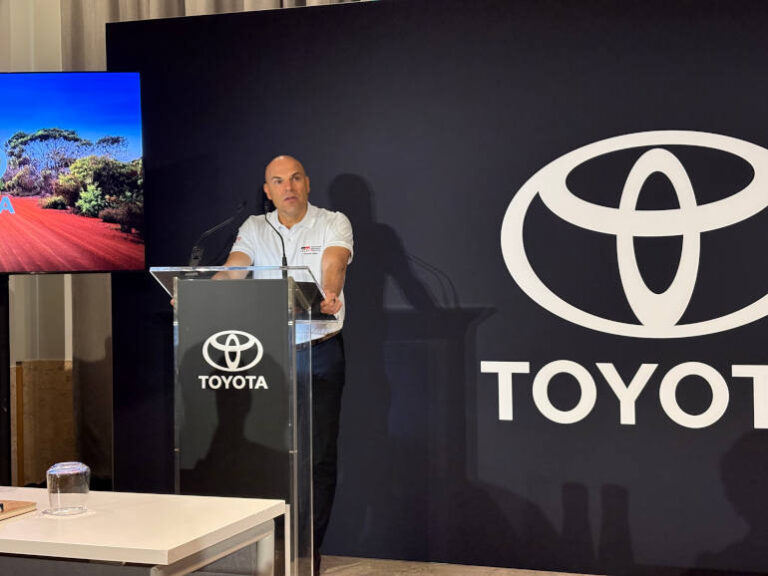
John Pappas, Vice President of National Sales, Marketing & Franchise Operations at Toyota Australia, told Fleet News Group that Toyota’s national dealer footprint would become increasingly important as more powertrain technologies entered the market.
“Customers want reassurance, they want trained technicians, they want access to servicing expertise, and they want confidence that they will be supported wherever they travel,” Pappas said. “This is exactly what our Toyota dealers deliver.”
Dealer capability becomes critical
Toyota has more than 270 dealer locations across metropolitan, regional and remote Australia, according to Pappas. That network has long been one of Toyota’s strongest fleet advantages, particularly for customers operating beyond capital cities.
However, the move from conventional petrol and diesel vehicles to a mix of electrified technologies raises new questions.
Fleet Managers will want to know whether hybrid, plug-in hybrid and battery-electric servicing capability will be consistent across the network. They will also need clarity around technician accreditation, parts availability, battery assessment, repair lead times, roadside recovery and support for vehicles operating in regional and remote areas.
PHEVs add a new operational layer
Toyota’s first plug-in hybrid, the RAV4 PHEV, introduces a new set of fleet considerations. The vehicle combines a 2.5-litre petrol engine, electric motors and a 22.7kWh lithium-ion battery, with up to 154km of claimed electric-only range under the NEDC test cycle.
For fleet buyers, that means service support must extend beyond conventional vehicle maintenance. It will also involve charging guidance, driver education and systems to help organisations understand whether vehicles are being used as intended.
Ray Munday, Senior Manager Product Planning and Pricing at Toyota Motor Corporation Australia, said Toyota’s multi-pathway approach was based on the fact that no single powertrain could meet every customer need.
“Toyota recognises there’s no silver bullet powertrain solution with current technology that meets the fit-for-purpose needs of all customers and all usage cases,” Munday said.
One fleet may operate several technologies
A large organisation could have hybrids assigned to high-kilometre urban roles, PHEVs for employees with home charging, battery-electric HiLux vehicles at depots or mine sites, and diesel vehicles working in remote locations or towing equipment.
That mix may reduce emissions, but it also creates a more complicated vehicle policy, maintenance plan and replacement strategy.
The HiLux BEV highlights the challenge. Toyota has developed the electric ute for mining, construction, energy, government and fleet customers with predictable operating cycles and access to back-to-base charging.
It has a 59.2kWh battery, claimed driving range of up to 315km in pick-up form, payload of up to 855kg and 2,000kg braked towing capacity.
Toyota says it has already received more than 300 customer orders, including from BHP, Newcastle Coal, Acciona and Essential Energy.
Charging, recovery and uptime matter
Those fleets will need more than an electric ute. They will need charging infrastructure, clear vehicle-use rules, repair and recovery arrangements, battery health information and confidence that the vehicle can be supported when operating away from a major city.
For fleet buyers, vehicle uptime will be the practical test of Toyota’s support model. A technically capable vehicle will still create problems if a specialist repair, replacement component or recovery arrangement is not available when it is needed.
Connected data brings new questions
Data management is another emerging fleet issue.
Pappas said Toyota’s connected vehicle systems were designed with privacy-first principles, with only data required for core safety services activated by default. He said more sensitive information, including facial biometric markers and in-cabin video, remained encrypted and was not transmitted.
“Australian customer and connected data stays protected within highly governed environments,” Pappas said. “Toyota systems use Australian-based servers for the majority of services.”
For fleets, the next question will be how connected-vehicle data can be used to improve utilisation, charging behaviour, maintenance planning and safety without creating uncertainty around driver privacy or data ownership.
Resale confidence remains important
Residual values will also become more important as electrified vehicles enter longer fleet replacement cycles.
Pappas said Toyota’s resale strength was an important contributor to customer confidence and lower total cost of ownership. But fleet buyers will want more detail about how battery condition, charging history and future repairability will influence used values for PHEV and BEV vehicles.
The fleet promise is bigger than product choice
Toyota’s multi-pathway strategy offers fleets a more realistic transition than a blanket move to one technology. It acknowledges that different jobs require different answers.
The real test will be whether Toyota can make the ownership experience as consistent as the product choice is broad.
For fleet buyers, the promise is not simply seven powertrains. It is seven powertrains supported with the same confidence in servicing, uptime, data security, resale value and regional coverage that Toyota has built its reputation on.