

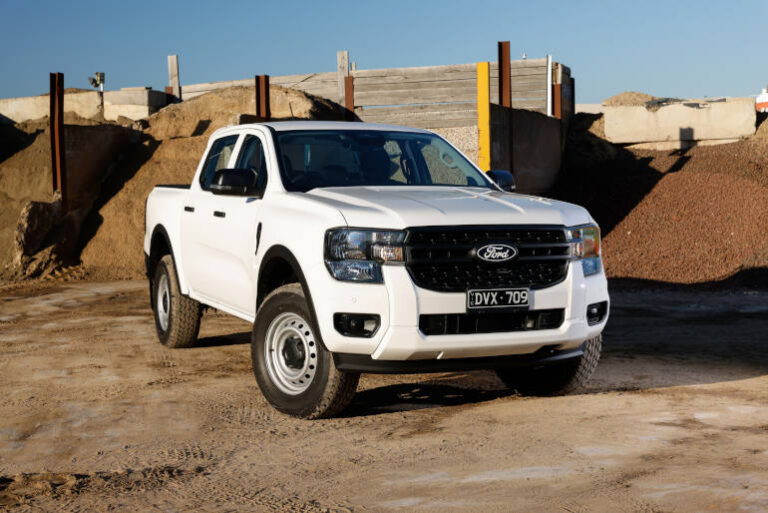
Ford’s updated Ranger range gives fleet buyers a familiar but important choice: prioritise everyday operating efficiency with the 2.0-litre diesel, or step up to the V6 for stronger response under load and more demanding towing work.
A drive program at the You Yangs Proving Ground provided the opportunity to sample both the 2.0-litre Ranger and V6-powered Wildtrak, following a road drive in the related Everest SUV.

2.0-litre diesel: practical fleet all-rounder
The 2.0-litre diesel Ranger initially felt a little hesitant when moving away from a standstill, with some noticeable turbo lag in urban driving. Once underway, however, it felt more responsive than those first impressions suggested.
On the proving-ground circuit, the 2.0-litre Ranger handled the chicanes with limited body roll and delivered a composed, predictable feel. Braking performance was solid, although it did not stand out as a particular strength.
For fleet applications, the 2.0-litre remains the logical volume choice. It offers the tray capacity, payload capability and 3,500kg towing rating that many fleets require, while being better suited to general daily duties where the vehicle is not permanently carrying a heavy load or towing regularly.
Fuel economy was also respectable in real-world conditions. In the Everest fitted with the 2.0-litre single-turbo diesel, the best recorded result during the road drive was 7.9L/100km, against an advertised combined figure of 7.2L/100km. Given the medium-to-heavy traffic conditions, that was a credible outcome and reportedly among the best results recorded during the drive challenge.
V6 diesel: the better choice for sustained heavy work
The V6 diesel Wildtrak felt more responsive from the outset, despite Ford’s view that the 2.0-litre delivers the sharper response. In a straight line, the V6 had a stronger and more effortless character, making it feel better suited to demanding work.
The Wildtrak also felt like the more substantial vehicle overall. Its handling through the chicanes and braking performance were broadly similar to the 2.0-litre Ranger, but the V6’s stronger low- and mid-range performance would be valuable for fleets operating with consistent tray loads, towing trailers or working in regional and rural conditions.
The trade-off for fleet buyers is the V6’s AdBlue requirement. This adds another consumable to manage, although the expected refill interval should generally align with scheduled servicing rather than create a frequent operational issue.
The fleet verdict
The MY26.5 Ranger 2.0-litre diesel is likely to remain the best fit for fleets using utes as general-purpose work vehicles. It has the capability needed for most roles, reasonable real-world economy and a composed road manner once on the move.
For operations where towing is frequent, loads are consistently heavy or drivers regularly work in more demanding conditions, the V6 diesel is the more convincing option. It feels stronger, more relaxed and better matched to sustained heavy-duty use.
The decision is less about which engine is best overall and more about matching the Ranger to the job. For everyday fleet use, the 2.0-litre makes sense. For work that regularly pushes closer to the vehicle’s capability limits, the V6 is likely to justify its additional complexity and cost.