

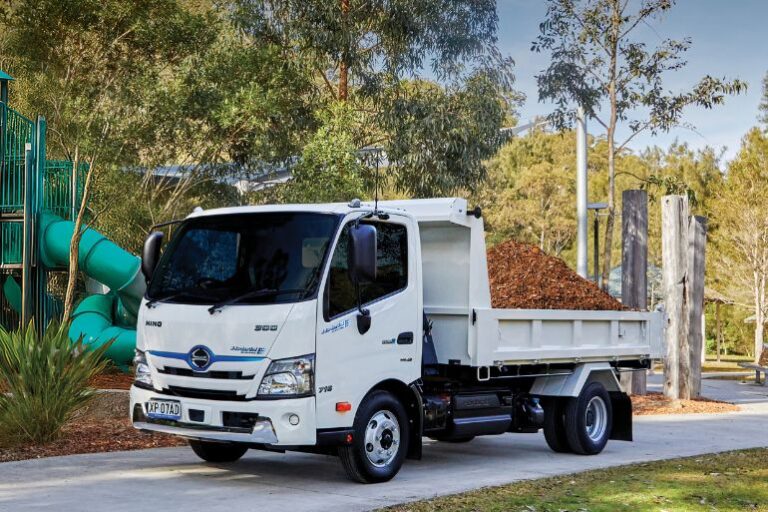
Hino is heading into 2026 with a product line-up shaped by emissions transition, shifting fleet demand and a renewed focus on heavy-duty applications. Speaking at a media briefing late in 2025, Richard Emery, President and CEO of Hino Motor Sales Australia, outlined how supply, powertrain strategy and model availability will evolve over the next 12 months — and what fleet buyers should realistically plan for.
300 Series: hybrid momentum builds, no supply gap
For light-duty fleets, the 300 Series will be a cornerstone of Hino’s 2026 offering.
Emery confirmed that Hino has sufficient Euro 5 production to carry supply through to mid-2026, with Euro 6 production scheduled to begin in June. While Euro 6 vehicles may not arrive locally until July, Hino expects no gap in supply.
“If I was sitting here a year ago… we were faced with a four or five month gap,” Emery said. “Now we will have no gap in our 300 Series supply.”
The other major shift is growing interest in the 300 Series Hybrid. Emery said order intake strengthened significantly in the second half of 2025 as fleets reassessed their emissions pathways.
“The market is certainly rethinking low-to-zero emissions,” he said, noting that customers previously committed to full electric are now considering hybrid as a practical interim step.
500 Series: a constrained year ahead
The 500 Series will be the most constrained part of Hino’s range in 2026.
Euro 5 production has largely concluded, with a small number of trucks delivering into 2026 only because they are delayed in body build. Euro 6 production for the 500 Series is not scheduled to commence until October 2026.
“We will be short on 500 Series production during next year,” Emery said.
Hino plans to go to market with Euro 6 specifications, pricing and line-up details around April–May 2026, but fleet buyers should factor in limited availability until later in the year.
For medium-duty fleets, this makes forward planning critical, particularly where body build timelines already extend delivery windows.
700 Series: the growth engine for 2026
The 700 Series emerges as Hino’s primary growth focus for 2026.
Emery said the brand is deliberately repositioning the 700 Series as a heavy-duty rigid and single-trailer specialist, rather than chasing linehaul prime mover dominance.
“We’re clearly highlighting ourselves as the heavy-duty rigid and single-trailer champion,” he said, pointing to the 320–480 horsepower range as Hino’s sweet spot.
Additional 700 Series variants will enter production from January 2026, with customer deliveries expected from February–March. Emery said dealer focus has shifted toward converting long-standing Hino light and medium-duty customers into the heavy-duty range.
He cited examples of customers trialling the 700 Series for the first time and subsequently placing larger follow-on orders, driven by supply reliability and product performance.
Production reality shapes volume expectations
Despite finishing 2025 at around 5,000 units, Emery said total volume in 2026 is likely to be lower due to the 500 Series production gap.
“We’re probably going to struggle to get to 5,000 next year,” he said, adding that a result in the high-4,000 range would still be solid given the model mix constraints.
The upside, he said, is that 300 Series supply normalises, 700 Series grows, and Hino enters 2027 with a full Euro 6 portfolio in production.
What this means for fleet buyers
For Fleet Managers and Procurement Managers, Hino’s 2026 product outlook highlights several planning considerations:
- Light-duty fleets can expect stable supply, with hybrid increasingly positioned as a practical emissions-reduction option
- Medium-duty fleets should plan early, as 500 Series availability will be limited for much of the year
- Heavy-duty rigid and single-trailer fleets will see the most product momentum, particularly with expanded 700 Series variants
- Delivery timing remains influenced by body build capacity, not just chassis availability
Looking beyond 2026
Emery framed 2026 as a transition year rather than a reset. With emissions challenges easing, new global structures bedding down and product availability improving, Hino expects to be fully positioned for a more predictable growth phase from 2027 onwards.
“We think 2026 will see us transition to what we would call a normal business environment,” he said.
For fleets, the message is clear: 2026 is a year to plan carefully around product availability — and to align replacement strategies with where Hino’s strengths will be most evident.
- SG Fleet wins FleetPartners race with $1.13 billion deal
 After months of bids, counter-bids, due diligence and speculation, the FleetPartners takeover race finally has a winner. SG Fleet has emerged from a highly competitive process to sign a binding Scheme Implementation Deed with FleetPartners, agreeing to acquire 100 per cent of the company for $5.30 per share in cash. The deal values FleetPartners at approximately $1.131
 - Petrol Meets Electric in BMW’s New 3 SeriesBMW’s next-generation 3 Series will give Australian buyers a choice of combustion and fully electric powertrains within the same model family, with four variants scheduled to arrive from the first quarter of 2027. The Australian launch range will comprise the BMW 320, BMW M350 xDrive, BMW i3 40 xDrive and BMW i3 50 xDrive. For
- Subaru Uncharted review: Familiar Subaru strengths meet a new electric directionThe Subaru Uncharted arrives at an interesting point in the Australian new-car market. Electric SUVs are no longer unusual, but the challenge for established brands is convincing existing customers that moving to an EV doesn’t mean giving up everything they already like about their current car. That is where the Uncharted makes sense. For people
- Clarion Puts AI in the Picture for Fleet ClaimsClarion Claims has partnered with RAVIN AI to introduce browser-based vehicle damage capture into its Australian motor claims service, aiming to speed up assessment and reduce delays for fleet operators. The technology allows drivers and fleet managers to photograph exterior vehicle damage using a standard mobile web browser, without downloading an app or using specialist
- Kia Seltos Makes the Hybrid SwitchKia’s all-new Seltos will arrive in Australian showrooms this month with a hybrid-only line-up, a larger footprint and the brand’s first electric all-wheel-drive system for a hybrid model in Australia. The new generation brings a significant change to the Seltos range, with every variant featuring a 1.6-litre hybrid powertrain paired with a six-speed dual-clutch transmission.