

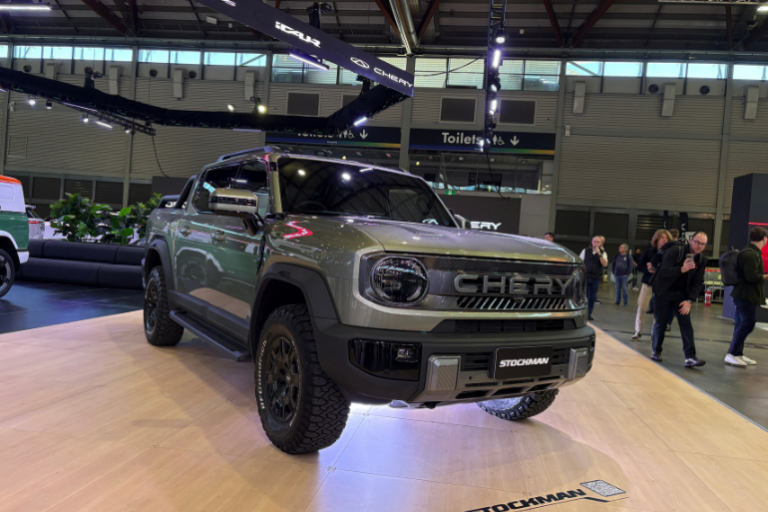
Chery is expanding its fleet sales team in Australia, but Chief Operating Officer Lucas Harris says winning fleet business will depend on much more than putting more people on the road.
For Fleet Managers, the bigger issue is confidence that the organisation behind the vehicles can support them throughout the ownership cycle.
That means fleet specialists, aftersales support, parts availability and a dealer footprint that can keep vehicles operating when something goes wrong.

Fleet team set to grow
Speaking with Fleet News Group at Everything Electric in Sydney, Harris said Chery’s existing fleet team was performing well and further expansion was planned.
“Our fleet guys are doing a great job, and they’re certainly really engaged and motivated in trying to help help fleet buyers decide which of our products is right for them,” Harris said.
The arrival of vehicles such as the Stockman plug-in hybrid ute is likely to increase that workload, particularly as Chery moves further into operational fleet segments rather than relying predominantly on passenger and SUV sales.
Retail success helps — but fleet needs more
Chery has built significant retail momentum in Australia, but Harris does not believe sales volume alone is what will convince fleet buyers.
Instead, he said fleets want confidence that there is a substantial local business behind the brand.
“I think what’s more important is being able to give fleet’s confidence that there’s a serious business standing behind the brand,” Harris said.
Chery currently has around 120 local employees, with Harris saying that number is expected to move closer to 180 in the not-too-distant future.
Importantly for fleets, a significant proportion of those employees are working in aftersales and support functions rather than simply sales and marketing.
For Fleet Managers, that distinction matters.
Vehicle acquisition is only one part of the fleet lifecycle. The ability to access parts, book repairs, resolve technical problems and minimise downtime can have a larger operational impact than the initial purchase experience.
Parts investment becomes part of the fleet proposition
Harris also pointed to Chery’s investment in parts distribution as evidence that the company is preparing for a larger vehicle population.
“At the moment we have about 50 million dollars worth of parts in stock,” he said. “Obviously, that’s going to grow as we increase that warehousing space.”
Chery is developing additional parts warehouse capacity, with Harris referring to distribution facilities in Perth, Melbourne and Brisbane as part of the expanding support footprint.
That investment will be particularly relevant as the brand starts targeting more operational fleets.
A passenger vehicle waiting for a part can inconvenience a driver. A commercial vehicle waiting for a part can remove a productive asset from service and potentially affect the work of an entire crew.
For fleet buyers considering newer brands, the depth of local parts inventory and the efficiency of the supply chain can therefore become an important part of the risk assessment.
Regional coverage will be important
Chery’s dealer network is also expanding.
During the Everything Electric presentation, Harris said the brand had 99 dealers nationally and was targeting around 120 by the end of the following year, with particular attention being paid to regional and provincial coverage.
That becomes increasingly important as Chery introduces vehicles such as the Stockman, which is expected to appeal to construction, agriculture, mining, trade and regional users.
Harris said customers needed confidence that support would still be available once vehicles moved beyond metropolitan areas.
“I think it’s got to be right, particularly with the amount of caravanning and and traveling that Australians like to do, and they need that confidence that wherever they’re going to go. They’ve got support there if they need it.”
The same issue applies to fleet operations.
For organisations running vehicles across regional Australia, the quality of the support network can influence downtime, vehicle availability and ultimately whole-of-life cost.
Supporting multiple brands
The expansion becomes more complex as Chery Motor Australia & New Zealand introduces additional brands and vehicles.
Harris explained that the dealer networks for the different brands would remain separate, but the broader group could share much of the infrastructure behind them.
“What what’s important about having the joint group is that all of the head office infrastructure around parts distribution and after sales support is existing already,” Harris said.
That structure could allow newer brands to establish smaller dealer networks while still drawing on the wider organisation for parts, technical support and service coverage.
For fleets, that shared infrastructure may become as important as the number of individual dealerships carrying each badge.
Fleet credibility has to be built after the sale
Harris believes this investment in people and infrastructure is ultimately more important to fleet customers than headline retail sales figures.
“Those things are much more important for fleets to know that there is a serious business standing here behind the brand to support you,” he said. “That’s more important than how many cars we sold at retail. I think.”
That is an important distinction as more manufacturers enter the Australian market.
Competitive pricing and new technology may attract fleet attention, but Fleet Managers also need confidence that vehicles can be supported over several years of operation.
Chery’s next phase of fleet growth will therefore depend not only on whether vehicles such as the Stockman, E5 and future electric models suit fleet applications, but whether the growing organisation behind them can deliver the parts, service and support fleets expect.