

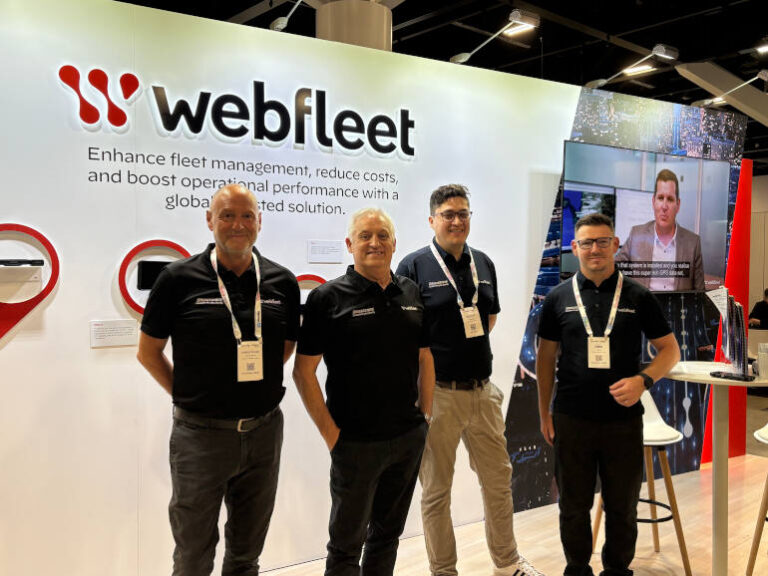
Webfleet drew strong attention at Mobility Live Australia 2025 with a dynamic display of its telematics and connected vehicle solutions, highlighting how data can drive smarter, safer, and more sustainable fleet operations.
Visitors to the Webfleet stand saw the company’s full suite of products designed to help businesses extract actionable insights from their vehicles — whether they’re managing traditional fleets, transitioning to electric, or reporting emissions performance.
“We help fleets get the data out of their vehicles to make smart decisions — whether it’s around electrification, fuel consumption, emissions reporting, or general business improvements,” said Scott Elkington, Webfleet’s Marketing Manager.
The Webfleet team said this year’s event reflected a growing maturity among Australian fleets when it comes to using telematics data strategically. Conversations were focused on efficiency, sustainability, and compliance with new emissions frameworks rather than simply tracking vehicles.
“Mobility Live brings together lots of sectors that share insights and information,” Elkington added. “It’s easy to just sit in a session and learn from the different fleets across Australia.”
As one of the leading global providers of connected fleet management solutions, Webfleet used the Sydney event to demonstrate how technology is helping organisations balance cost, compliance, and carbon reduction goals in real time.
Fleet managers who missed Mobility Live can connect with the team through Webfleet’s website or LinkedIn to learn more about the company’s telematics, sustainability, and safety solutions.
- Hyundai STARIA Load vs Toyota HiAce: Which van suits fleet operations?
 The Hyundai STARIA Load and Toyota HiAce are two established choices for fleets requiring a practical commercial van with close to a one-tonne payload. The STARIA Load offers diesel and petrol-hybrid powertrains, relatively compact exterior dimensions and car-like driving characteristics. The HiAce provides a larger cargo area, a higher Gross Vehicle Mass and a strong
 - Pajero Is Back: Mitsubishi Revives an Australian 4WD IconMitsubishi has confirmed the Australian range and specifications for the all-new Pajero, with the returning nameplate bringing a 2.4-litre turbo-diesel engine, seven drive modes, a 3.5-tonne towing capacity and a choice of five- and seven-seat configurations. The Mitsubishi Pajero will return to Australian showrooms in December 2026, reviving one of the brand’s best-known nameplates after
- Jaecoo Strengthens the J7 Line-UpJaecoo Australia is rolling out its MY27 J7 range, with the midsize SUV continuing to offer both petrol and plug-in hybrid powertrains as the brand broadens its appeal to Australian buyers. The updated line-up includes the petrol-powered Ridge AWD alongside three Super Hybrid System – PHEV variants: the Track SHS-P, Summit SHS-P 2WD and Summit
- Nissan Patrol Enters a New EraNissan has confirmed key Australian specifications for the new-generation Y63 Patrol, with the large SUV gaining a new twin-turbo V6, increased towing capacity, a revised chassis and a broader six-grade line-up. The new Patrol will arrive in Australia in early 2027, replacing the long-serving Y62 and introducing significant changes to the powertrain, suspension, cabin technology
- Hyundai Gives Palisade More Off-Road BiteHyundai will add a new Palisade XRT Pro variant to its Australian range from September, giving the large SUV more ground clearance, all-terrain tyres and a locally developed suspension tune. The XRT Pro is Hyundai Australia’s first model to use the XRT Pro designation. It sits alongside the existing Palisade Elite and Calligraphy variants, but differs through